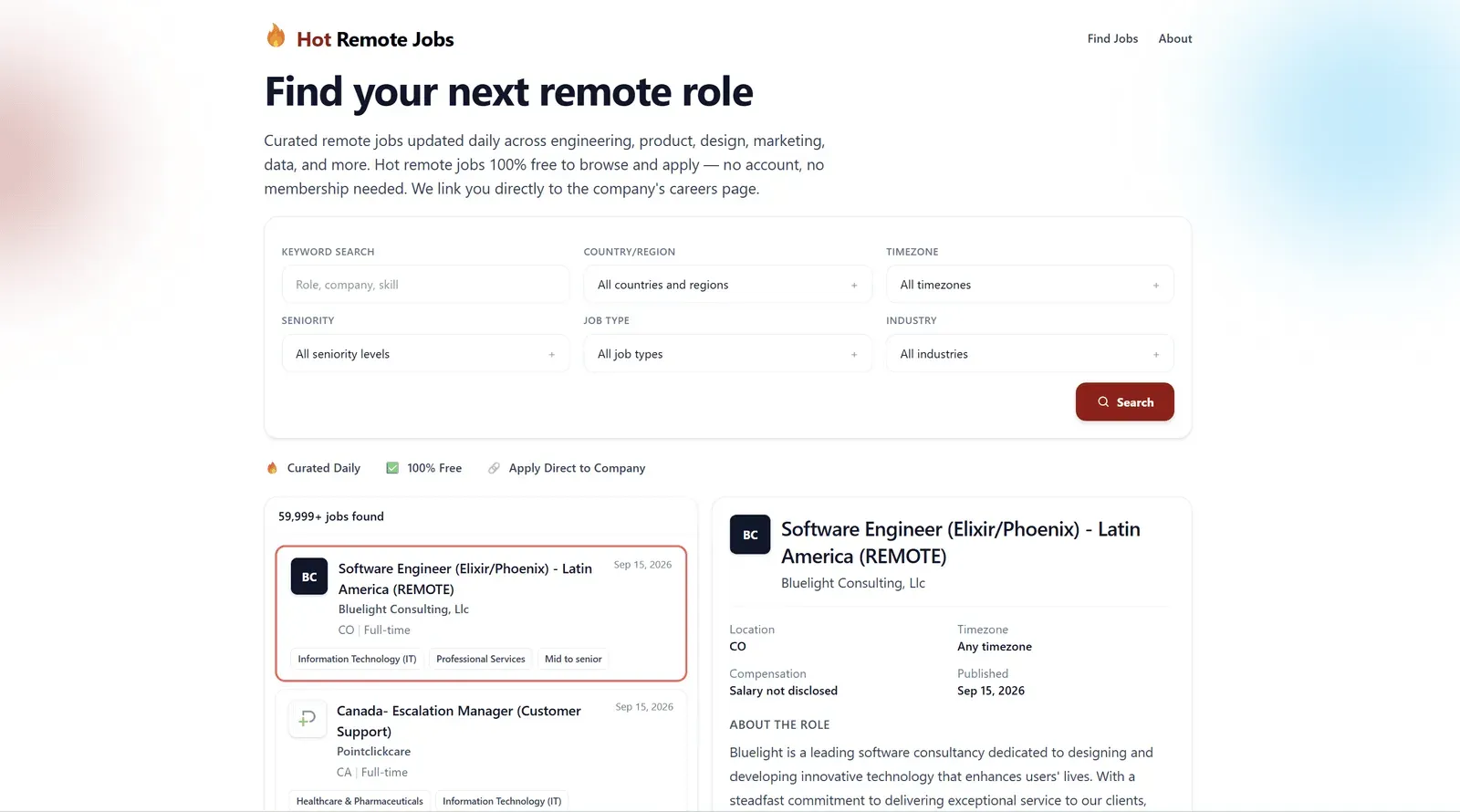
Overview
Hot Remote Jobs is a free, browser-based job board aggregating remote openings across engineering, product, design, marketing, data, and adjacent fields. The site presents itself as a curated feed refreshed daily, claiming more than 60,000 listings with no account or paywall between a visitor and the postings. Its audience covers candidates at every seniority level as well as employers seeking distribution for distributed roles, with each listing designed to funnel applicants toward a direct application.
Key Features
Daily curated inventory at scale. The board advertises 59,999+ jobs found on a single results page and describes the catalog as updated daily. Listings carry a publication date, and the sample data set shown resolves to one day, which supports the claim of a tightly refreshed feed rather than an archive of stale postings.
Smart Filters with six facets. A filter panel exposes keyword search plus dropdowns for country or region, timezone, seniority, job type, and industry. Panels collapse on smaller viewports, and the combination supports narrowing a very large index down to a specific geography and career band without requiring an account.
Rich listing cards. Each result card surfaces a company logo, job title, employer name, location scope, employment type, publication date, and up to three industry tags. Tags observed include Information Technology, Banking and Finance, Biotechnology, Retail, Entertainment and Media, and Professional Services, giving a quick sector read before a click.
Structured job detail pages. Individual postings expose a definition list covering Location, Timezone, Compensation, and Published date, followed by an About the role summary and an application block. The Senior Accountant sample, for instance, displays a US location, any timezone, a $130,000 annual figure, and a September 18, 2026 publication date.
Direct application routing. Postings offer an Apply via Email path and a Full Details link back to the canonical job page. The board states that it links applicants to the employer's own careers page, avoiding the resume black hole typical of intermediary aggregators.
Programmatic SEO landing pages. The footer organizes deep link hubs for roles such as Software Engineer, Product Manager, and Product Designer, locations covering Europe, the United States, and Worldwide, and high demand tracks like AI Prompt Engineer, DevOps and Cloud Engineer, and Paid Media and Growth. Legal pages for terms and privacy are also present.
Use Cases
Targeted role and geography searches. A mid level product designer looking only at European employers can set the region and seniority filters and browse matching cards without creating a profile, then jump to the company page for the full description. This suits candidates running a broad but time boxed search.
Sector specific discovery. Because every card carries industry tags, a candidate moving from banking into biotechnology can scan for finance adjacent postings that still sit inside a healthcare or life sciences employer, a filter combination that general boards often handle poorly.
Senior and specialized hiring visibility. The high demand role hubs gather narrow titles such as AI Prompt Engineer and DevOps and Cloud Engineer onto single pages, which benefits specialists who want a shortlist instead of a keyword lottery. Employers in those functions gain a dedicated landing page that search engines can index.
Differentiators
The clearest distinction is the absence of friction: no sign up wall, no membership tier, and no paywall on browsing or applying. Combined with a daily refresh cadence and six facet filtering, the board targets candidates who want to evaluate many listings quickly. Structured detail pages that publish compensation and timezone data, rather than hiding those fields behind an application, further separate it from aggregators that treat them as optional.