
Overview
StoreToAds is a web application that converts an ecommerce product page into a set of finished advertising creatives. A merchant pastes a store URL, ticks the products worth promoting, and receives designed ads sized for Instagram and Facebook feeds, Stories, Pinterest, and Google display placements. The company frames the product as an AI ad generator for online stores, built around real product photography rather than synthesized imagery.
The problem it targets is creative throughput. Small direct to consumer brands usually own decent product shots and a populated catalog, but no in house designer, and commissioning a static ad set across five aspect ratios is disproportionate for a catalog of a dozen SKUs. Generic AI image tools solve the volume problem while introducing a trust problem, because diffusion models redraw merchandise and frequently mangle labels, materials, and typography. StoreToAds takes the opposite route. It isolates the existing product photo and builds layout, background, and copy around that unchanged asset.
The positioning is deliberately adjacent to platform automation rather than competitive with it. Meta Advantage+ and Shopify Campaign Autopilot optimize spend using assets that already exist. StoreToAds manufactures the assets those systems consume, and the vendor says so plainly on its comparison pages. Neighboring tools include Canva and AdCreative.ai on the design side, with the service currently shipping as a public beta that grants fifteen free ads to registered accounts.
Key Features
Store link ingestion without a plugin. The onboarding flow begins with a single text field. StoreToAds reads Shopify, WooCommerce, Wix, Squarespace, and PrestaShop storefronts directly from the URL, and for marketplaces such as Etsy or Amazon it accepts one product listing link instead of a whole shop. Products, prices, sale prices, review counts, and photography are harvested in one pass, which removes the catalog import step that most creative tools demand.
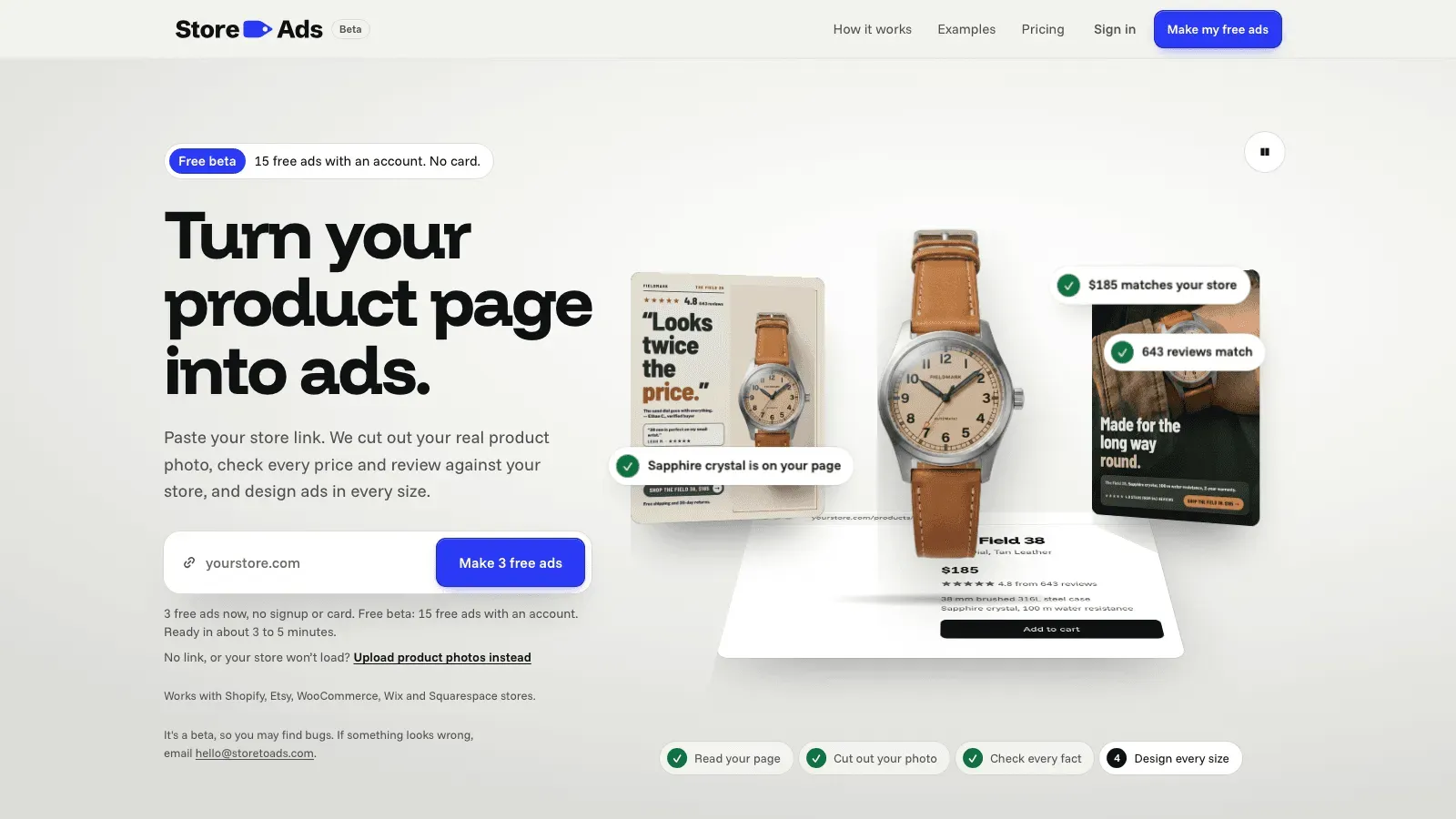
Non-generative product cutout. The core technical decision is that product pixels are never regenerated. The system segments the merchandise from its original photograph, then composites that cutout into new layouts with typography, color fields, and badges. The vendor is explicit that labels stay sharp and readable, and it advises reviewing crop, scale, and label visibility in each exported size. For categories where packaging legibility carries legal or brand weight, such as supplements or skincare, that restraint matters more than stylistic novelty.
Claim verification against the source page. Every number and quote placed into an ad is checked against the merchant's own product page before delivery. A price of $185, a 4.8 average across 643 reviews, or a specification such as sapphire crystal must appear in the source HTML or the element is stripped. The interface visualizes this with checkmarks and a struck through example of a removed superlative, an unusually candid design choice that sells the audit trail rather than the output.
Five sizes from a single design. Each paid creative ships in 1:1 square, 4:5 feed, 9:16 story, 2:3 Pinterest, and 1.91:1 landscape for Google. Free previews are limited to the 4:5 feed ratio, which is a sensible teaser because it demonstrates layout quality without giving away the full multi placement value. Automatic reflow across that many aspect ratios is the labor that eats design hours at small brands.
In browser copy editing. Headlines, prices, badges, and call to action buttons are all editable directly on the rendered ad, and edits are instant and free. The vendor also advertises conversational revision, where a change is requested in plain language and the design is rebuilt. This is a meaningful departure from template tools where the text layer is baked into an export.
Chat based creation inside Claude and ChatGPT. A separate integration path lets merchants generate ads inside a conversational assistant rather than the StoreToAds interface. It is a distribution play aimed at operators who already live in AI chat surfaces, and it costs nothing extra beyond the underlying plan.
Paused delivery to ad accounts. On higher tiers, ads can be pushed to a Facebook ad account pre-paused, meaning nothing spends until a human enables the campaign. Larger weekly batches and scheduled delivery are also reserved for the Growth tier and above.
Manual fallback for locked stores. Some storefronts, including certain Shopify configurations, block automated reading. In that case the product is added by hand or via uploaded screenshots, with all details confirmed by the merchant before any ad consumes them.
How It Works
The journey is short by design. A visitor lands on the homepage, pastes a store or product URL into a single field, and can generate three draft ads without creating an account or entering payment details. The promise is delivery in roughly three to five minutes, and the animation on the landing page spells out the four internal stages: read the page, cut out the photo, check every fact, design every size.
Registering extends the allowance to fifteen free ads during the beta. Inside the workspace, products are presented as a checklist. Each ticked item produces one ad, with an optional style prompt for merchants who have a look in mind. Review is a three button loop of reject, regenerate, and approve, and rejected concepts can be reworked by describing the change rather than adjusting sliders.
The final step splits into download or send. Downloads place all five sizes on disk. Sending pushes the creative into a connected Facebook or Instagram ad account in a paused state. No publishing happens without an explicit press, and no budget is committed by the tool itself, which is the right boundary for a product whose users are not full time media buyers.
Setup requirements are minimal, which is both the selling point and the structural limit. There is no design canvas, no layer editor, and no brand asset library on the entry tiers, so the product trades control for speed. Merchants who need a precise typographic system or a custom illustration will find the ceiling quickly. Brand logo and color application only appear on the Starter plan, which is a slightly awkward gating decision given that brand consistency is the reason most stores want a repeatable pipeline.
Use Cases
A skincare brand shipping weekly creative volume. A five person direct to consumer operation needs twelve to twenty statics a month across Stories and feed. A designer quotes a per asset rate that scales badly. StoreToAds pulls the serum bottle from existing packshots, checks the 4.9 star rating against the product page, and returns a month of variants in an afternoon, leaving the in house designer to handle packaging and lifestyle photography instead.
An Etsy seller with a single hero listing. Etsy shops often have one listing that carries most revenue. Because the tool accepts a single listing URL rather than requiring a whole store, a solo seller can generate Pinterest pins at 2:3 and story assets at 9:16 from the same photograph, testing placements that would otherwise go untried for lack of properly formatted assets.
A multi channel retailer covering Google display. Landscape creative at 1.91:1 is the format small brands most often skip because it looks wrong when cropped from a square. Automated reflow into a Google sized layout makes remarketing campaigns feasible without a second design pass, and the paused delivery means the media buyer can review before spend.
An agency producing for several small clients. Agencies can treat the tool as a first draft engine, generating concept directions across a client roster and then refining in house. The claim checking reduces the risk of a junior strategist shipping an outdated price or a review count that drifted since the last catalog sync, which is a real source of compliance complaints in regulated verticals.
A store with a locked or custom frontend. For merchants whose storefront blocks crawling, the screenshot upload route preserves the same workflow. That matters for older PrestaShop builds and bespoke headless frontends that would otherwise be excluded from scraping based tools entirely.
Pricing & Value
The beta tier is genuinely free: fifteen ads with an account and no card, plus three feed sized previews before signup. Lite costs $29 a month for nine new ads with all five sizes unlocked. Starter runs $49 a month for twenty ads and adds logo and brand color application to every creative. Growth at $99, Pro at $149, and Scale at $199 add paused Facebook sending and larger weekly batches, with the full ladder documented on the pricing page.
Per creative, Lite works out to a little over three dollars, which undercuts freelance static design by an order of magnitude. Every plan carries a thirty day money back guarantee, and the three upper tiers include a seven day trial that does not charge at activation. One trial and one refund are permitted per store, a reasonable anti abuse clause.
Against Canva Pro at a comparable monthly rate, StoreToAds wins on automation and loses badly on creative control. Against AdCreative.ai it is narrower in scope but stronger on provenance, since the product photography is preserved rather than approximated. The honest read is that the value concentrates at Lite and Starter for catalog driven stores, and thins out at Scale unless the paused delivery workflow replaces meaningful manual coordination.
Final Verdict
StoreToAds solves a narrow, real problem with an unusually disciplined technical stance. Refusing to regenerate product pixels is the correct call for physical goods, and auditing prices and review counts against the source page is a differentiator that most competitors treat as an afterthought. The five size output, in browser copy edits, and the paused ad account handoff form a coherent pipeline for merchants who already know what they want to say.
The limits are structural rather than accidental. There is no layer editor, no motion or video output, and brand assets sit behind the Starter tier. The product is also in beta, which the team acknowledges alongside a support email for bug reports. Merchants with a mature design system or a strong opinion about typography will feel constrained.
It fits small and mid sized ecommerce brands, Etsy and marketplace sellers, and agencies that need fast concept coverage. Teams producing video first creative, or brands in categories where every frame must be art directed, should look elsewhere. For catalog retailers who need competent statics in every placement by Friday, this is a practical and defensible addition to the stack. Shoppers browsing ad ideas by category will recognize the sample brands as synthetic, but the layout logic is real, and the free ad checker offers a low risk way to evaluate the underlying thinking before committing.