
Overview
Alternative.tools is an independent platform that positions itself as a discovery engine for newly launched websites, tools, and products. The site promises unbiased reviews and analysis of everything from features to full potential. It is built for founders, makers, and product teams who need to keep a pulse on the rapidly evolving SaaS landscape. The platform solves two problems at once: it gives users a curated, low-noise way to discover useful software, and it gives product creators a launchpad to get noticed without relying on noisy social channels.
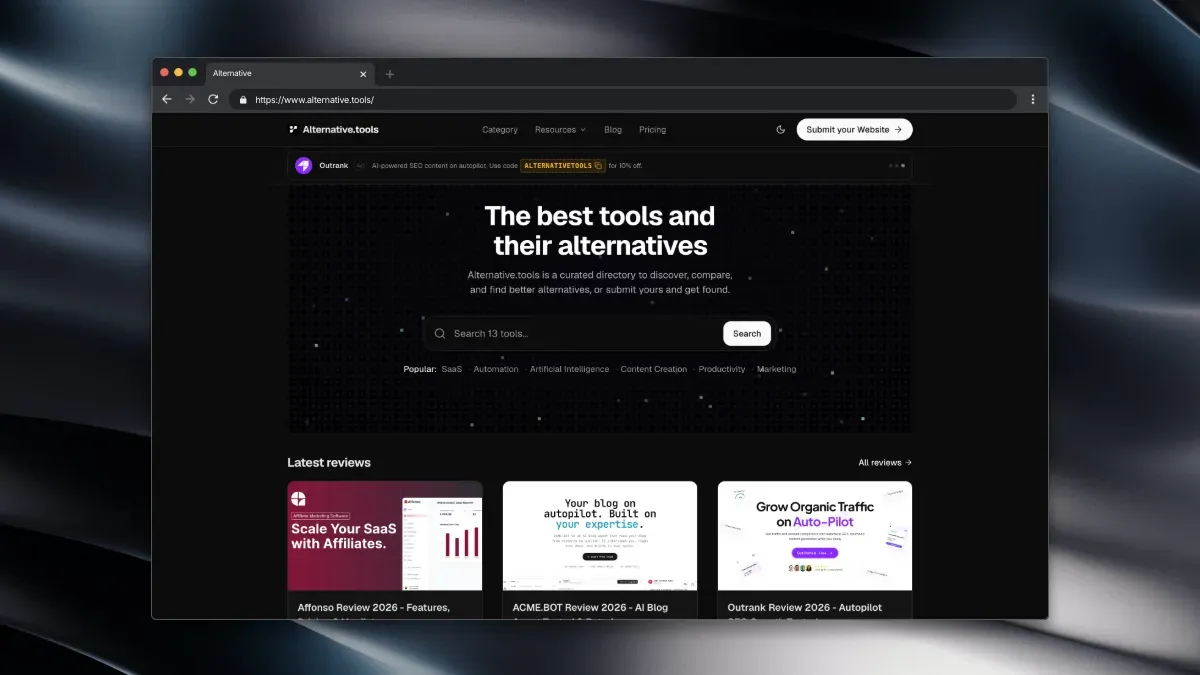
At first glance, the homepage reveals a sophisticated yet minimal interface. A hero section invites visitors to search across 13 tools, with popular categories immediately visible. The directory is categorized into niches like SaaS, Automation, Artificial Intelligence, Content Creation, Productivity, Marketing, Developer Tools, Design, Social Media, Analytics, SEO, Fintech, Sales, and Startups. This breadth shows ambition, even if the current count is small. The phrase "The best tools and their alternatives" is prominent, underlining the site's core value proposition: helping users compare products and find better fit.
Market positioning is distinct. While Product Hunt focuses on daily launches and social voting, and G2 relies on verified user reviews, Alternative.tools combines a curated index with long-form editorial content. It also includes educational resources such as guides, how-to playbooks, and a glossary, which are uncommon in traditional directories. This editorial approach gives the platform a TechCrunch-like flair. The "Google Graveyard" link in the footer adds a touch of tech culture, documenting deprecated Google products, which will resonate with the target audience.
For anyone launching or evaluating software, Alternative.tools promises a mix of discovery, critique, and learning. The current limitations are clear: a small database and a dependency on community submissions. Yet the foundation is solid, and its independent stance is refreshing in an era of sponsored content.
Key Features
Curated Directory and Categories: The homepage presents a "Browse our Popular Categories" section with emoji icons and tool counts for each category. SaaS, Automation, Artificial Intelligence, Content Creation, Productivity, Marketing, Developer Tools, and Design appear first, with more categories accessible elsewhere. This visual organization lowers the barrier to entry for users who prefer navigation over search. The category pages list all relevant tools with descriptions and links, enabling quick comparisons.
Editorial Reviews: The "Latest reviews" section on the homepage showcases recent article titles like "Affonso Review 2026 - Features, Pricing & Verdict" and "ACME.BOT Review 2026 - AI Blog Agent Tested & Rated". These headlines suggest a structured template covering features, pricing, and a verdict. The reviews are not crowdsourced; they appear to be written by the Alternative.tools team, giving them a consistent voice and analytical depth. This is a significant differentiator from run-of-the-mill directories that auto-generate listings.
Submission System: A "Submit your Website" button sits in the header, linking to a dedicated submission page. The footer further links to "Submission Guidelines" and "Pricing", indicating a formal onboarding process for new products. Founders likely submit a URL, provide metadata, and possibly choose a paid tier for enhanced visibility. The presence of a pricing page implies that free submissions exist but premium placements cost money. This creates a sustainable revenue model which helps ensure the directory's independence.
Alternative and Comparison Focus: The tagline "The best tools and their alternatives" is reinforced by a "Best for" section in the resources menu. This feature curates top tool picks by use case, as seen in the sidebar widget "Best for…". It suggests that Alternative.tools goes beyond simple listing; it actively recommends alternatives and helps users understand trade-offs. The platform also has a "Compare" theme in its reviews, often comparing competing tools in the same category.
Learning Hub: A "Resources" dropdown presents Guides, How-to, Glossary, and Best for. The footer deepens this with specific resources like "Directory Submission" and "SaaS Payments". These seem to be in-depth articles that educate users on topics like SEO tools, directory submission services, and payment processing for SaaS. This educational layer adds significant value, transforming a simple directory into a knowledge base.
Featured and Recent Sections: The homepage includes "Top Products" and "Recently Listed" widgets. "Top Products" shows ranked picks such as Affonso, ACME.BOT, Outrank, Viktor, Postiz, Fuzzy AI, Zinley, and DataFast. These products are presented with logos, descriptions, and category badges, offering a quick snapshot of what's trendy. "Recently Listed" includes newer entries like Kinetic Pricing, V2Fun, PhotextAI, Acti, and Screen Charm, proving the directory is actively updated. This dynamic nature keeps content fresh and encourages repeat visits.
Clean and Responsive Interface: The layout is uncluttered, with a sticky header, clear typography, and smooth navigation. The mobile version collapses into a hamburger menu, ensuring usability across devices. Subtle touches like theme toggling and keyboard accessibility (aria-labels) indicate attention to technical polish. The search bar at the top functions as a dynamic query field, showing the live count of indexed tools. This user experience is a pleasant surprise for a young directory, matching the standards of established tech publications.
How It Works
The user journey on Alternative.tools is straightforward. A first-time visitor lands on the homepage, where a hero section displays a headline and a searchable input field. Typing a keyword triggers a search across the database of tools, with popular categories displayed below for those who prefer browsing. For example, clicking on "SaaS" leads to a category page listing products like Affonso and Outrank, each with a short description and a link to a detailed review.
After finding an interesting product, the user can click through to a dedicated item page, which likely contains a full review, screenshots, and maybe feature comparisons. The blog section offers longer-form analyses that follow a consistent structure: features, pricing, verdict. These articles are interspersed with guides and how-to playbooks that explain broader concepts like directory submission or SaaS payments. Internal linking between articles and category pages creates a web of related content, improving discoverability and session duration.
For founders, the path is slightly different. They navigate to the "Submit your Website" link, either from the header or footer. The submission process likely involves filling out a form with product details, selecting a category, and uploading a logo. If they choose a premium placement, they may be redirected to the pricing page to select a plan. After submission, the product enters the queue, and the editorial team reviews it before it appears in the directory. The recent additions to "Recently Listed" suggest that this review process is efficient.
Daily use might involve monitoring the "Top Products" sidebar to see which tools are gaining traction, reading new reviews to stay informed, or using the glossary to clarify technical terms. The "Google Graveyard" section offers a nostalgic look at defunct Google services, which can be a conversation starter. Overall, the platform is designed to be a self-serve resource for anyone interested in software discovery and analysis.
Use Cases
A Startup Founder Seeking First Users: A founder with a new SaaS product can submit their website to Alternative.tools to gain visibility within a curated community. The submission process likely includes a review, which provides early validation. The founder can then share the review link on social media as social proof. Additionally, they can use the directory to research competitors and alternative solutions, refining their positioning.
A Product Manager Evaluating Alternatives: A PM tasked with selecting a social media scheduling tool can browse the "Social Media" category and compare options like Postiz with other products. The editorial reviews offer detailed feature analysis and pricing information, enabling a data-driven decision. The "Best for" section might highlight which tool is optimal for specific team sizes or use cases.
An Indie Hacker Spotting Trends: Independent makers can use the "Latest reviews" section to detect early signals in the market. For instance, the presence of reviews for AI blog agents like ACME.BOT or AI employees like Viktor suggests where the industry is heading. By reading the guides on directory submission and SaaS payments, indie hackers can also learn operational best practices for their own ventures.
A Marketing Professional Searching for SEO Tools: A marketer looking for backlink building solutions can explore the "SEO" category and read the review for Outrank, which claims to automate SEO growth. The platform's comparison-oriented approach helps them understand how Outrank stacks up against other automated SEO platforms. The glossary can clarify terms like "dofollow backlinks", enhancing their knowledge.
An Investor Conducting Due Diligence: An investor can use Alternative.tools as a secondary research source. The featured "Top Products" list offers a snapshot of what's currently popular in the SaaS ecosystem, and the editorial reviews provide independent analysis that might reveal strengths or weaknesses beyond marketing claims. The small database makes it easy to track specific products over time.
Pricing & Value
The exact pricing structure is not disclosed on the homepage, but the presence of a dedicated /pricing route indicates that Alternative.tools offers tiered plans. Based on common directory models, free submissions are likely available with limited exposure, while premium tiers may include featured listings, sponsored reviews, or banner ads. The visible advertisement for Web Review, a website review directory, confirms that the platform accepts sponsorship. For users, the directory itself is free to browse, search, and read, which is a straightforward value proposition.
When compared to other directories, Alternative.tools offers a unique blend. Product Hunt charges nothing but relies on algorithmic ranking, which can feel chaotic. G2 offers a vast database but can be cluttered with user-generated noise. Alternative.tools, despite its small size, delivers curated content with a human touch. The educational articles and guides add tangible value that goes beyond simple listing. For founders, the cost of a paid listing could be justified as a marketing expense, especially if it leads to early adopters. However, the active user base is currently small, so the return on investment might be limited until the platform grows.
Final Verdict
Alternative.tools is a well-executed niche directory that fills a gap between noisy launch platforms and stale software catalogs. Its editorial reviews, educational resources, and clean design make it a pleasure to use. The strengths are clear: unbiased analysis, categorical organization, and a genuine commitment to helping founders get discovered. The weaknesses are equally obvious: the database is tiny, the user base is immature, and there is no public API or community layer such as comments or voting. For indie hackers, startup marketers, and early-stage founders, Alternative.tools is a worthwhile tool to submit their products and monitor the landscape. For enterprises relying on comprehensive market intelligence, it is too early to be the primary source. That said, the platform's direction is sound, and with continued curation and expansion, it could become a go-to resource for software discovery. The recommendation is to submit your website, read a few guides, and keep an eye on its evolution.