
Overview
Capture Studio is a Windows-native screen recorder and video editor distributed by OpenHub AS, a Norwegian software company. The product targets a specific gap in the market: recording tools tend to produce raw footage that then requires a separate editor, while editors tend to be heavyweight applications built for professional post-production. Capture Studio collapses both steps into a single application, capturing a screen, window, or drawn region at up to 120 FPS and then presenting that footage on a multi-track timeline where every effect renders in a live preview before export.
The problem it addresses is familiar to anyone producing software demos, tutorials, or product walkthroughs. A raw capture has a jittery cursor, no visual emphasis, unreadable text at full-screen scale, and audio that picks up keyboard clatter and fan noise. Traditionally, fixing that meant exporting from a recorder and importing into a nonlinear editor, then manually keyframing zoom, adding captions, recording narration, and masking sensitive data. Capture Studio attempts to automate most of that pipeline with smart zoom that follows the cursor, smoothed pointer motion, click ripples, keystroke overlays, on-device speech-to-text captions, and neural voice generation.
Positioning-wise, the product sits against established options such as Camtasia, which appears in the site's own keyword list, along with ScreenFlow on macOS and lighter recorders such as OBS paired with a separate editor. Its differentiator is privacy and local processing: every feature runs on the user's own machine, so no footage ever leaves the device. That matters for teams recording internal systems, customer data, or unreleased software. The trade-off is hardware demand, and the features overview is unusually explicit about those requirements.
Key Features
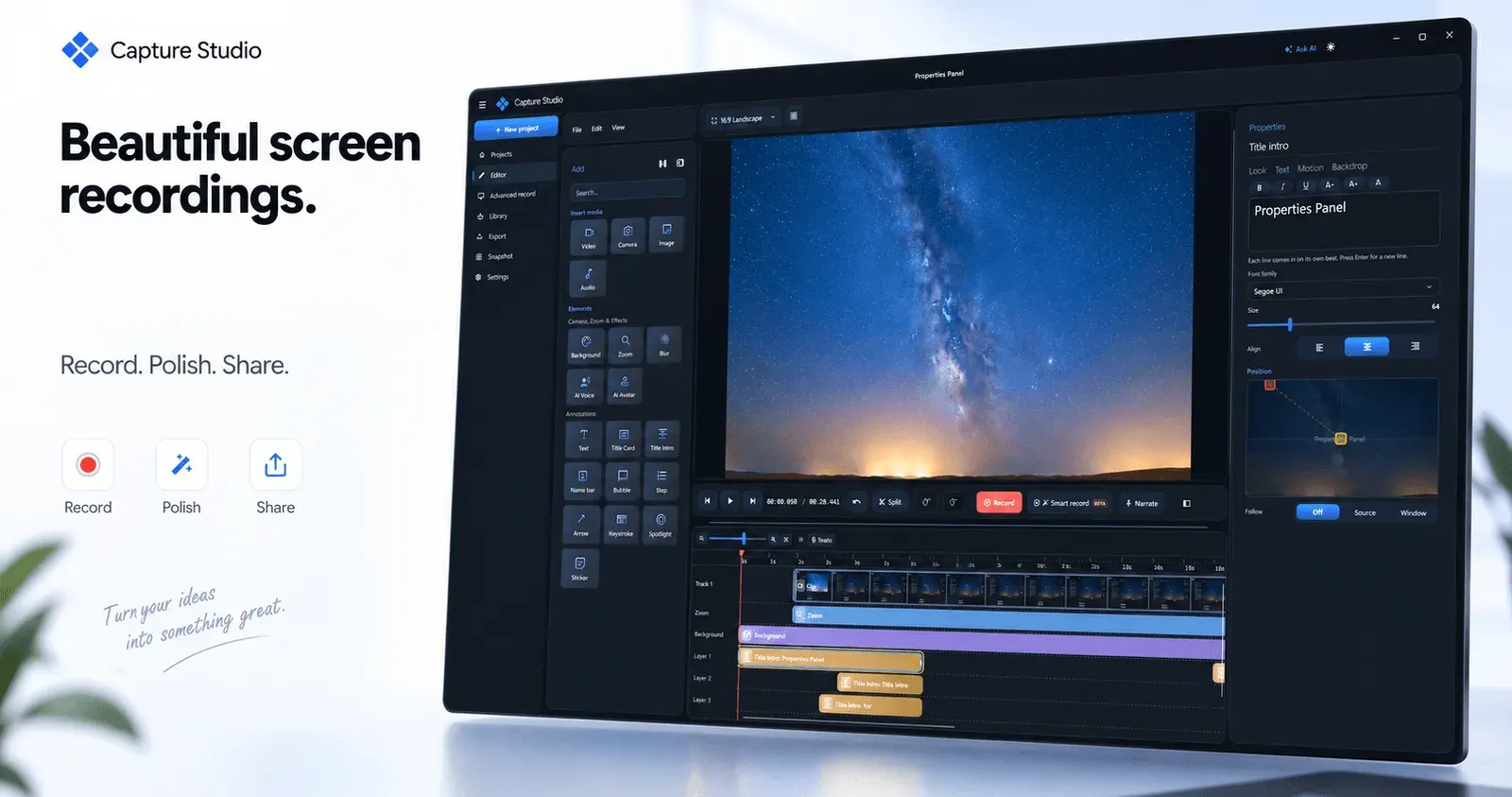
Timeline Editing with Live Effects. The editor is a genuine multi-track timeline where clips can be trimmed, zoomed, and layered with effects. Preview is rendered live, so the export matches what appears in the panel during editing. A properties panel sorts every setting into tabs, allows favorite styles to be saved and reused, and displays timing information before playback begins.
Smart Zoom That Follows the Cursor. Automatic zoom-ins keep viewers focused on the relevant region of a recording without manual keyframing. Manual keyframe zoom remains available for scenes that demand a specific framing or a slow push-in. Combined with the smooth cursor treatment and click ripples, this is the feature that most directly removes post-production labor from tutorial production.
Keystroke Overlay and Click Highlights. The recorder can display pressed keys on screen, which is useful for shortcut-heavy demonstrations and software training. Click ripples and smoothed pointer motion are applied automatically, producing the polished feel associated with professionally produced product demos.
On-Device AI Voice, Subtitles, and Avatar. Studio Voice produces neural narration in 22 languages using 85 voices, and can clone a speaker's own voice from a short recording of roughly ten to fifteen seconds. Studio Avatar generates an on-camera presenter whose lip movements sync to the narration. Automatic subtitles rely on an on-device speech-to-text model with language auto-detection. Studio Avatar is limited to two standard female voices plus most premium female voices at launch, with more avatars promised at a later date.
Privacy Blur and Alignment Guides. A blur region hides passwords, faces, or other sensitive material, and it can be keyframed or set to auto-track a moving window. Alignment guides display canvas center and object edges and illuminate when elements line up, which removes guesswork from layout work.
Snapshot Documentation Export. For written documentation, Snapshot follows a workflow, snaps each step automatically, captures accompanying text, generates clean descriptions, and exports to Markdown, PDF, HTML, or PowerPoint Show format. This turns a screen recording session into structured documentation without retyping steps.
Additional Capture and Output Controls. Recording supports full screen, a single window, or an arbitrary drawn region at up to 120 FPS where hardware permits. Noise cancelling strips fan hum, keyboard clatter, and room tone from audio. Floating displays place a recording inside a rounded, shadowed window that slides in over a background. Projects can be exported portably with all associated media bundled, and Android devices can be mirrored and recorded alongside the computer via Android Developer Mode. Backgrounds, titles, stickers, arrows, and spotlights round out the annotation set.
How It Works
The journey begins with a purchase, since Capture Studio is a paid desktop download rather than a browser-based service. A licence key is delivered after payment clears through a Paddle checkout, and add-ons such as Studio Voice and Studio Avatar activate the next time the application checks in. There is no account dashboard or cloud workspace to configure, which keeps onboarding short.
Once installed, the workflow is capture first, edit second. The user selects the capture target, meaning the entire screen, a specific window, or a drawn region, plus the frame rate and audio sources. Recording runs locally, with the pointer and keystrokes logged in parallel so the editor can reconstruct smooth cursor motion and key overlays afterward. Because processing is local, quality and performance depend on the machine. The published minimums sit at a four-core 2.5 GHz CPU with 8 GB of RAM and DirectX 11 graphics, while recommended hardware rises to eight cores, 3.5 GHz, 16 GB of RAM, and an NVIDIA RTX 2060.
After capture, footage lands on the timeline. Zoom, backgrounds, annotations, and layout are applied through the properties panel, and the preview updates in real time. Sensitive regions get a blur keyframe. Narration is either recorded live, generated with Studio Voice, or cloned from the speaker's own short sample. Captions are generated automatically and restyled. Export produces the final video, or Snapshot converts the session into a written guide.
Daily use is therefore a loop of capture, annotate, narrate, and export inside one window, with no round trip through a second application. The main friction points are hardware, since the AI features carry separate GPU requirements, and the Windows-only constraint.
Use Cases
Software teams producing training material. A product manager at a B2B SaaS company records a walkthrough of a new feature, then uses Studio Voice to narrate a script and automatic subtitles to localize it. Smart zoom keeps attention on the relevant panel, and privacy blur masks a customer name visible in a sidebar before the video goes to the wider company.
Technical writers maintaining knowledge bases. A documentation specialist uses Snapshot to capture a multi-step configuration process, exporting the annotated steps directly to Markdown so the internal wiki inherits structured text instead of grainy screenshots pasted by hand.
Educators and course creators. An instructor teaching keyboard-driven software relies on the keystroke overlay and click highlights so students can follow shortcuts in real time. Backgrounds and framing options produce consistent lesson aesthetics across a full course without a separate design pass.
Support and customer success teams. A support engineer records a fix for a ticket, blurs the customer's account identifiers, and sends a short narrated clip instead of a long written explanation, cutting follow-up messages.
Agencies producing product demo videos. A small studio records client software at high frame rates for smooth motion, adds arrows, spotlights, and titles on the timeline, and exports a portable project bundle so the work can be archived or handed to another editor.
Pricing & Value
Capture Studio is sold as a one-time purchase rather than a subscription. The Early Bird tier is listed at EUR 119.00 and currently discounted to EUR 85.00 as a launch offer, described as the most popular option. That price includes a lifetime licence and one year of updates. Two premium add-ons, Studio Voice and Studio Avatar, are each priced at EUR 21.20 one-time and are already included in the Early Bird purchase, so buyers at that tier effectively receive both neural modules at no extra cost.
The value proposition is straightforward against subscription competitors. A perpetual licence at under a hundred euros compares favorably with annual plans on comparable editing suites, particularly for freelancers and small teams that dislike recurring costs. Hardware is the hidden expense: Studio Voice recommends an RTX 2080 with 16 GB of RAM, and Studio Avatar recommends an RTX 2070, so the AI features effectively assume a modern discrete GPU. Buyers without that hardware still get the recorder and timeline editor, which is where the bulk of day-to-day value sits. Those weighing the numbers can check out their pricing directly.
A 14-day withdrawal window is offered, with the caveat that using or activating the software during that period forfeits the refund. There is no free tier or trial listed, which is a meaningful barrier for evaluation.
Final Verdict
Capture Studio makes a coherent argument that recording and editing belong in one application. The strongest elements are the automation layer, covering smart zoom, smooth cursor, click highlights, keystroke overlays, and subtitles, all of which eliminate tedious manual work, plus the on-device processing model, which keeps sensitive footage off third-party servers. Snapshot's documentation export is a distinctive capability that few direct competitors match, and the perpetual licence structure is friendly to cost-conscious buyers.
The limitations are equally clear. Windows exclusivity rules out macOS and Linux workflows entirely. The AI modules carry demanding GPU requirements that many laptops will not meet, and Studio Avatar launches with a narrow voice selection. There is no free trial, so evaluation requires a purchase and a refund request within 14 days. Finally, several items on the product roadmap, including more avatars and camera background removal, remain future promises rather than shipping features.
For Windows-based creators producing tutorials, software demos, and training content who want a single tool and value local processing, Capture Studio is a credible and competitively priced option, particularly at the current launch price with premium add-ons bundled. Teams standardized on macOS, editors needing advanced color grading or compositing, and anyone unwilling to buy before trying should look elsewhere.