
Overview
Papaya Chat is a pre-launch AI companion service that organizes conversational characters around fruit-themed personas. The public site introduces Papaya Chat as a place where users can meet AI friends with distinct voices, from a blunt lemon to a relaxed mango. The core problem it targets is familiar to the consumer AI market: many chatbot products feel interchangeable, so Papaya Chat uses character branding and playful copy to make selection feel more human and less technical.
The product is aimed at consumers who want lighthearted, personality-driven conversation rather than a generic assistant. Its roster includes eight characters, each with a name, tagline, traits, and sample dialogue. The site positions the service around mood-based selection, so a user can choose a fruit based on whether they want honesty, humor, calm, hype, or curiosity. The group chat concept, described as a fruit bowl, suggests multi-character conversations rather than only one-to-one exchanges.
Papaya Chat is not yet open to the public. The primary call to action is joining a waitlist, and the site uses early access language such as now ripening and first bite. That places it in a crowded field of AI companion apps, character chat platforms, and general-purpose assistants, but the branding is more distinctive than most. The main differentiator is not a disclosed technical model or integration set, but the packaging of AI personalities as a playful cast.
Key Features
Eight fruit personas with defined traits. The site presents Pip the Papaya, Lola Lemon, Bash the Banana, Duke Durian, Mango Mae, Kiki Kiwi, Cher and Ry, and Coco Coconut. Each card includes a short role description, three personality tags, a sample line, and a custom SVG illustration. This structure gives users a quick way to compare tones, from sunny and curious to theatrical and bold.
Meet first preference selection. Every fruit card includes a button that lets visitors mark a preferred first character. The selected card receives a visible outline, and the button label changes from an invitation to a confirmation state. This is a small but effective personalization mechanic because it gives the waitlist a concrete choice instead of a generic email capture.
Group chat fruit bowl concept. The how-it-works section describes a three-step flow: pick a fruit, chat about anything, and mix a fruit bowl. The third step explicitly says users can drop several fruits into one group chat so the characters can riff, debate, and hype the user up together. This suggests a multi-character conversation format, which is more ambitious than a standard one-on-one companion app.
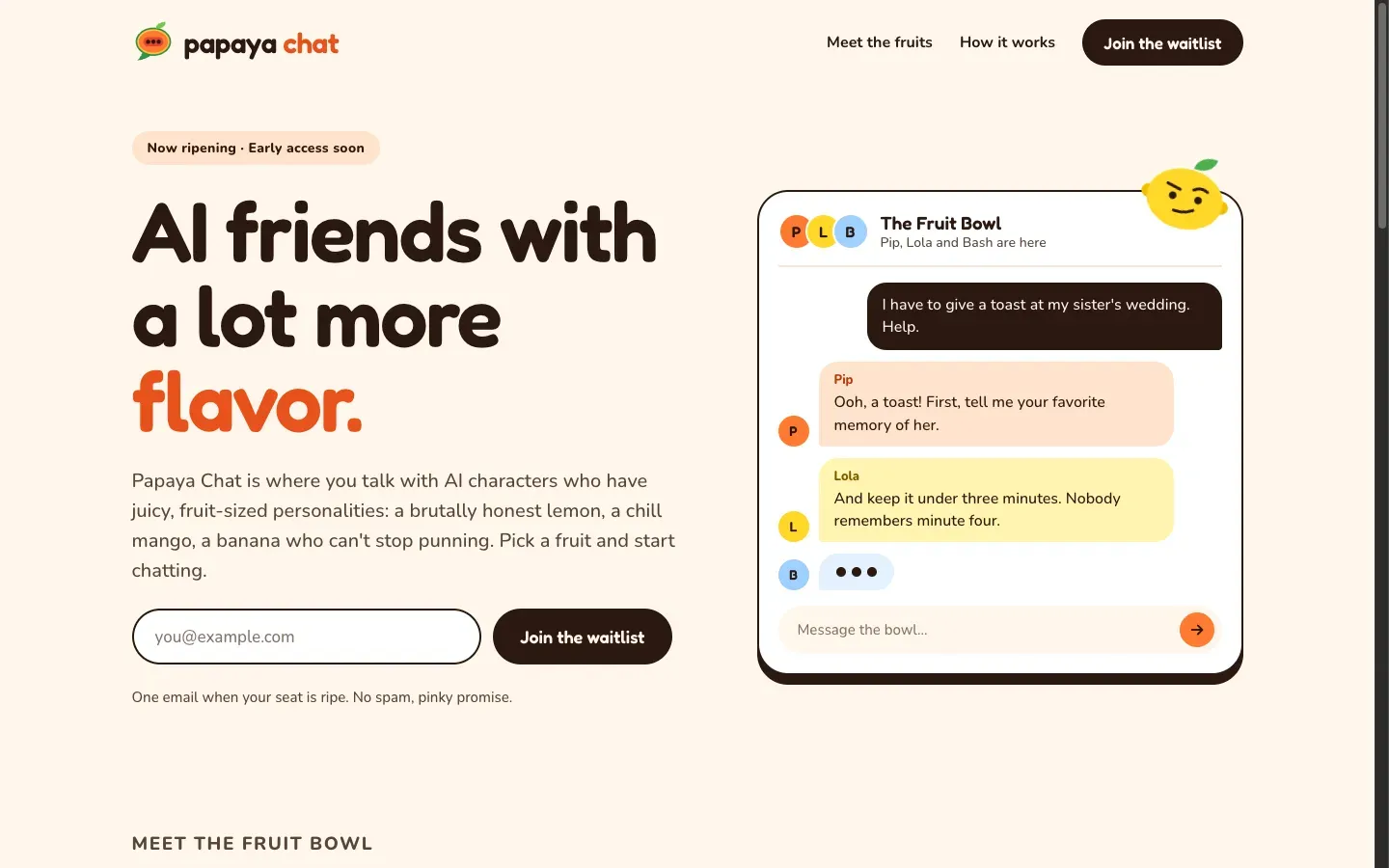
Illustrative chat interface on the homepage. The hero includes a mock conversation titled The Fruit Bowl, with three avatars, message bubbles, a typing indicator, and a composer labeled Message the bowl. The mock chat shows Pip and Lola responding to a request for help with a wedding toast, while Bash is shown typing. This demonstrates the intended interaction style without exposing a live product demo.
Waitlist capture with form states. Both the hero and the join section include email waitlist forms. The forms include labels, email validation, a hidden company field for bot filtering, an error region, and a success state. The site also tells visitors that they will receive one email when a seat is ready and no spam. These are basic but important trust signals for a pre-launch consumer service.
Cohesive playful design system. The interface uses a cream, seed brown, orange, rust, and peach palette, with Fredoka for display type and Nunito for body text. Custom fruit SVGs, rounded cards, sticker-like details, and a chat mockup create a consistent visual identity. The site also includes responsive grids, visible focus styles, and a reduced-motion media query, which indicates attention to accessibility beyond surface styling.
How It Works
A visitor lands on the Papaya Chat homepage and immediately sees the value proposition: AI friends with fruit-sized personalities. The top navigation links to the fruit roster and the how-it-works section, while the primary call to action points to the waitlist. The hero form asks for an email address and includes a hidden field for spam prevention. After submission, the page can show an error message or a success message, but it does not create an account or open a chat session.
The next step is character discovery. The fruit roster presents eight cards with names, taglines, traits, sample dialogue, and a Meet first button. A visitor can mark one fruit as the preferred first contact, which updates the card styling and button text. This helps the service learn which personality appeals to each waitlist member, and it gives the visitor a sense of agency before launch.
After early access opens, the site describes a simple flow. A user picks a fruit, chats about any topic, and can then mix multiple fruits into a group chat. There is no disclosed onboarding survey, memory system, safety tutorial, or account management flow. The main UX decisions visible today are low-friction email capture, mood-based character selection, and a single-page structure that keeps the explanation brief. Interested users can join the waitlist to reserve access, but the actual chat experience remains unverified until launch.
Use Cases
A sibling preparing a wedding toast could use the fruit bowl format shown in the homepage mockup. Pip would ask for a favorite memory, while Lola would push for brevity and sharper structure. The value is a low-pressure brainstorming session with two contrasting voices, one warm and one blunt, rather than a single assistant trying to cover both roles.
A student revising an essay might choose Lola Lemon for direct feedback and Kiki Kiwi for explanatory depth. Lola's sample line promises honest critique, and Kiki's description suggests a precise, science-minded style. The pairing could help a user separate emotional encouragement from technical correction, although the product has not shown how memory or context sharing works across characters.
A late-night overthinker could select Coco Coconut for calm listening. Coco's card emphasizes patience and warmth, with a sample line that says there is no rush. That positioning fits users who want companionship or gentle reflection more than task completion. It also highlights a potential moderation challenge, because sensitive conversations require clear safety boundaries that the public site does not yet describe.
A creative professional stuck on a campaign could use Bash the Banana for puns and Duke Durian for dramatic angles. Bash's sample joke and Duke's theatrical self-description suggest a brainstorming pair that could loosen up a stale concept. Cher and Ry add a hype squad option for moments when encouragement matters more than critique, such as finishing a 5K or shipping a personal project.
Pricing & Value
The public site does not publish pricing tiers, subscription rates, credit systems, or a free plan. The only commercial action available is joining the waitlist, and the page says users will receive one email when a seat is ready. There is no trial length, no paid upgrade path, and no indication of whether the product will be free, freemium, or subscription-based.
That absence is normal for a pre-launch consumer product, but it limits any value assessment. Competing AI companion services often use monthly subscriptions or token-based access, yet Papaya Chat has not confirmed its model. The value proposition currently rests on character design, group chat potential, and a low-commitment waitlist. Until pricing, platform availability, and conversation limits are disclosed, buyers cannot compare cost of ownership with alternatives.
Final Verdict
Papaya Chat has a memorable brand and a clear roster-based approach to AI companionship. The strongest elements are the differentiated fruit personas, the Meet first selection mechanic, and the group chat concept. The visual identity is cohesive, and the waitlist flow is simple enough for casual visitors to understand in seconds. For a pre-launch product, the site communicates personality well and avoids overloading users with technical jargon.
The main gaps are transparency and proof. There is no live demo, no pricing, no privacy policy link, no moderation framework, and no information about platform support. The chat mockup shows tone, but it does not prove conversational quality, memory, safety, or reliability. Consumers who want a playful AI companion should keep Papaya Chat on a watchlist and explore the fruit bowl as details emerge. Buyers who need immediate access, enterprise controls, or documented data handling should look elsewhere until the service launches with clearer terms.