
CertWorthIt is a data research platform built to test a claim that certification vendors repeat constantly and rarely substantiate: that a given credential shows up in genuine hiring demand. The site counts job advertisements pulled through the Adzuna API, applies AI analysis to the listing text, and publishes the share of postings that name each certificate for a specific role. The current snapshot covers 362,748 job ads across 10 countries and 78 certifications, with figures dated October 2026. Every published number links back to its source, and a dedicated methodology page explains how the counting is performed.
The problem CertWorthIt addresses is familiar to anyone weighing a professional credential. Training providers market aggressively, course platforms sell subscriptions on the promise of employability, and forum advice tends to be anecdotal. Very few independent sources quantify how often a hiring manager actually types the credential name into a posting. CertWorthIt steps into that gap by publishing share-of-ads percentages per certification and per role, then letting readers compare those percentages against the skills the same ads request.
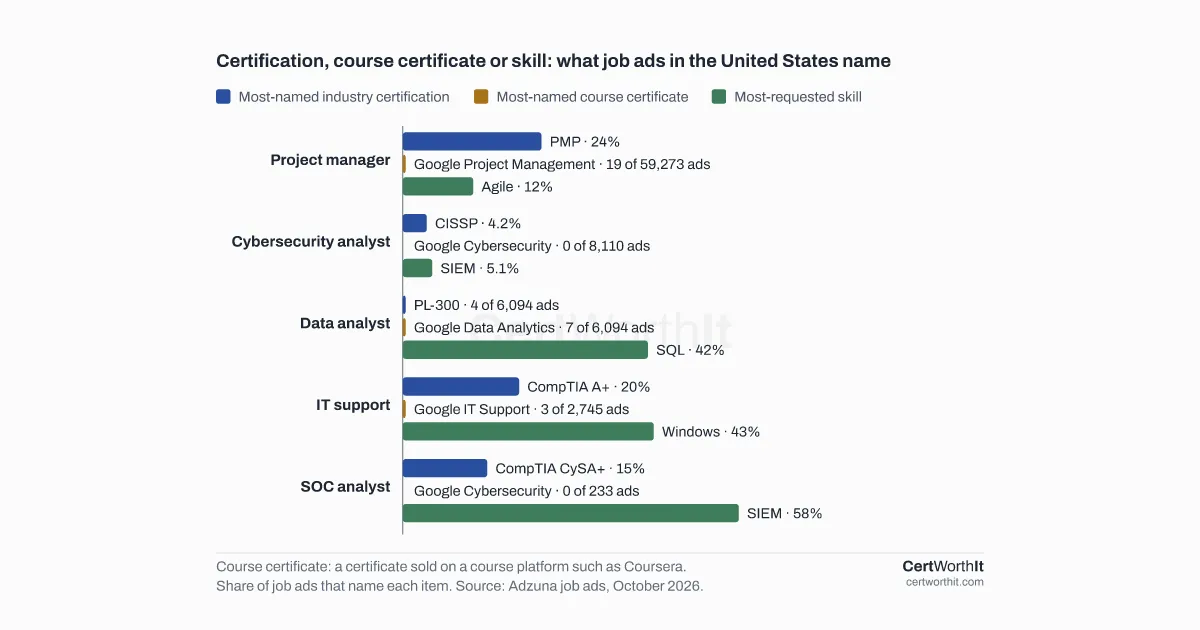
The editorial angle is deliberately deflationary. On the homepage, the headline finding states that in five of five tracked United States roles, the top named skill appears in more advertisements than the leading course certificate. A project manager posting names PMP in 24 percent of cases, while the most-named course certificate for that role, Google Project Management, appears in 19 of 59,273 ads. A data analyst ad asks for SQL in 42 percent of cases, while Google Data Analytics appears in 7 of 6,094. The platform does not argue that certificates are worthless. It argues that the gap between vendor marketing and hiring language is measurable, and that the measurement is worth publishing.
The audience includes career switchers evaluating an entry point, early-career IT professionals deciding between CompTIA and Cisco tracks, project managers weighing PMP against CAPM, and the career counsellors, bootcamp operators and university advisors who guide those groups. The service is positioned as a research utility rather than a course marketplace. It does not sell training, and it does not gate its headline data behind a login. The operator is identified in the footer as Lumavera OÜ, registry code 17438605, based in Tallinn, Estonia, with an editor named publicly as Jere Salmisto, a level of disclosure that is unusual for a small data site.
Competitive context matters here. Salary aggregators such as Glassdoor measure pay, not credential mention rates. Vendor-published surveys measure outcomes for people who already bought the product. Reddit threads offer texture but no denominator. CertWorthIt occupies a narrower niche: the frequency with which a credential name appears in the text of a live job advertisement, sliced by country, by role and by professional field. That is a single metric, and the platform is honest about its limits, but it is a metric that is difficult to find elsewhere in a comparable, source-linked form.
International coverage is a differentiator. Data is assembled for the United States, the United Kingdom, India, Brazil, Mexico, Spain, France, Germany, Italy and Poland, and the interface is localized into English, Portuguese, Spanish, French, German, Italian and Polish. The ranking structure shifts meaningfully between markets. OSCP leads in the United States at 73 percent, CCNP leads in the United Kingdom at 14 percent, and PMP leads in India at 24 percent, which suggests that certification value is a regional question rather than a universal one. That nuance is often lost in English-language career advice.
The platform also publishes deliberately uncomfortable figures. Google Cybersecurity appears in 0 of 8,110 cybersecurity analyst ads in the United States sample, and 0 of 233 SOC analyst ads. AI-900 registers 0 of 7,726 AI-adjacent ads. Microsoft PL-300 appears in 4 of 6,094 data analyst ads. Presenting zero-result findings alongside strong ones gives the dataset a credibility that a curated highlight reel would lack, and it is the clearest signal that the project is trying to inform rather than to sell.
For a reader trying to decide whether a certificate is worth the exam fee and study hours, the practical value lies in the comparison layer. The site pairs credentials head to head, showing CAPM at 1.7 percent against PMP at 24 percent, CCNA at 16 percent against CCNP at 20 percent, and CISSP at 4.2 percent against OSCP at 73 percent. Those pairings convert an abstract debate into a concrete ordering. The trade-off is that a mention rate is not the same as a hiring outcome, and the platform says so in its own methodology rather than hiding the caveat.
Overall, CertWorthIt reads as a focused data project with a narrow remit executed carefully. It is not a course, not a job board and not a salary tool. It is a measurement layer for one specific question, backed by a disclosed sample size, a dated snapshot, a named editor and a public counting method, and it earns attention by making that question answerable.