
Overview
DataExpert.io Academy is a cohort and subscription based learning platform built around a single, narrow promise: teach working professionals the data engineering stack the way large technology companies actually run it. Founded by Zach Wilson, a data engineer known for his writing and video instruction, the platform bundles self-paced courses, live boot camps, capstone projects, graded mock interviews and a Discord community into one product. The problem it addresses is familiar to anyone who has tried to learn data engineering from scattered documentation, stale tutorials and disconnected video clips. Rather than presenting a loose pile of lessons, the academy frames the journey as a pipeline, moving learners through explore, build, source, signal, interview and ship stages.
The positioning is deliberately premium and practitioner led. Instructors listed on the site include a solutions architect manager at Databricks, a data engineer at phData, the founder of Rebel Data Science, an AI and machine learning growth lead with experience at Google, and a former Google software engineer turned content creator. The platform claims more than 9,696 learners already enrolled. Alternatives range from generalist marketplaces such as Udemy and Coursera to dedicated data boot camps and free community resources. DataExpert.io differentiates by keeping the curriculum opinionated, tightly bound to real cloud tooling, and taught by people who still ship production systems for a living. Prospective students can review the pricing structure to compare the self-paced and live cohort tracks before committing.
Key Features
Live cohort boot camps. The flagship offering is a scheduled, instructor led boot camp with lectures and labs delivered twice a week. The current headline program is the Senior AI Analytics Engineering Boot Camp, which covers Snowflake, AI agents, Airflow and dbt across a fixed calendar starting November 16, 2026. Every session is recorded and published within eight hours, so asynchronous learners can keep pace without attending live.
Self-paced all-access subscription. For learners who cannot commit to a cohort calendar, the all-access subscription unlocks the entire on-demand library plus membership in a Discord community of motivated peers. This tier is the entry point for anyone who wants to sample the teaching style before paying for a full boot camp.
Provisioned cloud environments. A recurring theme in student testimonials is that the program hands out real accounts rather than simulated exercises. Learners receive Databricks workspaces, GitHub access to private repositories and onboarding flows that activate cloud services from the dashboard. The curriculum deliberately uses the same tools that appear in job postings, from Snowflake and dbt to Spark and Iceberg.
Capstone portfolio projects. The build stage is organized around concrete deliverables instead of toy datasets. Projects shown on the site include real-time Formula 1 analytics, a Chess.com analytics pipeline, a cryptocurrency trading strategy submission, a Big Bag Data project and BetFlow, a real-time sports betting application. Each follows an explicit source, pipeline, transform, warehouse and dashboard flow, which mirrors how production data platforms are assembled.
Graded mock interviews. A separate interview product offers timed, role-specific simulations covering SQL under pressure, dimensional modeling, system design, algorithms in Python and behavioral rounds. Submissions are graded automatically the moment they are sent, and pricing starts at $50 with several free entries available. Candidates can browse the mock interview catalog by seniority and role.
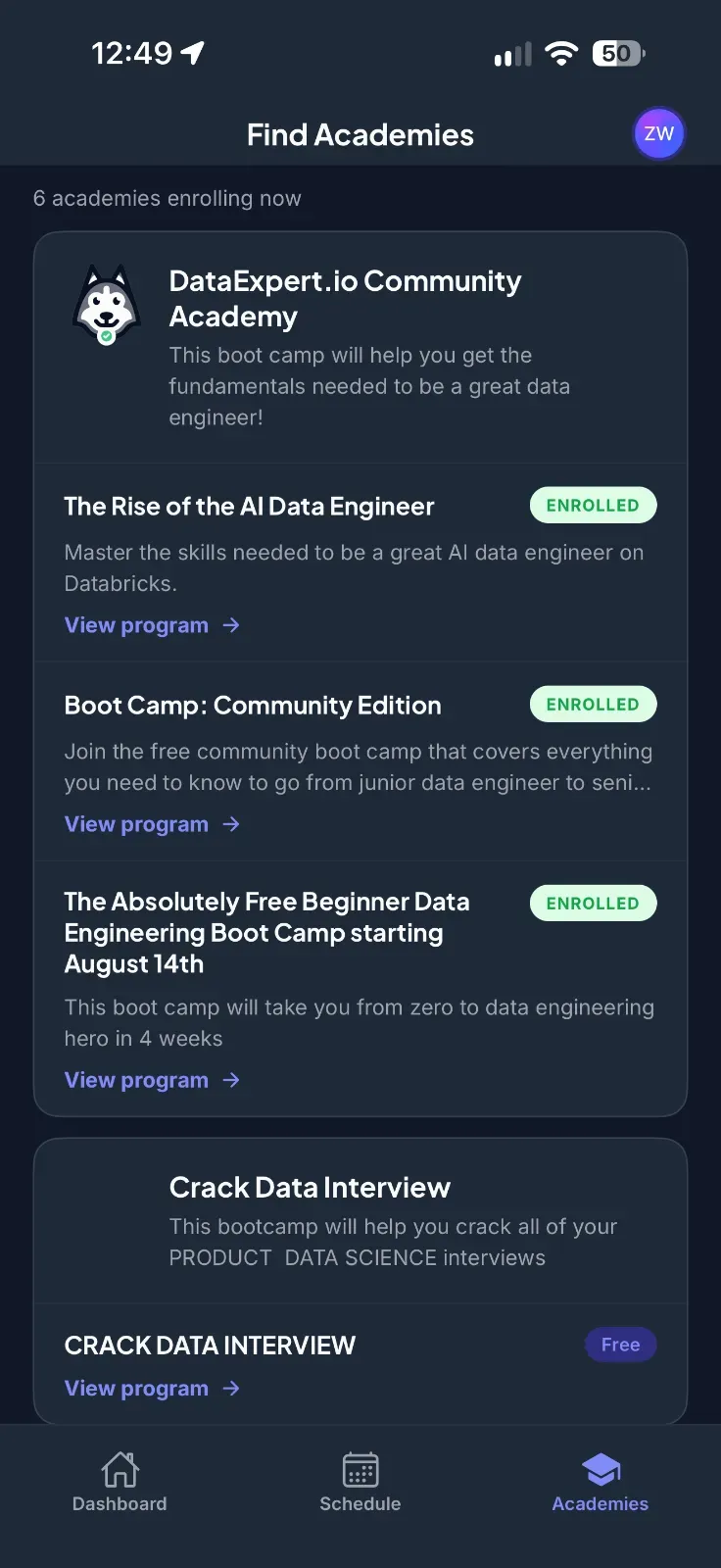
Program finder and guided onboarding. A short questionnaire asks what the visitor is trying to become, offering paths such as becoming a data engineer, leveling up analytics skills, switching careers, or preparing for interviews. That choice routes into relevant programs, which reduces the paralysis that plagues large course libraries.
Community and mobile access. Live lectures and labs run on Discord stages while book clubs and teaching assistant sessions happen on Google Meet. Native iOS and Android apps let learners watch recordings and review material between sessions, and profile settings centralize GitHub usernames, Discord handles and timezone preferences.
How It Works
The entry path starts with an email capture form on the landing page, followed by account creation and a choice between a live program and the subscription library. After purchase, learners land on a dashboard that exposes an onboarding button for each registered program. That onboarding step is where cloud access is provisioned, and it is the gate that unlocks the query environment and repositories.
Setup requires a few deliberate steps that the FAQ documents clearly. Learners create a schema by visiting the query page and running a prepared statement found under the schema information panel. GitHub access depends on adding a username to the profile page first, then activating the integration from a credentials tab. Discord usernames and timezones are edited in the same profile screen, which keeps identity management in one place rather than spread across onboarding emails.
Day to day, the rhythm is predictable. Live lectures and labs run from 6 to 8 PM Pacific on Discord stages, with recordings posted within eight hours. Book clubs and teaching assistant sessions happen on Google Meet, and links live on both the dashboard and a dedicated schedule page. Assignments push learners into the query editor and their provisioned warehouse, and the expectation is that work is explained out loud rather than merely completed. The user experience leans utilitarian rather than glossy: dense dashboards, tables and schedule views dominate, which suits an audience of practicing engineers more than beginners seeking a friendly interface.
Use Cases
The platform engineer with limited hours. A working data platform engineer balancing family commitments needs structure rather than more bookmarks. The cohort format forces a schedule, the recordings cover missed sessions, and the provisioned Databricks account removes hours of environment setup. The outcome is a completed pipeline and a demonstrable project rather than a half-finished tutorial series.
The analyst moving into engineering. An analytics professional fluent in SQL but unfamiliar with orchestration wants to cross the boundary into pipeline ownership. The curriculum's dimensional modeling content, dbt and Airflow coverage, and the analytics engineering boot camp give a scaffolded route, while the capstone dashboard requirement connects new skills back to familiar reporting work.
The interview candidate on a deadline. Someone with interviews scheduled in six weeks can buy mock interview rounds covering data modeling, system design and algorithms, submit answers, and receive graded feedback immediately. That is a far cheaper and faster feedback loop than arranging peer mock interviews, and several rounds are free.
The career switcher seeking proof of work. A candidate arriving from an adjacent field needs artifacts, not certificates. The public capstone examples, including streaming Formula 1 telemetry and a real-time betting application, show the kind of portfolio piece the program produces, and Discord participation supplies the peer accountability that self-study usually lacks.
The university instructor or team lead. Reviews from an associate professor and a senior data engineer suggest the material also serves people who already teach or lead, particularly for real-time analytics patterns and Spark internals that are hard to learn from documentation alone.
Pricing & Value
The pricing model splits into three visible components. The Senior AI Analytics Engineering Boot Camp is listed at $3,000 for a dated cohort beginning November 16, 2026. The All-Access DataExpert.io Subscription costs $96 per month and unlocks all self-paced content plus the Discord community. Mock interviews start at $50, with some rounds offered free. Mobile apps are free to download but require an account to be useful.
Value depends heavily on how the hours are used. A cohort learner who attends live sessions, completes capstones and books interview practice extracts considerably more than $3,000 of instruction compared with a typical multi-course certificate. The subscription is the lower risk entry point, and it is the rational first purchase for anyone unsure about fit. The refund terms are strict: self-paced and subscription products are non-refundable, live boot camps carry a 25 percent processing fee inside seven days and a 50 percent fee inside fourteen days, with nothing returned afterward. That structure rewards decisive buyers and penalizes hesitation, which is worth understanding before checkout. By comparison, generalist marketplaces charge far less but offer no live instruction, no provisioned infrastructure and no graded interview feedback.
Final Verdict
DataExpert.io Academy earns its premium positioning through specificity. The tooling is current, the instructors hold relevant industry roles, the projects use non-trivial streaming datasets, and the interview product closes a loop that most course libraries ignore entirely. The staged structure from exploration to shipping gives learners a mental model of the discipline rather than a checklist of videos. The mobile apps and Discord community add practical reinforcement for people learning alongside full-time jobs.
The limitations are equally clear. Live sessions run late on the Pacific coast, which is punishing for learners in Europe and Asia despite recordings. Refund terms are unforgiving, and the marketing itself concedes that the material is not entry level, with one reviewer stating plainly that prior engineering experience is assumed. Learners starting from zero will need foundational coursework first.
For practicing engineers and analysts who want structured, hands-on depth in data engineering, analytics engineering and applied AI, this is a credible and well-scoped investment. For absolute beginners or anyone needing flexible live schedules and generous cancellation terms, other options fit better. The subscription is the sensible starting point, with the cohort reserved for those ready to commit.