
Overview
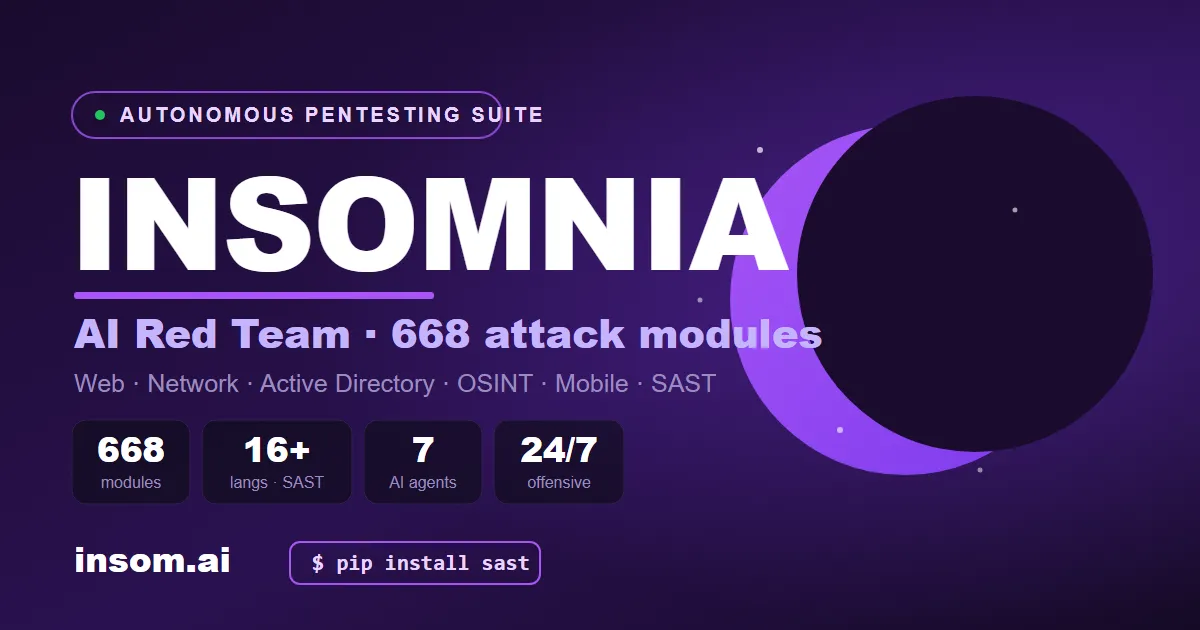
Insomnia (INSOM, insom.ai) is a commercial offensive-security platform built by CQR Cybersecurity LLC that combines a broad vulnerability scanner with an autonomous, multi-agent AI red team. It targets professional penetration testers, red teamers, bug bounty hunters, DevSecOps engineers and security students who need one consistent interface across web applications, APIs, networks, Active Directory, source code, and mobile binaries instead of chaining a dozen single-purpose tools together. The product is available as a desktop suite with a hardware-bound license, as a Debian-based "Insomnia OS" distribution (including a Raspberry Pi 5 drop-box appliance), as an IDE plugin for SAST, and as a hosted MCP server for driving scans from AI assistants.
Key Features
- AI Red Team (7 agents) — Seven specialised AI personas (Offensive Lead, Analyst, Strategist, Exploit Dev, Social Engineer, and others) collaborate in a visible chat log to enumerate, validate and exploit targets. The stack can mix Claude, GPT-4, Mistral and Gemini models, and an agent replay log records the reasoning behind each finding.
- Web & API scanning — 275+ active modules covering SQL injection, XSS, SSTI, SSRF, LFI, RCE, deserialization, GraphQL, JWT issues and HTTP request smuggling, plus REST/GraphQL/MCP API testing.
- Network, AD and OSINT coverage — Port scanning with 20+ protocol-specific enumerators (SMB, LDAP, Kerberos, SNMP, RDP, Redis, ICS/SCADA), 30K+ CVE matching, Active Directory attack-path analysis (Kerberoasting, DCSync, ADCS ESC1), and an interactive OSINT canvas with 200+ transforms.
- SAST and IDE integration — A free
pip install sastCLI plus VS Code/JetBrains/Visual Studio plugins perform cross-file taint analysis in 18+ languages, 230+ secret regexes, and a 12-ecosystem dependency audit. The vendor publishes a 50-repo benchmark claiming 84.9% class recall versus Semgrep (57.9%), SonarQube (33.2%) and Bandit (14.8%). - CI/CD pipeline builder — A seven-step wizard generates a single YAML pipeline combining SAST, secret detection, dependency and Docker audits, DAST/API checks, a deploy gate and Slack/Discord/Teams notifications, exportable to GitHub Actions, GitLab, Jenkins, Bash or PowerShell.
- Reporting and remote MCP — One-click PDF/DOCX/HTML reports with CVSS scoring, evidence and compliance mapping (PCI, HIPAA, SOC 2, ISO 27001), plus a hosted MCP server (mcp.insom.ai) exposing 163 pentest tools so ChatGPT, Claude or Grok can run scans and email reports from a phone.
Primary Use Cases
- Full penetration-test engagements: A tester launches
insomnia --agent -t https://target -o "full pentest"and receives an autonomous enumeration-to-exploitation run capped by a Smart Approval gate that prevents exploits from firing without human confirmation. - Shift-left application security: Development teams run the free SAST CLI or IDE plugin on every pull request and block deployment on critical findings using the generated CI/CD pipeline.
- Security education and lab practice: Insomnia OS bundles 430+ modules, 11K+ CVEs and Academy CTF tasks on bootable Raspberry Pi or x86 images for training environments.
What Stands Out
Insomnia's differentiator is transparency. The vendor publishes 376 raw HTML/JSON scan reports across eight attack surfaces (web, 1-day CVEs, network, SAST, REST API, mobile, MCP servers, GraphQL) alongside its claimed ~6.0% false-positive rate, and runs head-to-head comparisons against Burp Suite, Nuclei, ZAP, Nessus, Semgrep and SonarQube. The combination of agentic AI execution, an explicit human approval gate, and offline/air-gapped deployment options is unusually complete for a single-license product.
Value Proposition
Insomnia positions itself as a consolidation play: one license, one UI and one reporting engine replacing a rack of scanners, with autonomous AI coverage running around the clock and public benchmark evidence backing its detection claims. Pricing starts at $149/month for Advanced and $399/month for Pro, with monthly, annual and lifetime tiers plus pay-as-you-go MCP credits.