
Overview
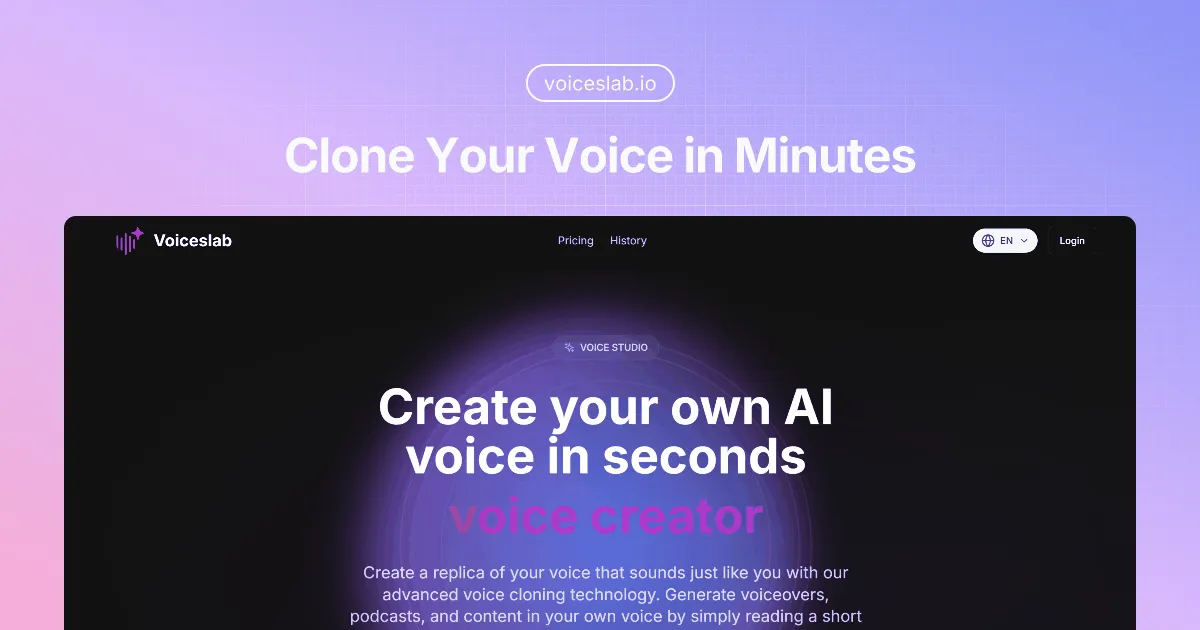
Voiceslab is a browser based AI voice cloning and speech synthesis service aimed at creators, marketers, and internal communications teams that need reproducible narration in a recognizable voice. A short audio sample is enough to build a digital replica that then drives text to speech, dialogue generation, and document narration across 24 languages. The platform is positioned for podcasters, video producers, and learning teams rather than machine learning engineers building custom models.
Key Features
Short sample voice cloning. A single recording of 10 to 60 seconds feeds the cloning pipeline. Voiceslab states the model captures tone, accent, and speaking cadence, then applies those characteristics to entirely new text. Guidance on the page favors clean audio, a consistent pace, and no background music or overlapping speakers, which suggests output quality tracks input quality closely.
Coverage across 24 languages. Cloned voices can be driven in Arabic, Cantonese, Chinese, Czech, Dutch, English, Finnish, French, German, Greek, Hindi, Indonesian, Italian, Japanese, Korean, Polish, Portuguese, Romanian, Russian, Spanish, Thai, Turkish, Ukrainian, and Vietnamese. The company claims accent and pronunciation are preserved per language, which matters for creators republishing the same voice into multiple regional markets.
No signup preview console. A demonstration area on the landing page offers three free previews of up to 500 characters each, using preset voices such as Rachel, Adam, and Alexandra alongside character voices. This lowers the evaluation barrier considerably, since a prospect can judge output quality before handing over an email address or payment details.
Connected production tools. Beyond cloning, the suite bundles a text to speech engine, an AI dialogue generator for multi speaker scenes, a PDF to audio converter, and a searchable voice library organized by style, including narration and calm presets. Tool specific landing pages cover YouTube, TikTok, character voices, and audiobook narration, which indicates a template driven approach to acquisition.
Performance and security claims. Voiceslab advertises roughly 0.5 second latency for real time generation, positions itself as suitable for live applications, and states that voice data is protected with encryption and SOC 2 aligned controls. These are marketing assertions rather than independently verified benchmarks, so buyers with compliance requirements should validate them directly.
Per generation limits. Each cloned voice generation caps at 10,000 characters, with longer scripts expected to be split into segments. Free accounts include one clone and 3,000 characters without a credit card, while paid tiers add more clones and larger allowances. Pause and speech rate controls for cloned voices are not supported; punctuation is the only pacing lever documented.
Use Cases
Audiobooks and podcasts. Authors can narrate long form material in their own voice without booking studio time for every revision, and podcast producers can regenerate intros, outros, and ad reads as sponsors change. The 10,000 character ceiling means full manuscripts require segment by segment assembly.
Marketing and localized video. Agencies producing product videos, social clips, and multilingual campaigns can keep a spokesperson voice consistent while swapping scripts, and can extend that same voice into languages the original speaker does not fluently deliver.
Internal and support communications. Companies cloning an executive or training lead voice can push policy updates, onboarding modules, and customer responses at scale, keeping tone consistent across departments and regions while avoiding repeated recording sessions.
Differentiators
Voiceslab competes on accessibility rather than depth. An unauthenticated preview console, a free clone with no card on file, and adjacent utilities like PDF to audio and dialogue generation give generalist creators one destination. Specialized dubbing studios and developer first speech APIs still offer finer prosody control, so the platform appeal is breadth and low setup friction rather than precision engineering.