
Overview
SysRound is a web based interview preparation platform for software engineers who need to prepare for multiple stages of a technology interview loop. The product combines a large question library with coding study plans, a practice workspace, and AI mock interviews for system design. According to the homepage, the library contains 8,847 interview questions from 489 companies, including 4,878 coding questions, 1,593 system design questions, 965 machine learning questions, and 594 behavioral questions. It also reports 205 coding problems with checked examples and 267 system design questions supported by AI mock interviews.
The platform is built for candidates preparing for coding, system design, machine learning, behavioral, object oriented design, practical engineering, and product interviews. Its main differentiator is Alex, an AI interviewer that conducts timed system design rounds with voice conversation, a shared whiteboard, and a detailed scorecard. SysRound positions itself as a single workspace for the full interview loop rather than a narrow question bank. The product sits between free community question lists and expensive human coaching. It leans toward self directed practice with structured content and automated feedback. The homepage makes clear that SysRound is an AI practice tool, not a hiring assessment platform, and it warns that AI feedback can be wrong. The coding portion is organized into study plans that group problems by pattern, which gives the product a more guided workflow than a simple list of questions.
Key Features
Company indexed question library
SysRound organizes thousands of questions by company and by interview category. Company pages for Meta, Amazon, Google, OpenAI, Microsoft, Anthropic, Uber, LinkedIn, Apple, Bloomberg, Oracle, and Airbnb show question counts and link to reported questions. Each question is designed to show its sources and report dates. The site also includes categories beyond system design, including coding, machine learning, ML system design, behavioral, object oriented design, practical engineering, and product questions. This breadth makes the product useful for candidates who are preparing for more than one round type.
Coding study plans with pattern grouping
The platform offers structured coding plans such as Coding Patterns 150 and Coding Core 75. Coding Patterns 150 contains 150 problems across 18 groups and is positioned for candidates with six weeks or more. Coding Core 75 contains 75 problems across 22 groups and is positioned for candidates with two to four weeks. The plans put problems in order and group them by pattern, with progress tracking for each group. This design helps candidates move from foundational patterns to harder variations instead of practicing randomly.
Integrated practice workspace
Each question can be opened in a workspace that places the tools for a round side by side. The workspace includes a code editor for Python, JavaScript, and TypeScript, notes with headings, lists, and checklists, and a whiteboard with boxes and arrows for design work. AI hints provide a hint, a review, or an explanation when a candidate is stuck. The homepage demonstrates the workspace with a Two Sum coding question and an AI hint that asks what needs to be remembered about items already seen. The combination of code, notes, whiteboard, and hints makes the workspace more complete than a static problem page.
AI system design mock interviews with Alex
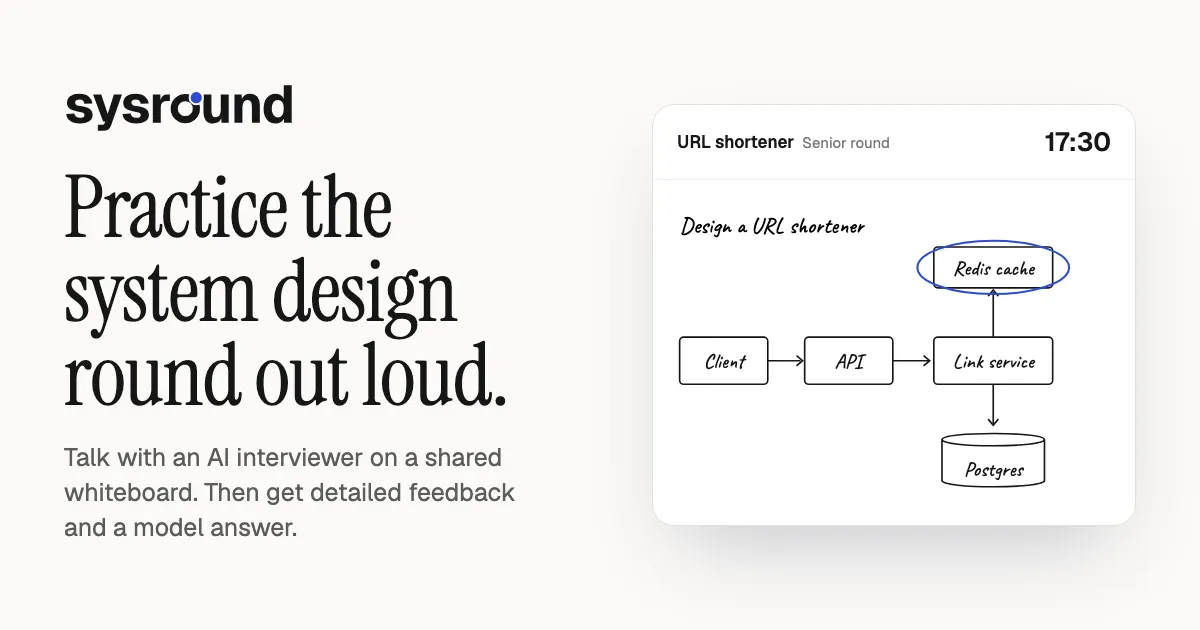
Alex is the AI interviewer for system design rounds. The interviewer listens to the candidate, challenges the design, and draws with the candidate on a shared whiteboard. Alex asks one question at a time and does not give the answer, which mirrors a real interviewer. The homepage shows an interview room with notes on the left, a shared whiteboard in the middle, and Alex on the right with a comment on a Redis cache. The mock interview is voice based, and the page notes that the candidate and Alex can talk at the same time, so the candidate can stop Alex and think out loud.
Timed round structure and level calibration
A mock round follows a timed structure that resembles an onsite interview. For a 45 minute round, the phases include requirements from 0 to 8 minutes, estimation from 8 to 12 minutes, API and data model from 12 to 18 minutes, high level design from 18 to 28 minutes, deep dives from 28 to 40 minutes, and wrap up and scorecard from 40 to 45 minutes. Candidates can choose 45 or 60 minutes when starting. The level selected changes the bar, the deep dives, and how much the interviewer leads. The platform covers mid level at L4 or E4, senior at L5 or E5, and staff at L6+ or E6+.
Evidence based scorecards and model answers
After a round, SysRound provides feedback that quotes what the candidate said or drew. The scorecard evaluates seven skills against the bar for the selected level. It shows important moments, better answers, and a model answer that starts from the candidate notes. The page also mentions a replay of the whiteboard minute by minute and a practice plan for the weakest skills. The grading process scores the round three times and uses the middle result, which is a reasonable attempt to reduce variability in AI feedback.
Free core tools and focused paid mock interviews
The question library, company pages, coding study plans, and workspace are free. Paid access is limited to mock interview rounds during the beta. The product does not use a subscription, and rounds do not expire. There are 2 free rounds of 45 minutes during the beta, followed by packs of 1, 5, or 12 rounds. This structure makes the platform easy to sample without payment and keeps the paid offer tied to a high effort activity, the live system design mock interview. The separate system design question library supports that paid workflow with 267 questions that include interviewer briefs, scope, numbers, deep dives, and level bars.
How It Works
A typical SysRound workflow begins with a company search or a study recommendation. The homepage invites candidates to enter a company name, browse popular companies, open coding study plans, or start a free AI mock interview. Sign in is handled with an email code, according to the final call to action. After sign in, a candidate can browse the question library, open a company page, or choose a study plan. The question library organizes content by category, so a candidate can move between coding, system design, machine learning, behavioral, and other round types.
For coding practice, the candidate opens a problem in the workspace. The left side of the workflow includes the problem statement, examples, and the code editor. The candidate can switch to notes or a whiteboard, and can request an AI hint if stuck. Study plans add sequence and progress tracking. A candidate marks problems as done and sees progress for each group. The plan pages explain how much time each plan is designed for and how to pace the work. Coding Patterns 150 is intended for six weeks or more, while Coding Core 75 is intended for two to four weeks with two or three problems each day.
For system design practice, the candidate starts a mock interview and chooses a duration and level. Alex opens with requirements, answers as a product owner would, and writes agreed points into the notes. The round moves through estimation, API and data model, high level design, deep dives, and wrap up. Alex reads the whiteboard while the candidate draws and asks about the design. At the end, the candidate explains what fails at higher traffic and how to detect it, then receives a scorecard. The feedback quotes the candidate own words and drawings, compares performance with the chosen level bar, and provides a model answer plus practice recommendations. Setup requirements are modest because the product runs in the browser. The page recommends a computer or tablet for voice rounds with a whiteboard, while questions, study plans, and the workspace work on a phone. SysRound can also be added to a phone home screen as a progressive web app, so it opens in its own window without an app store download.
Use Cases
A backend engineer with six weeks before a general software engineering loop can use Coding Patterns 150 to work through 18 pattern groups in order. The engineer marks problems as done and uses the workspace to write Python or TypeScript solutions. The value comes from sequence and repetition, because later groups build on earlier patterns. Instead of choosing random problems, the candidate follows a plan that covers 150 problems and tracks progress across groups.
A senior engineer preparing for an L5 or E5 system design round can use the URL shortener, distributed rate limiter, notification system, news feed, chat app, and ticket booking questions. The candidate starts a 45 minute mock with Alex, practices requirements and estimation out loud, draws the high level design on the shared whiteboard, and answers deep dive questions. After the round, the scorecard shows whether the design met the senior bar and where the candidate needs more work. The model answer and quoted feedback make the practice more concrete than a peer discussion without notes.
A machine learning engineer targeting AI labs or product teams can use the 965 machine learning questions and the ML system design category. The candidate can review questions about models, data, metrics, and ML systems, then switch to the coding workspace for implementation practice. SysRound does not currently offer AI mock interviews for ML rounds, so the ML value is concentrated in the question library and study material. That limitation is important for candidates who want live practice in every round type.
A candidate with two to four weeks before an interview can use Coding Core 75 and focus on two or three problems each day. The shorter plan is designed for limited time, and the group structure helps the candidate cover core patterns without building an unrealistic schedule. The workspace notes and AI hints support quick review sessions, while the company pages help the candidate prioritize questions associated with the target company.
A career switcher or front end engineer preparing for behavioral rounds can use the 594 behavioral questions to build stories about conflict, failure, leadership, and projects. The candidate can combine behavioral preparation with company research from the 489 company pages and with coding review in the workspace. The platform does not provide a live behavioral mock, but it gives structure and prompts that can be used with a peer or independently. SysRound also states that it should not be used to interview candidates or make hiring decisions, so its appropriate use is individual preparation.
Pricing & Value
The core study materials are free. SysRound does not charge for the question library, company pages, coding study plans, or practice workspace. During the beta, candidates receive 2 free rounds of 45 minutes. After that, the paid product is sold in packs of mock interview rounds. One round costs $29. Five rounds cost $99, which works out to $19.80 per round. Twelve rounds cost $199, which works out to $16.58 per round. There is no subscription, and the rounds do not expire. The site states that a round is taken only when it starts.
The value calculation depends on how much a candidate uses live system design practice. A single round at $29 is more expensive than most question banks, but it is far below the cost of human coaching or a specialized mock interview service. The five round and twelve round packs lower the per round cost and fit candidates who want repeated practice before a senior or staff loop. The free library and workspace make the product useful even without payment, which reduces the risk of trying it. The main limitation is that paid AI mock interviews currently focus on system design, so candidates who need live coding or ML practice receive less value from the paid packs. Full pricing details are available on the site.
Final Verdict
SysRound is a well structured interview preparation product with a clear point of view. Its strongest asset is the combination of a broad question library, company specific pages, coding study plans, and a workspace that supports code, notes, and whiteboard work. The AI system design interview with Alex is the standout feature because it turns passive review into a timed, spoken round with a scorecard and model answer. The free core tools and the two beta rounds make the product easy to evaluate. The no subscription model and non expiring rounds are also sensible for candidates who prepare in bursts.
The weaknesses are equally clear. AI mock interviews are limited to system design, so coding, machine learning, and behavioral rounds do not have the same live practice experience. Question sourcing depends on candidate reports and public lists, and the site correctly warns that a company tag does not guarantee the same question in a real interview. The $29 single round price may be high for candidates who only want occasional practice, although the packs improve the economics. Voice rounds with a whiteboard are also better on a computer or tablet than on a phone.
SysRound is best suited to software engineers preparing for mid level, senior, or staff loops who want a free question library and are willing to pay for realistic system design practice. It is especially relevant for candidates who want to rehearse requirements, estimation, API design, high level architecture, deep dives, and trade off discussions out loud. Candidates who need live coding mock interviews, human feedback, or a complete behavioral mock experience should look elsewhere or supplement SysRound with another service. As an AI practice tool, it offers good structure and useful feedback, provided users treat the scorecards as practice signals rather than hiring judgments.