
Overview
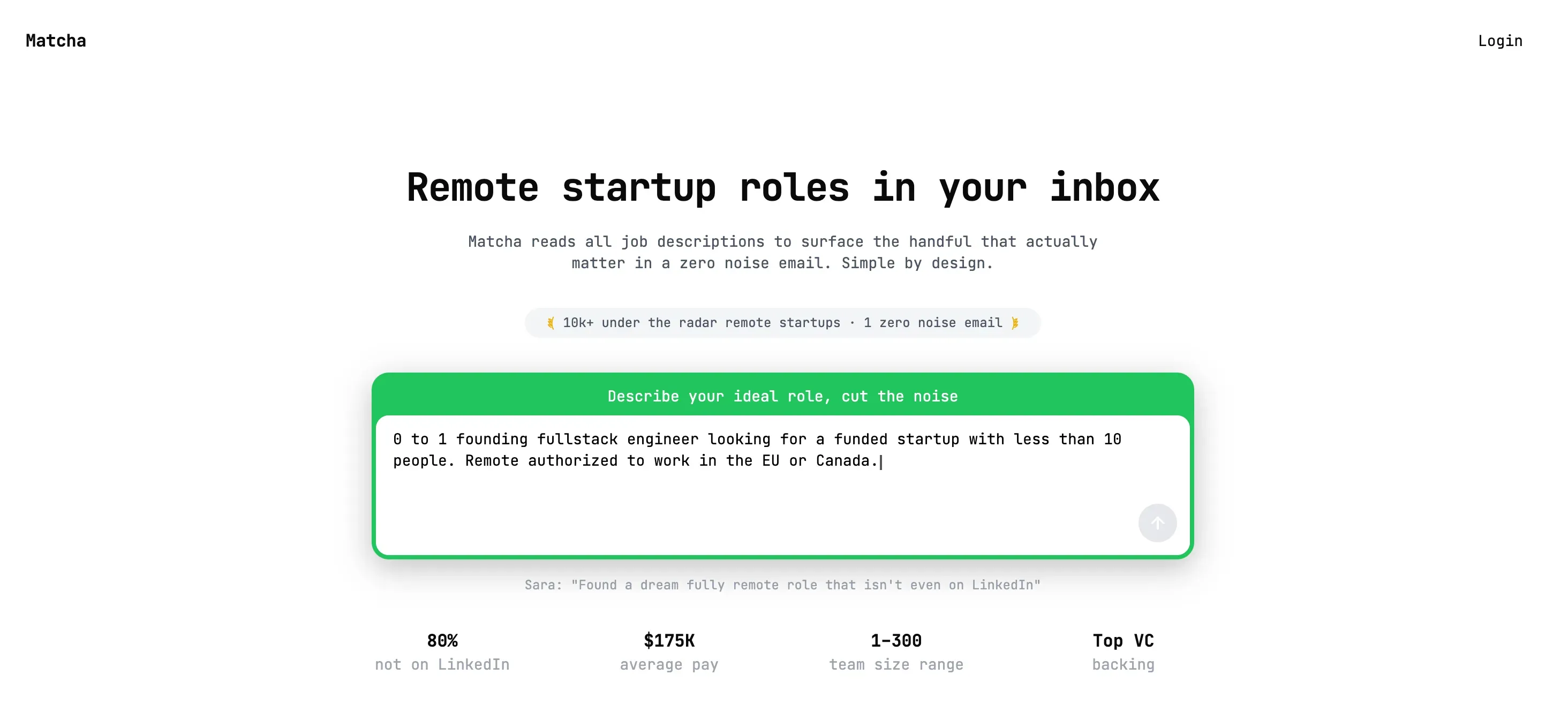
Matcha positions itself as a zero-noise alternative to traditional job search platforms, targeting professionals seeking roles at well-funded remote startups. The service scans over 10,000 under-the-radar startups daily, curating a handful of relevant positions into a single email. With an average salary of $175,000 and 80% of listed jobs not appearing on LinkedIn, Matcha addresses the pain point of information overload in the job hunt. The platform is built for experienced candidates who value quality over quantity and prefer a curated, low-friction approach. In a market dominated by broad aggregators like Indeed and LinkedIn, Matcha differentiates through extreme curation and focus on remote startup ecosystems backed by top venture capital firms.
Key Features
Daily Curated Email: The core delivery mechanism is a single email containing only the most relevant job matches based on the user's described ideal role. This eliminates the need to constantly check job boards or dashboards. The email is designed to be read in under two minutes, containing concise descriptions and direct application links.
Personalized Role Description: Users start by writing a detailed description of their ideal role in a textarea on the homepage. This input drives the matching algorithm, ensuring that only positions aligning with specific skills, industry preferences, and company culture are surfaced. The description can be updated at any time to refine results.
Under-the-Radar Startup Focus: Matcha exclusively lists jobs from startups that are not widely advertised. The service claims 80% of its listings are absent from LinkedIn, giving users access to unadvertised opportunities. The startups are pre-screened for factors like top VC backing, funding stage, and team size (1-300 employees).
Transparent Job Metrics: The homepage displays key statistics: average pay of $175,000, team size range of 1-300, and the percentage of jobs not on LinkedIn. These metrics are intended to build trust and set expectations for the quality of listings.
Simple Interface: The website itself is minimal, with a header linking to "Matcha" and a call-to-action to explore current job listings. The design prioritizes the description input and statistical proofs, reflecting a focus on conversion rather than browsing.
Zero Spam Promise: Matcha emphasizes a "zero noise" experience, meaning no promotional emails, irrelevant listings, or push notifications. The email is sent only when there are matches worth sharing, which could be daily or less frequently depending on the user's profile.
No Dashboard Browsing: Unlike traditional job platforms, Matcha does not offer a searchable database. Instead, it relies entirely on the email delivery model. This reduces feature creep but also limits user control over filtering and exploration.
How It Works
The user journey begins on the homepage, where the primary action is to describe an ideal role in a textarea field. After submitting this description, Matcha processes it against its database of over 10,000 remote startups. The system evaluates factors like job title, required skills, company stage, and location preferences. The matching likely employs keyword and semantic analysis to align user input with job descriptions. Once a match is found, the user receives a daily email containing typically a handful of positions. Each email includes job titles, company names, salary ranges, and a brief description along with application links. Users can apply directly from the email. The service does not require signup beyond providing an email address, as indicated by the placeholder "Describe your ideal role, cut the noise" and the disabled submit button (likely enabled after input). The onboarding is frictionless, requiring no profile creation or resume upload. However, the lack of a dashboard means users cannot see all available jobs at once; they must rely on the daily curation. This design is intentional to reduce cognitive load but may frustrate users who want to explore manually.
Use Cases
Senior Software Engineer Seeking Startup Exit: A developer with 10+ years of experience wants to join a series A startup with equity potential. Matcha filters out large corporations and early-stage risky ventures, focusing on well-funded startups with 1-300 employees and top VC backing. The engineer describes their ideal stack (e.g., Python, AWS) and receives openings at companies like those in Y Combinator or a16z portfolio.
Product Manager Transitioning to Remote: A PM at a mid-sized company wants to switch to a fully remote role in a high-growth startup. Matcha's emphasis on remote-only and salary transparency ($175K average) helps them find roles that match their compensation expectations and location independence.
Founder Looking for Co-Founder Roles: A startup founder interested in joining another early-stage company as a technical co-founder can use Matcha to find opportunities that explicitly seek co-founders or early hires. The description can include "co-founder" or "founding engineer" keywords to surface relevant matches.
Career Changer Exploring New Industries: A professional with transferable skills (e.g., marketing manager wanting to move to SaaS product marketing) can describe their ideal role without needing to specify exact job titles. Matcha's algorithm may surface roles at startups that value diverse backgrounds.
Freelancer Seeking Full-Time Return: A freelancer looking to stabilize income by taking a full-time position at a startup can use Matcha to find roles that offer equity and competitive salary. The curated email keeps them from getting overwhelmed by the thousands of listings on general job boards.
Pricing & Value
Matcha is currently free to use, as there is no mention of pricing or payment on the homepage. The service likely monetizes through future premium tiers or employer sponsorships, but as of now, users can sign up at no cost. This makes it an exceptionally low-risk option for job seekers. Compared to alternatives like Vettery (now part of The Mom Project) or Hired.com (which often require employer-side fees), Matcha's zero-cost model is a strong differentiator. However, the free model raises questions about sustainability and potential future pricing changes. If premium features are introduced (e.g., advanced filters, instant notifications), they may add value but could also create a tiered experience. For now, the value proposition is clear: access to curated, high-salary remote startup jobs without any upfront cost.
Final Verdict
Matcha excels at solving information overload for job seekers targeting remote startup roles. Its curated email approach, combined with a focus on well-funded companies not on LinkedIn, provides genuine value for experienced professionals. The average salary transparency and VC backing metrics build credibility. However, the service's limited scope (startups only, primarily remote) means it is not suitable for everyone. Corporate job seekers or those preferring a hands-on dashboard will find it lacking. Additionally, the reliance on a single text description for matching may exclude candidates who have diverse or evolving preferences. Overall, Matcha is a solid addition to a job seeker's toolkit, particularly for those in tech who value curation over volume. It is recommended for anyone actively seeking a remote startup opportunity and willing to trust an algorithm's filter.
For more details, visit Matcha's homepage or browse current job listings. The service also provides statistics about its job pool to set expectations.