
Overview
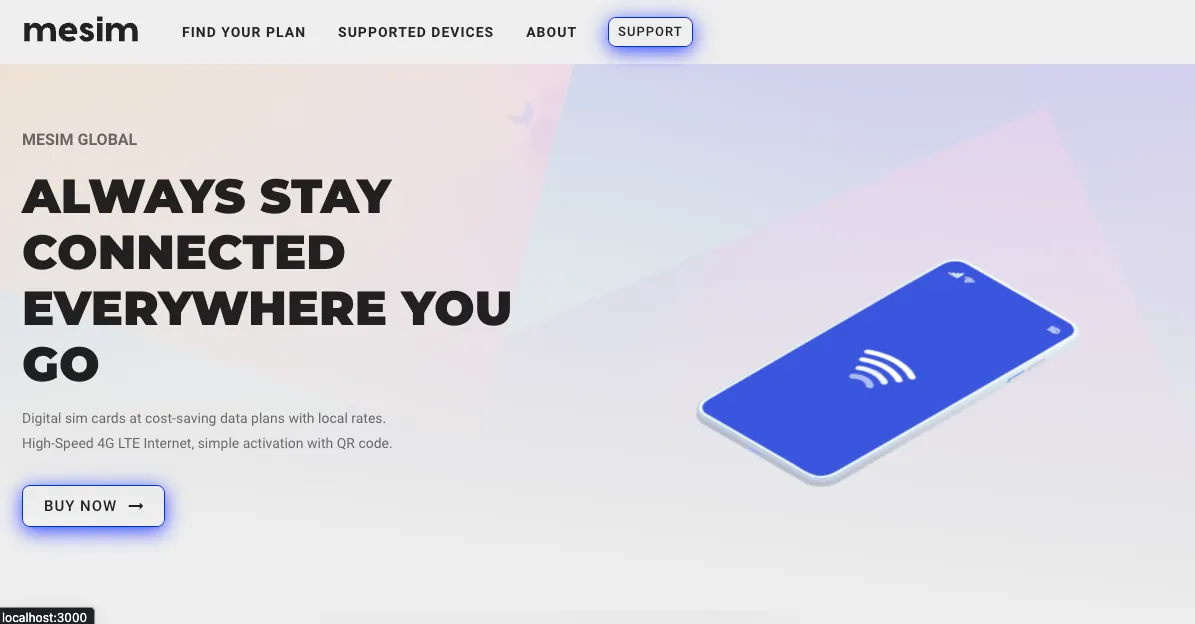
MeSIM is a prepaid travel eSIM storefront aimed at leisure and business travellers who want mobile data waiting on their phone the moment they clear arrivals. The product is a catalogue of digital SIM profiles sold per destination, per region, or globally, each bundled with a fixed data allowance and a validity window, and delivered electronically rather than as physical plastic.
The problem it addresses is familiar to anyone who has landed in a foreign airport and weighed three bad options: roaming charges from a home carrier, a kiosk queue for a local prepaid SIM, or an expensive airport vending machine. An eSIM solves the mechanics by installing a profile onto an unlocked handset before departure, but the market that formed around that capability is crowded and price opaque. Airalo, Holafly, Saily and Roamless all compete for the same wallet, and each prices the same nominal 10GB allowance differently depending on destination.
MeSIM's positioning is explicitly price led. The homepage leads with a comparison table that sets its own 10GB thirty day plans against matched Airalo and Saily offers and against Holafly's unlimited product, with three worked examples in Australia, Japan and the United States. It is a narrow claim, deliberately qualified, and the qualifying text is present rather than buried. The brand also sells itself as a full itinerary tool rather than a single country shop, with regional, global, unlimited and phone number variants all reachable from the primary navigation.
The target buyer is the independent traveller who is comfortable installing an eSIM unaided, compares prices before committing, and wants one vendor for a multi country trip. The comparison set is therefore app based resellers on one side and unlimited data specialists on the other, with MeSIM claiming the lower price slot on fixed allowance plans.
Key Features
Destination catalogue spanning 200+ markets. The core inventory is a per country plan list, with dedicated landing pages for each destination that expose data allowance, validity period, price and network partner details in one view. Plans are named in a predictable pattern, so a buyer can move from a country page to a specific allowance without guessing at naming conventions. A dedicated destination browser organises the catalogue for anyone who has not yet decided on a plan.
Price comparison tables with dated, sourced competitor figures. The homepage publishes a table that places MeSIM, Airalo, Holafly and Saily side by side for identical thirty day windows. MeSIM quotes US$12.99 for 10GB in Australia and Japan, and US$16.49 for the United States, against Airalo at US$18.00, US$18.00 and US$22.50 respectively and Saily at US$17.99, US$17.99 and US$22.99. Every competitor figure is footnoted with an outbound link to the exact product page and a stated check date, which is unusually verifiable for marketing collateral.
Unlimited data plans as a separate product line. A distinct unlimited section exists for travellers whose usage pattern makes a fixed allowance impractical, such as navigation heavy road trips or remote work tethering. MeSIM is careful to state that Holafly's unlimited product is not identical to a fixed 10GB offer and that fair use policies and hotspot limits apply, which is the kind of disclosure that avoids later disputes.
Phone number eSIMs. Beyond pure data, the catalogue includes plans that provision a phone number, covering use cases where data only connectivity is insufficient, for example receiving verification codes or making local calls. This is a meaningful differentiator against data only resellers and moves the product closer to a replacement for a local SIM.
Regional and global coverage passes. Multi country itineraries can be handled with a single regional profile or a global pass instead of stacking several country plans. This reduces the administrative overhead of activation and keeps one balance and one expiry date for the whole trip, which matters for travellers crossing borders weekly.
Instant digital delivery and a pre departure install flow. Purchase completes online and eSIM credentials are issued digitally, with the explicit instruction to install before flying and to enable the profile only on arrival. That sequencing is the correct one technically and is presented as a four step process rather than left to the buyer to discover.
Comparison and guide content hubs. Separate pages compare MeSIM against Airalo, Holafly and a combined Roamless versus Airalo versus Holafly versus MeSIM analysis. A guides hub covers installation and roaming practice, and a travel data price index extends the pricing transparency beyond the three featured markets.
How It Works
The journey begins with destination selection rather than account creation. A traveller either searches a country directly or uses the destination browser, then lands on a plan page that lists allowance options with validity and price. Plan naming is consistent enough that a 10GB thirty day profile is identifiable from the label alone, and network partner information is displayed alongside commercial detail so the buyer can sanity check coverage before paying.
Once a plan is chosen, checkout is a conventional online purchase with no subscription commitment. Payment completes and the eSIM credentials arrive digitally, typically as a QR code and manual activation string. MeSIM's stated sequence is to install the profile on a compatible, carrier unlocked handset before travel, leave it disabled while at home, and switch it on after landing so the device attaches to a supported local network.
The technical prerequisites are stated plainly: the handset must be eSIM capable and unlocked. MeSIM maintains a device compatibility list to answer that question before purchase, which removes the most common cause of post purchase failure. There is no separate app requirement described on the site, so the product behaves as a web storefront plus native device eSIM support rather than a standalone application ecosystem.
Daily use thereafter is passive. Data is consumed against the purchased allowance, the validity clock runs from activation, and top ups, where offered, are handled through the same storefront. For a multi country trip, the user simply activates the regional or global profile once and lets it roam across included networks, avoiding a second installation mid journey.
Use Cases
The two week Japan and Australia holidaymaker. A traveller flying into Tokyo and out of Sydney needs two separate profiles or one broader pass. With MeSIM's published pricing, 10GB in Japan at US$12.99 and 10GB in Australia at US$12.99 totals under US$26 for thirty day windows, against roughly US$36 at the matched Airalo prices. The saving is modest in absolute terms but arrives with no kiosk time and no language barrier at a foreign counter.
The United States road trip family. A multi state driving itinerary consumes data on navigation, fuel price lookups and accommodation changes. MeSIM's US plan at US$16.49 for 10GB sits about US$6 below the matched Airalo and Saily offers, and the buyer can pre install on arrival day, avoiding a roaming bill that frequently runs well above US$10 per day on home carriers.
The consultant on a three country week. A professional visiting Singapore, the United Arab Emirates and the United Kingdom in five days has no appetite for three separate purchases. A regional or global profile covers the itinerary with one activation, and the phone number option handles inbound calls from clients who do not use messaging apps.
The long stay remote worker. Someone spending a month in one country and tethering a laptop periodically is better served by the unlimited line than by metering a fixed allowance, provided the fair use and hotspot constraints are read first. MeSIM surfaces those caveats rather than hiding them, so the trade off is visible before payment.
The price sensitive first time eSIM buyer. A traveller who has never installed a profile benefits from the guides hub and the device checker, then from a comparison table that shows exactly what the alternatives charge for the same nominal product. That combination lowers the risk of a first purchase gone wrong.
Pricing and Value
MeSIM does not publish tiered subscriptions or a monthly plan structure. The model is transactional: a single prepaid purchase per plan, priced in US dollars and varying by destination and allowance. The visible price points are US$12.99 for 10GB over thirty days in Australia and Japan, and US$16.49 for the United States variant. Unlimited, regional, global and phone number products are priced separately and are not disclosed in the homepage table.
There is no free tier, no trial and no stated refund window on the material reviewed. Value therefore rests entirely on per gigabyte cost and on coverage breadth. On the three sampled markets the position is clear: at US$12.99 against US$17.99 to US$18.00 for matched fixed plans, MeSIM undercuts the two largest app based resellers by roughly 28 percent, and by about 26 percent on the US plan. Against Holafly's unlimited offers the comparison is not like for like and MeSIM says so, since an unlimited allowance with fair use throttling is a different product from 10GB.
Buyers should treat the three examples as illustrative rather than comprehensive. The site itself notes that not every plan or destination was compared and that MeSIM may not be cheaper on every offer, which is an honest limitation. Anyone considering a destination outside the sample should verify cost per gigabyte directly on the country pages.
Final Verdict
MeSIM is a competent, transparently priced entrant in a market where opacity is the norm. Its strongest asset is the comparison discipline: named competitors, linked source pages, dated price checks and explicit caveats about unlike for like products. That is rarer than it should be. The breadth of the catalogue, covering single countries, regions, global passes, unlimited profiles and phone number plans, means a traveller can consolidate a whole itinerary with one vendor instead of juggling three apps.
There are real gaps. The public pricing surface is thin, with only three countries worked through in detail, and the absence of any stated trial, refund policy or visible support tier structure makes the purchase feel irreversible. The brand is also young, carrying launch badges from directories such as SaaSCity and Fazier rather than the review volume that established resellers have accumulated, so first time buyers are trusting a comparison table rather than a track record.
The product suits price aware, technically confident travellers with unlocked handsets who are willing to read a plan page before paying, and it suits multi country itineraries where one vendor simplifies activation. It suits less well anyone who wants a money back guarantee, an in app account ecosystem or a long history of independent reviews. For everyone else, the honest recommendation is straightforward: treat the published table as a starting point, browse the destination catalogue for the actual cost, compare unlimited travel eSIMs if metered data looks restrictive, and check the supported devices list before committing. On the evidence available, the fixed allowance plans are the value story and the comparisons are the reason to trust the pricing.