
Overview
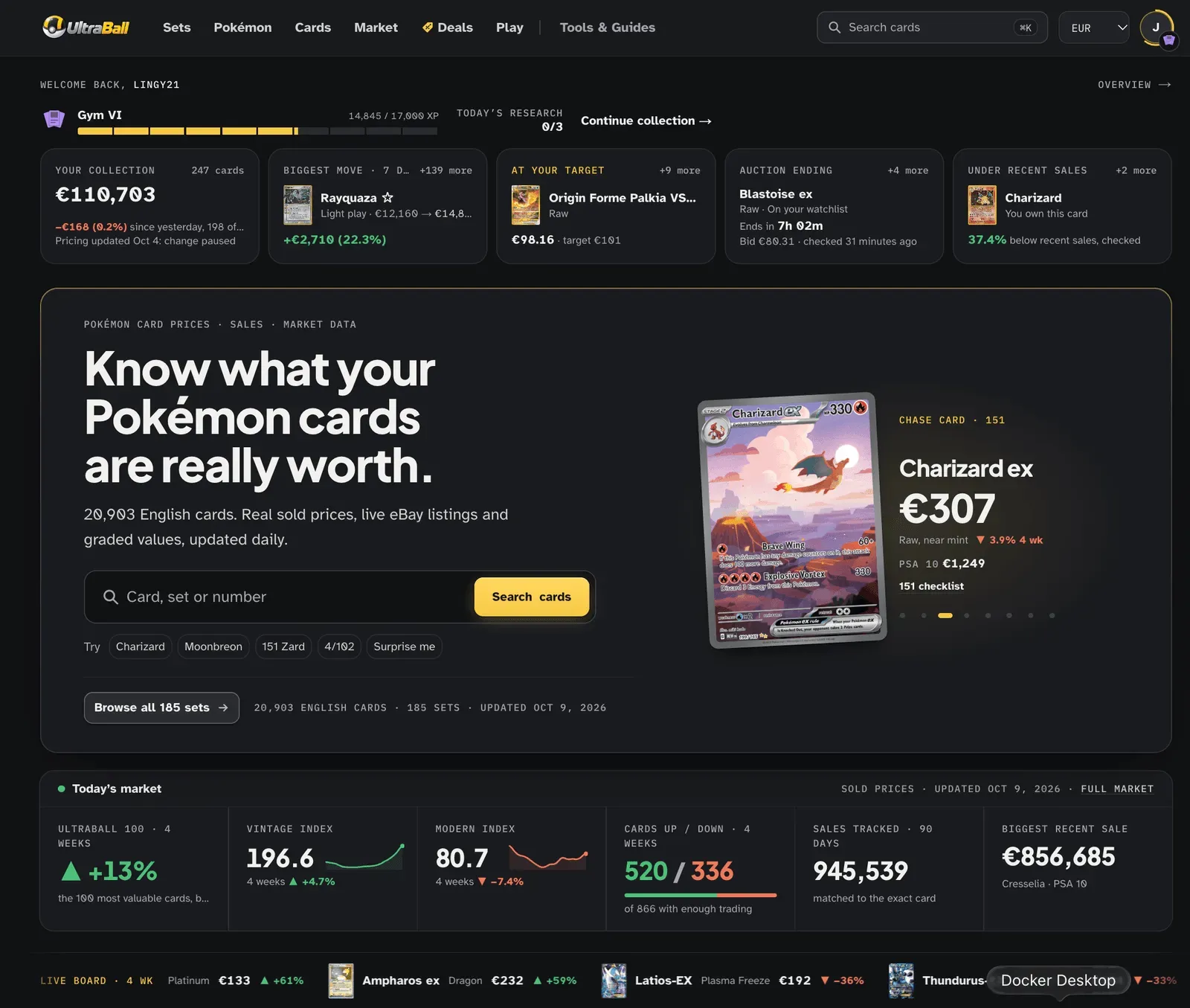
UltraBall is a market data platform built around the English Pokémon trading card game, cataloguing 20,903 cards across 185 sets and pairing every entry with ungraded prices, graded valuations, recorded sales and price history. The service is aimed at collectors, resellers, graders and hobby investors who want a defensible number before buying, selling or submitting a card for professional grading. Rather than behaving like a traditional checklist archive, the homepage reads like a pricing terminal: index values, sale counts, liquidity signals and record transactions appear above the fold.
The problem UltraBall addresses is fragmentation. Card values for English Pokémon product are scattered across auction archives, forum threads, marketplace sold listings and static price guides that frequently go stale. Those sources disagree with each other, blend raw and graded results together, and rarely state how much evidence sits behind a quoted figure. UltraBall's response is to attach transaction context to each price, separating unslabbed cards from graded ones and keeping each grading company in its own lane.
The breadth of the structured data is notable. Alongside the card and set index, the site maintains pages for 1,025 Pokémon species, era groupings running from the 1999 Wizards of the Coast releases to the current Mega Evolution block, rarity tiers, illustrator credits, Trainer characters and community nicknames such as Moonbreon or Bubble Mew. That taxonomy matters because collectors rarely search by card number alone. Someone hunting a Crystal Charizard or a Van Gogh Pikachu needs the database to understand shorthand, and UltraBall does.
The homepage carries the same disclaimer found on many hobby data services: UltraBall states it is an independent collector resource and is not affiliated with, sponsored by or endorsed by Nintendo, Creatures, GAME FREAK or The Pokémon Company. Values are presented as estimates rather than offers to buy or sell, which is an important framing for anyone treating the numbers as investment guidance.
Key Features
Daily refreshed card and set database. The core index covers 20,903 English cards spread over 185 sets, with a stated update cadence of daily and a visible last-refresh date. Each set page carries an aggregate set value, a designated chase card and a card count, which gives collectors a fast read on where a sealed box or a complete run stands financially.
Sales-backed pricing with confidence and liquidity marks. UltraBall does not simply publish a number. Every card page shows recent sales, how many copies transacted, how recently they moved and how easily a card in that condition actually sells. The methodology page splits listings still for sale from completed sales, so asking prices do not pollute the value estimate. Thin evidence is labelled rather than hidden, which is the single most useful design decision on the platform.
Graded prices separated by grader and grade. PSA, CGC, BGS, SGC and TAG results are never blended into a single graded average. Each grade ladder is generated for that exact grader and grade, with its own supporting sales. For collectors weighing a submission, that separation is essential, because a PSA 10 population is not interchangeable with a CGC 10 Pristine population.
Market indexes and the UltraBall 100. The platform publishes composite indexes including Vintage, Modern, PSA 10, Raw and a Charizard index, plus a flagship UltraBall 100. The homepage displays a vintage index reading of 196.6 against a modern index of 80.7, giving hobby participants a rough barometer for how older printings are performing relative to contemporary releases.
Deal and auction tooling tied to live eBay data. A dedicated deals section aggregates eBay listings, highlights auctions ending soon, surfaces new listings and flags price drops. Specialised views include Sniper for auctions with a maximum bid, Slab Hunter for raw cards that look worth grading, and a What can I buy tool for budget-constrained buyers. Watchlists, alerts and a Grail Radar round out the monitoring layer.
Grading, centering and valuation utilities. A toolkit collects an AI card grader, a card centering tool, a grading calculator, a selling calculator and a collection tracker in one place. A set symbol identifier and a nickname search help users who cannot name the card in front of them. Each utility is narrow, but together they cover the practical steps between finding a card and deciding what to do with it.
Engagement layer built on the same dataset. The play section adds a daily card challenge, a fantasy portfolio with leaderboards, a pack simulator, a luck checker, Collector Routes, achievements and an annual Wrapped recap. These features do not change the underlying data, though they give the platform a reason to be revisited on quiet days and provide a low-stakes way to learn how set composition and pull rates work.
How It Works
Access begins on the homepage, where a primary search field accepts a card name, set or collector number, with example chips for Charizard, Moonbreon, 151 Zard and the numeric query 4/102. A keyboard shortcut opens the same dialog from anywhere on the site. Roughly thirty currencies can be selected from a dropdown, so international collectors can read values in their own denomination without manual conversion.
No account is required to browse. A visitor can move from the landing page into a set page, then into an individual card page, and read ungraded pricing with a four-week change, a graded price ladder, a price chart, liquidity and confidence marks and a list of recent sales. Navigation menus organise the catalogue four ways: by set, by Pokémon, by card attributes such as rarity and nickname, and by market view. Era pages group sets chronologically for collectors who think in generations rather than product codes.
Onboarding into the more personal features is gradual. Creating an account unlocks a watchlist, price alerts, a collection tracker, set completion progress and the fantasy portfolio. From there, routine use tends to settle into a loop: check the market overview for index movement, review the most traded list for liquidity, add candidates to a watchlist, set an alert threshold, then act on a flagged eBay listing. The set completion view converts the browse experience into a checklist with progress states.
Setup requirements are minimal, since the product runs in the browser with no desktop installation, no browser extension and no documented API key. The heaviest lift is data entry for collection tracking, which is a manual process unless a user restricts the tracker to a handful of high-value cards.
Use Cases
The returning collector with a loft binder. Someone who rediscovered a stack of 1999 and 2000 cards needs to know whether the Charizard and Blastoise in front of them are Shadowless, Unlimited or First Edition printings before any valuation is meaningful. The guides section covers printings, errors and counterfeits, while the card pages give a price band for each variant, so a rough inheritance can be triaged in an afternoon rather than outsourced to a dealer at a discount.
The modern set completionist. A collector chasing the full Ascended Heroes checklist can use set pages to see the aggregate set value, the designated chase card and the total card count, then track personal progress through the collection tool. Because the most traded table shows 90-day sale volume for cards like Mega Gengar ex and Mega Dragonite ex, the collector learns which missing cards are easy to source and which rarely surface.
The part-time reseller working eBay margins. A hobbyist buying raw cards and flipping them needs both a purchase ceiling and a realistic resale price. Recent sales data establishes the sale price, the selling calculator estimates net proceeds after fees, and the deals and price drops feeds highlight listings that sit below prevailing market value. Slab Hunter targets the specific arbitrage of raw cards whose graded value exceeds the cost of submission.
The collector deciding on a submission. Grading costs money and time, so the decision hinges on centering, surface condition and the gap between raw and graded pricing. The centering tool and AI card grader address the condition side, the graded price ladders quantify the upside, and the PSA grading cost guide frames the expense. UltraBall also publishes population-sensitive lists such as low pop cards, hardest PSA 10s and most PSA 10s added, which reveal where grading difficulty is concentrated.
The hobby investor tracking a portfolio. Someone holding a spread of vintage and modern cards can follow the Vintage, Modern, PSA 10 and Raw indexes to see which segment is moving. Setting index movements against the sales tracked figure, which stands at more than 925,000 transactions over a 90-day window, gives a sense of how much liquidity actually exists behind those headline numbers.
Pricing & Value
The homepage does not display subscription tiers, credit packs or gated feature levels. Every section, from the 20,903-card index to the calculators and the play features, appears reachable without a paywall, and there is no visible pricing page on the site. The commercial model instead appears tied to outbound marketplace activity, since the deals, auctions, new listings and price drop sections route users toward live eBay inventory.
That structure makes the value proposition straightforward for hobbyists. Comparable paid price-guide services typically charge monthly fees for graded sales histories or portfolio tracking, and UltraBall delivers a similar depth of transaction context at no visible cost. The absence of a documented API or bulk export is the main limitation of the free model, since developers and analysts wanting programmatic access have no published route.
For casual collectors the trade-off is acceptable. Anyone needing guarantees about uptime, data licensing or long-term availability may find the affiliate-supported model less reassuring than a paid subscription with a service-level commitment.
Final Verdict
UltraBall is one of the more thoughtfully structured Pokémon price resources currently available. The decision to keep graded values separate by grading company, and to publish liquidity and confidence marks next to each price, puts it ahead of the blended averages common on hobby sites. The surrounding catalogue is genuinely deep, covering 185 sets, more than a thousand Pokémon species, rarity tiers, illustrators and community nicknames, and the tool suite extends usefully into grading decisions.
There are real gaps. Coverage is explicitly English-language, so Japanese exclusives and other regional printings sit outside the dataset. Pricing depends on matched marketplace sales, which means thinly traded cards will always carry softer evidence even when that softness is labelled clearly. The lack of a published API, export facility or documented pricing plan also limits adoption by developers and analysts.
Collectors, resellers and graders working primarily with English product will find the platform useful on a weekly basis, particularly for grading decisions and for judging whether a listing is genuinely cheap. Anyone trading Japanese-only cards, or requiring programmable access to historical price data, should treat UltraBall as a reference point rather than a primary system. For the audience it targets, the combination of depth, transparency and free access is difficult to match.