
Overview
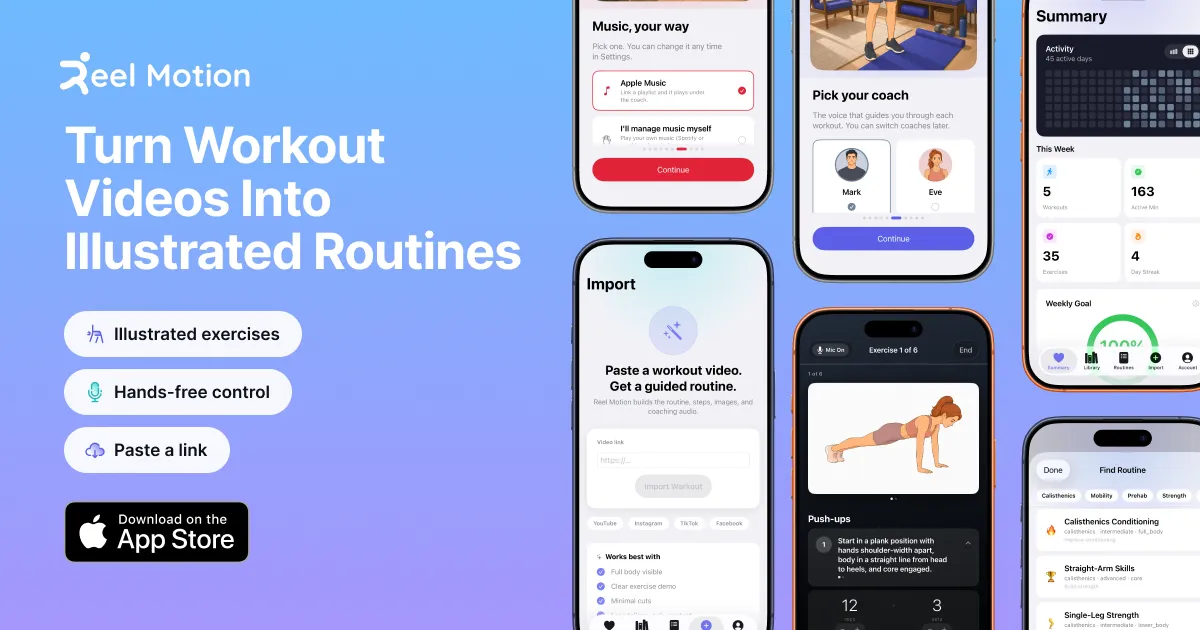
Reel Motion is an iOS and iPadOS application that converts workout videos published on YouTube, Instagram, and TikTok into structured, illustrated exercise routines. A saved link is pasted into the app, and the software reads the footage, extracts the movements, redraws them as start and finish position illustrations, and serves the result as a guided session with timers and spoken cues. The product targets home trainees, gym members, and casual fitness audiences who collect clips from social feeds but rarely follow them in real time. It also suits anyone training without a coach present. Billing runs through three subscriptions: weekly at $4.99, monthly at $19.99, and annual at $59.99, which works out to roughly $5.00 per month. Family plans start at $7.99 per week and can be shared with up to six people through Apple Family Sharing. Every tier unlocks the full application.
Key Features
Link-based video import. The workflow starts with a share action rather than a manual entry form. A link from YouTube, Instagram, or TikTok is submitted, and Reel Motion parses the video to identify the exercises inside it. The claim is that the app reads the video once so the user does not have to pause, rewind, or take notes during training.
Illustrated exercise breakdown. Each movement in a generated routine is drawn as a start and finish position, rather than relying on a still frame pulled from the source clip. The subscription includes unlimited illustration redraws, which matters for exercises that are hard to parse from a single angle.
Hands-free control and coach audio. Voice commands such as start, next, and done drive the player, so the phone can stay on the floor or on a stand during a set. A spoken coach narrates each step while music continues playing in the background, a detail aimed squarely at people who train to their own playlists.
Guided player with session tracking. The player presents one exercise at a time with step-by-step instructions and timers. After a session, the app surfaces weekly minutes, streaks, and session history, turning imported clips into something closer to a training log than a video queue.
Apple Health and HealthKit integration. Completed workouts write directly into Apple Health. For users who already track activity on Apple Watch or an iPhone, this keeps fitness history consolidated instead of creating a second, isolated record.
Routine library and cross-device sync. A browsable library lets users pull in routines that other people have imported, or assemble their own from scratch. Routines sync across iPhone and iPad, which supports the common pattern of programming on a larger screen and running the session on a phone.
Use Cases
A frequent scenario is the saved-clip problem. Social platforms are full of mobility flows, kettlebell circuits, and follow-along sessions, but a bookmark is not a program. Reel Motion turns a backlog of saved links into a runnable sequence with instructions attached, which is useful for anyone who curates workout content faster than they complete it.
The second scenario is a distraction-free training floor. Because control is verbal, the device does not need to be touched mid-set, which suits garage gyms, hotel rooms, and commercial gyms where reaching for a phone breaks cadence. Music continues uninterrupted, so the session does not require switching audio sources.
The third is household training. Family Sharing support for up to six people suggests the developer expects shared accounts, letting partners or flatmates run separate routines from a single plan while each account keeps its own history.
Differentiators
Most fitness applications either stream a coach's video or catalogue static exercises. Reel Motion sits between the two by treating an external video as source material and producing a new artefact: an illustrated, narratable routine that exists independently of the original clip. The combination of voice-driven playback, illustration redraws, and Apple Health write-back is what separates it from a simple video player with timers.