
Overview
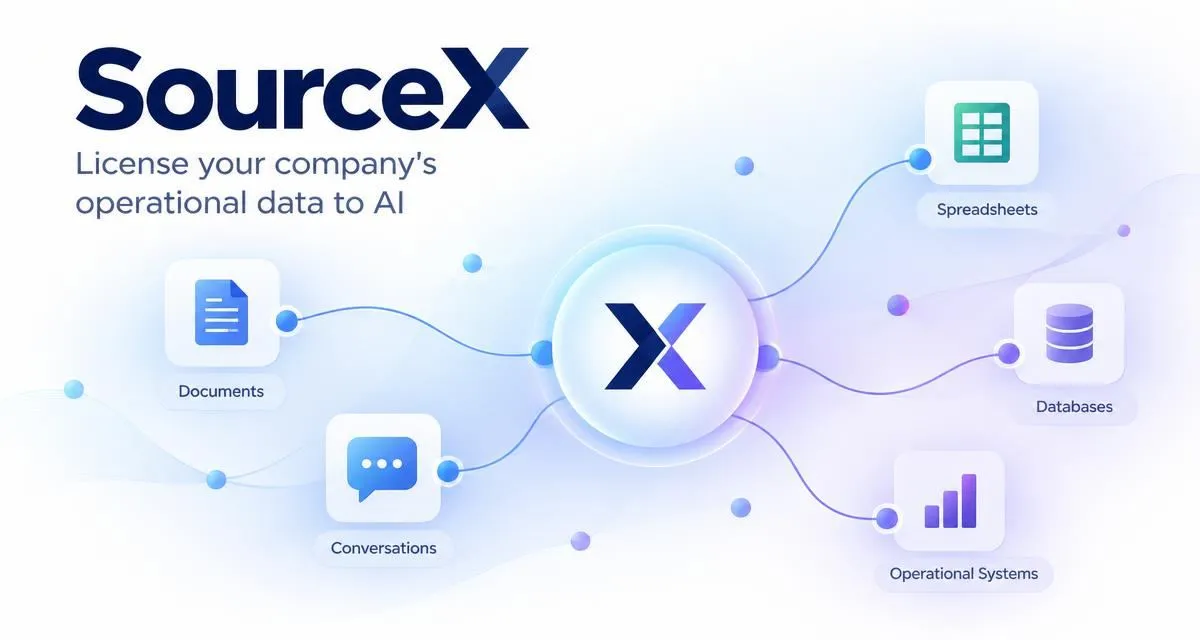
SourceX is an enterprise data transaction layer built to move operational business records into the hands of AI developers. Headquartered in Los Angeles, California, the company positions itself between two groups that rarely negotiate directly: businesses that generate enormous volumes of internal work records, and the AI labs that need that material to train and refine models.
The core thesis is straightforward. Most openly available text has already been consumed by model training pipelines, and much of what remains is duplicated, low quality, or restricted by license. Meanwhile, the richest record of how real work actually happens, support ticket threads, sales cycles, engineering histories, legal negotiations, and internal documents, sits inside private systems at companies that have no practical mechanism for selling it. SourceX exists to close that gap with a managed process covering sourcing, rights review, preparation, contracting, delivery, and payment.
The target supplier profile is narrow and explicit. SourceX is designed for organizations with 50 or more full-time employees at peak headcount, based in the United States, Canada, or the European Union, with several years of operating history. Companies that are still operating, have been acquired, or have wound down all qualify. On the demand side, the platform lists model developers such as OpenAI, Meta, Google, Anthropic, and Amazon as buyer profiles, while stating plainly that it is not affiliated with or endorsed by any of them.
Competitive context matters here. Alternatives include direct enterprise data partnerships brokered in-house, crowdsourced annotation and data vendors, and general-purpose data marketplaces. SourceX differentiates by owning the entire transaction rather than operating as a passive listing board, and by making supplier authorization a hard gate before any release. The company frames the market as a scarcity problem: rights-cleared, real-world data is genuinely uncommon, and scraped alternatives carry legal and reputational exposure that AI developers increasingly avoid.
Key Features
Full transaction lifecycle management. The platform handles sourcing, rights, preparation, contracts, and delivery through a single relationship rather than distributing responsibility across separate vendors. A five-stage workflow runs from supply through rights, preparation, approval, and delivery, with each stage documented before release. This structure means a supplier does not need to build its own legal, privacy, and delivery apparatus around a data sale.
Rights review before any license. Every dataset is reviewed for licensing rights prior to being offered. Suppliers provide confirmation, and the review record becomes part of the packet. This is a meaningful distinction in a market where provenance disputes have become a recurring source of litigation, and it gives AI buyers a documented chain back to the original rights holder.
Privacy preparation and de-identification. The site describes a preparation stage in which personal details are removed from records before sharing. An illustrative example shows a text fragment where a name and company reference are replaced with bracketed placeholders, signalling entity substitution rather than simple deletion. The preparation record is dataset-specific and travels with the packet.
Supplier-controlled release gates. Nothing leaves the originating company until explicit authorization is given. Scope must be defined and approved, and the platform describes release as requiring supplier authorization as a formal step. The messaging is consistent throughout: the data owner decides what is shared, how buyers may use it, and when it moves.
Broad source system compatibility. The platform lists exports and records from customer and support tools including Zendesk, Intercom, Salesforce Service Cloud, ServiceNow, Genesys Cloud, NICE CXone, Five9, and Amazon Connect. Sales and CRM coverage spans Salesforce Sales Cloud, HubSpot, Microsoft Dynamics 365, Pipedrive, Gong, Chorus, Zoom Revenue Accelerator, and Salesloft. Engineering and IT sources include GitHub Enterprise, GitLab, Bitbucket, Azure DevOps, and Jira. Documents and knowledge systems cover SharePoint, Google Drive, OneDrive, Box, Confluence, and Notion, while finance, legal, and operations sources include NetSuite, QuickBooks Online, Xero, Sage Intacct, iManage, NetDocuments, DocuSign CLM, Ironclad, Procore, and Autodesk Construction Cloud.
Structured dataset catalog. The data library organizes offerings into recognizable categories rather than abstract buckets. Support and communication datasets focus on conversations that resolve problems, including cases, escalations, and expert responses. Workflow and engineering datasets capture decisions with the context behind each action, framed as context, action, and outcome. Documents and knowledge datasets cover approved documents, structured records, and domain knowledge accumulated through operations.
Fit assessment and trust documentation. A short qualification flow asks about headcount, years operating, current status, industry, and available data types. It requires no uploads and no commitment. Alongside this, a dedicated trust center and a published legal framework document security posture, deal terms, and the boundaries of what the platform does with supplier records.
How It Works
The entry point is a qualification check rather than a contract. A prospective supplier answers five questions covering full-time employee count at peak, years of operating history, company status, industry, and the types of data available. The interface clearly states that no files are uploaded during this stage, and that estimates are indicative only. Progress is tracked with a percentage indicator, and the flow is deliberately short, described as taking a few minutes to establish fit.
If the fit check suggests a match, SourceX moves into sourcing, where relevant business records, scope, and potential licensing fit are defined. This is followed by rights review, then preparation, where personal details are removed and a dataset-specific preparation record is generated. Approval is the next gate, and the platform is explicit that release requires supplier authorization. Delivery follows, after which payment is issued according to the signed agreement.
The user experience leans on visual state rather than jargon. An illustrative transaction panel shows stages marked in review, with progress bars and status labels, and the interface repeatedly labels conceptual material as illustrative so that no diagram is mistaken for a live deal. A walkthrough video of roughly 56 seconds shows real platform screens with labelled examples, covering the path from first check to payment. The overall design decision is to demystify an unfamiliar transaction type, since most companies have never licensed internal records for AI training and have no reference point for how the process should feel.
Use Cases
A mid-sized customer support organization running Zendesk and Intercom accumulates years of resolution threads, escalation notes, and agent responses. That corpus shows how problems move from first contact to closure, including the dead ends and reformulations that pure documentation never captures. Licensing it gives model developers a behavioural record of troubleshooting rather than a static knowledge base.
A BPO or contact center operator with several hundred agents holds call recordings and structured interaction logs across Genesys Cloud or Five9. The operator has already invested in quality monitoring and compliance, so de-identification processes are familiar territory. The licensing transaction converts an existing operational byproduct into a revenue line without changing day-to-day service delivery.
A software company with a long GitHub Enterprise or GitLab history holds issue threads, review comments, and merge histories that document engineering judgment. This is the context, action, outcome pattern the platform markets under workflow and engineering data. For a company that has already wound down or been acquired, this archived material has no remaining operational value but retains substantial training value.
A professional services or legal firm with approved documents, structured records, and domain knowledge in iManage, NetDocuments, or SharePoint can package accumulated expertise that is otherwise locked in partner workflows. Similarly, a finance or accounting operation working in NetSuite or Sage Intacct holds transaction structures and process documentation that illustrate how operational decisions get made under constraints.
Pricing & Value
SourceX does not publish a public rate card. The commercial model described on the site is a one-time fee paid after SourceX selects data in writing. Payment timing and conditions are governed by the signed transaction agreement, and suppliers retain ownership of their original data. Rights to the prepared dataset, exclusivity, review, and confidentiality are all set by that agreement rather than by a public schedule.
That structure makes value assessment genuinely case-dependent. There is no upfront cost to run the fit check and no obligation to proceed, which lowers the barrier to exploration considerably. The trade-off is opacity: without published ranges or benchmarks, a supplier cannot easily compare an offer against market alternatives, and the decision rests heavily on the negotiation process documented in the standard deal terms. For organizations with large, rights-clean archives and no internal AI data partnerships function, the managed route is plausibly cheaper than assembling legal, privacy, and delivery capabilities in-house. For smaller firms, the 50-employee threshold removes the question entirely.
Final Verdict
SourceX addresses a real structural gap. Public training corpora are thinning, scraped alternatives carry escalating legal risk, and businesses sit on operational records with no obvious route to market. The platform's decision to own rights review, de-identification, contracting, and delivery rather than act as a listing board is a coherent answer to that problem, and the insistence on supplier authorization before release is the right default in a category where trust is the binding constraint. The published trust center and legal framework add credibility that many data brokers lack.
The limitations are equally clear. The 50-employee floor and the U.S., Canada, and EU geographic focus exclude a large share of potential suppliers. Exclusivity provisions are typically expected, which constrains what a company can do with the same records elsewhere, and once data is selected in writing and the fee is paid, the license is permanent. Pricing opacity makes comparison shopping difficult. Companies should also weigh the reputational dimension of licensing internal work records, which is a strategic decision beyond legal review.
The best-fit users are mid-market and enterprise organizations in support, BPO, software, legal, finance, and consulting with substantial historical archives and no existing data monetization program. Companies below the headcount threshold, those outside the supported regions, or those unwilling to grant exclusivity should look elsewhere. For everyone else, the fit check costs nothing and requires no data upload, which makes exploring the dataset catalog and running a qualification assessment a reasonable first step before committing to anything material.