
Overview
AI Web Maker is an artificial intelligence powered website generator built by Finclock LLC, a company that frames its output as practical AI tools which build a website and then run the surrounding marketing, customer chat, and content operations. The core promise is narrow and concrete: a business owner types a plain language description of what the business does, and the platform returns a complete, mobile optimized website with pages, copy, images, forms, and a live chatbot already configured. Marketing copy on the site claims an average of five minutes from description to a published website.
The problem the product attacks is not website design in the abstract. It is the fragmented stack that most small businesses end up maintaining: a builder subscription, a separate host, a blogging plugin, a social scheduling tool, an email platform, and a chatbot widget. AI Web Maker positions itself as an eight in one bundle that collapses those line items into a single dashboard. The company states directly that most business owners assemble five or more subscriptions to obtain what the platform includes by default, which is the clearest statement of its competitive thesis.
The target audience is deliberately non technical. The site names local retail shops, freelance consultants, food and hospitality operators, health and wellness practices, real estate agents, creative agencies, and e commerce startups as the segments best served. That list leans toward service businesses with limited in house engineering capacity, a segment where Wix ADI, Durable, 10Web, Hostinger's AI builder, and GoDaddy Airo also compete. AI Web Maker's differentiation is less about the generator itself and more about what ships alongside it: hosting, automated blogging, social scheduling, email, lead capture, and a round the clock chatbot, plus a public suite of free SEO tools that pulls prospects in before they commit to a plan.
Key Features
AI Website Builder. The generator accepts a business description and produces a full site with pages, copy, imagery, contact forms, and lead capture logic already wired up. The marketing material emphasizes that no templates need to be chosen and no setup wizard gates the process, with output tuned for mobile and adapted to the industry described. Copy is generated in the same pass, which removes the blank page problem that stalls most first time site owners.
Blog Automation. The platform writes and publishes SEO oriented blog posts on a schedule the account holder defines. Posts include structured headings and keywords, and the workflow supports either a review step before publication or fully automatic publishing. For businesses that know content marketing matters but lack the bandwidth to sustain it, this is the feature most likely to justify the subscription on its own.
Social Media Automation. Content creation and scheduling for connected social accounts happen from the same dashboard, covering networks including Facebook, Instagram, and LinkedIn according to the FAQ. The value proposition is consolidation: no separate login per network and no manual caption drafting. Depth of analytics around scheduled posts is not documented on the homepage, so the tool reads as a publishing layer rather than a full social management suite.
AI Chatbot Support. Every generated site includes a chatbot that answers common visitor questions, captures lead information, and escalates anything it cannot handle by email. The site states it works from day one without manual training, with customization available afterward. A continuous coverage claim appears in the statistics block, framed as day one availability rather than a later upsell.
Email Management. Welcome messages, follow ups, and promotional sends are handled inside the dashboard, with contacts sourced from the platform's own lead capture and form submissions. This turns the tool into a lightweight CRM adjacent system rather than only a publishing surface. There is no indication of advanced segmentation or dedicated deliverability tooling beyond standard sending.
Web Hosting Included. Every site is deployed on infrastructure the company maintains, so no third party hosting account is required. The FAQ confirms hosting is included on every plan at no additional charge and that sites are deployed and maintained on publish. This removes a common point of failure for non technical owners as well as one recurring bill.
Lead Capture and Contact Forms. Intelligent prompts and configurable forms collect visitor details automatically and route submissions into the dashboard's contact system. All entries land in a single organized inbox, which shortens the path from enquiry to follow up. Combined with the chatbot, the platform treats conversion as a built in layer rather than a plugin decision.
How It Works
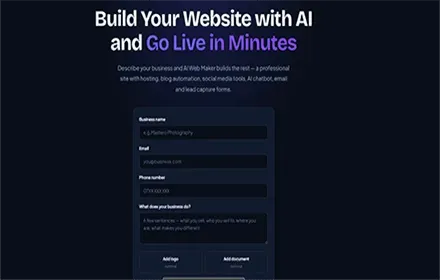
The entry point is the hero form rather than a traditional signup wall. A prospective user supplies a business name, an email address, and a phone number, then writes a description of the business in a textarea capped at four thousand characters. The form explicitly prompts for what the business sells, who it serves, where it operates, and what makes it different. Two optional uploads sit alongside the text fields: a logo image and a supporting document in PDF, DOC, DOCX, or TXT format. That document slot is a thoughtful detail, since many established businesses already have a company profile or brochure that can seed the generation with accurate material.
Technical safeguards are visible in the markup. The form runs through a Cloudflare Turnstile challenge, includes a hidden honeypot field positioned off screen to catch automated submissions, and is served as a multipart form to accommodate the file uploads. Those are ordinary but sensible choices for a lead generating marketing page that also doubles as the product's first step.
From there the journey is presented in three steps. The user describes the business. The AI generates the website with pages, copy, images, contact forms, lead capture, and a chatbot. The user publishes, at which point blog automation and social scheduling begin operating on the configured schedule. The FAQ confirms the process is fully self serve and that no coding background is required, with the comparison drawn that anyone who can write an email can build a site. Support is available at a published email address for users who stall. Nothing on the page suggests a developer handoff, a theme marketplace, or a manual design review step, which keeps the funnel short but also means users surrender fine grained structural control in exchange for speed.
Use Cases
A boutique fitness studio owner who has postponed a website for years because agency quotes and developer calls felt intimidating can complete the hero form in a few minutes and end up with a site, a booking oriented contact form, and a chatbot that answers class schedule questions overnight. The testimonial from Maria T. describes exactly this trajectory, including three client conversions attributed directly to the chatbot.
A logistics startup founder paying an agency roughly two thousand dollars per month for a static site represents the second profile. The appeal is feature breadth at a lower recurring cost: blog, email, and social tooling included rather than quoted separately. James K.'s account frames the switch as a straightforward economic decision rather than a technical one.
An independent consultant with no interest in writing weekly content is the third scenario. Blog automation publishes scheduled, keyword aware posts so the site keeps accumulating indexed pages without manual effort. Sandra R. reports that rankings improved noticeably after automated posting began, which is the outcome the feature is designed to produce even if results will vary by niche and competition.
A restaurant owner needs the most mundane thing imaginable: an online presence that accepts enquiries and answers repeat questions about hours and reservations. The generation flow reduces this to a paragraph of input, and the resulting chatbot handles the repetitive traffic. David O.'s testimonial places the total build time under five minutes, with daily bookings arriving through the site afterward.
Beyond those profiles, the stated audience list points to local retail shops, real estate agents, and early e commerce operators, all of whom need a credible presence and lead routing more than they need bespoke design. The common thread is a preference for consolidation and speed over granular control, which is precisely the trade the platform asks users to make.
Pricing & Value
Public pricing is the weakest link in the presentation. The homepage never publishes a tier table, a monthly figure, or a free plan definition, and the FAQ only confirms that hosting is included on every plan at no additional charge. That leaves value assessment dependent on comparison rather than stated numbers. Against the agency benchmark the site itself raises, roughly two thousand dollars per month for a basic managed site, almost any bundled subscription looks inexpensive. Against standalone builders, however, the calculus is less obvious, because the low cost of a bare builder plus free chatbot and email tiers can undercut a bundle whose price is not disclosed.
The genuine value argument rests on consolidation and labor substitution. A business owner who would otherwise pay for hosting, a blog writing service, a social scheduler, and an email platform is likely to spend more than a single bundled subscription costs, and the time saved on setup and content production is real. The public toolset, documented at its free SEO toolset, functions as a no signup trial in its own right, letting prospects score a site, hunt for a domain, or generate a marketing plan before spending anything. For anyone weighing the platform against alternatives, a comparison of website builders published on the same domain offers the company's own framing of the field.
Final Verdict
AI Web Maker is a coherent, well scoped product for a specific buyer: the owner operated business that needs a competent website and a working marketing stack without hiring anyone. The bundling is the real story. Hosting, blog automation, social scheduling, chatbot, email, lead capture, and forms in one dashboard is a genuinely useful consolidation, and the zero code, five minute framing is backed up by a form that takes minutes to complete. The free SEO utilities extend the funnel intelligently and give skeptics a way to evaluate the brand's output quality before registering at the registration page.
The honest caveats matter. Pricing is not published, so buyers cannot evaluate cost efficiency without contacting the company or starting the process. The chatbot and social tools are described at a level of detail that leaves integration depth unverified, and there is no mention of an API, export path, or data portability, which raises standard lock in questions for anyone planning to scale beyond a brochure site. Websites that require intricate layout control, custom application logic, or a heavily governed design system will outgrow a description driven generator quickly.
Recommended for local service businesses, solo consultants, restaurants, and early stage ventures that value speed and consolidation over control. Not recommended for teams needing bespoke front end work, strict design governance, or documented developer access. The pragmatic path is to run one of the free tools first, then trial the builder on a single site before migrating an existing domain.