
Overview
StartupKit, marketed as Kit, is a European SaaS platform that consolidates four back-office functions into one account: recruiting, vulnerability disclosure, compliance training, and cold email outreach. It targets small and mid-sized technology companies that would otherwise assemble an applicant tracking system, a bug bounty platform, a training vendor, and a prospecting tool separately. Pricing begins at €6,99 per seat per month after a 30-day trial that requires a card but is not charged during the trial window.
Key Features
Unified hiring pipeline. Kit provides per-role pipelines with GitHub code assignments, resume extraction, team review workflows, and interview scheduling bundled in at no extra cost. Candidates interact through a magic link on the company's own careers domain, where they can check their stage, book an interview slot drawn from real team availability, and respond to an offer without creating an account. Twenty role templates span seven categories and five languages.
Vulnerability disclosure workflow. The security product covers report intake through triage, SLA tracking, severity assessment, duplicate detection, researcher appeals, bounty approvals, and audit exports. Report pages surface the hours remaining on an acknowledgment SLA, possible duplicates, and open triage checklist items, while researchers see payout status and can upload tax documents through their own portal.
Compliance training with tamper-evident records. Kit ships SOC 2, ISO 27001, GDPR, and HIPAA course decks without per-learner fees. Trainees submit evidence themselves, such as a screenshot of a locked screen carrying a capture date and device name. Completion data becomes a register with one row per person, listing employee ID, department, role, and completion date, exportable as CSV or PDF with individual evidence bundles.
Outreach with mandatory human approval. Priced as a €17,99 per month add-on, Outreach researches prospects using LinkedIn, company sites, and a knowledge base, then drafts email for review. Nothing sends without approval. A unified reply inbox collects responses from every campaign with detected sentiment, and a silver medalist tool checks prospects against past application records.
Model Context Protocol integration. More than 190 MCP tools let assistants such as Claude Code, ChatGPT, Cursor, and GitHub Copilot read applications, advance stages, triage reports, approve bounties, and query training completion. Tool annotations declare whether an action reads data, makes a destructive change, or contacts someone outside the company, and connections use scoped access tokens tied to Kit permissions. A public server works before signup.
Compensation Research (beta). Included with the platform, this module collects advertised salary ranges from live job postings and refreshes them daily, letting teams track roles and regions and export the resulting data.
Integrations. Slack, GitHub, Google Calendar, Google Meet, Webhooks, and any MCP-compatible client are supported natively.
Use Cases
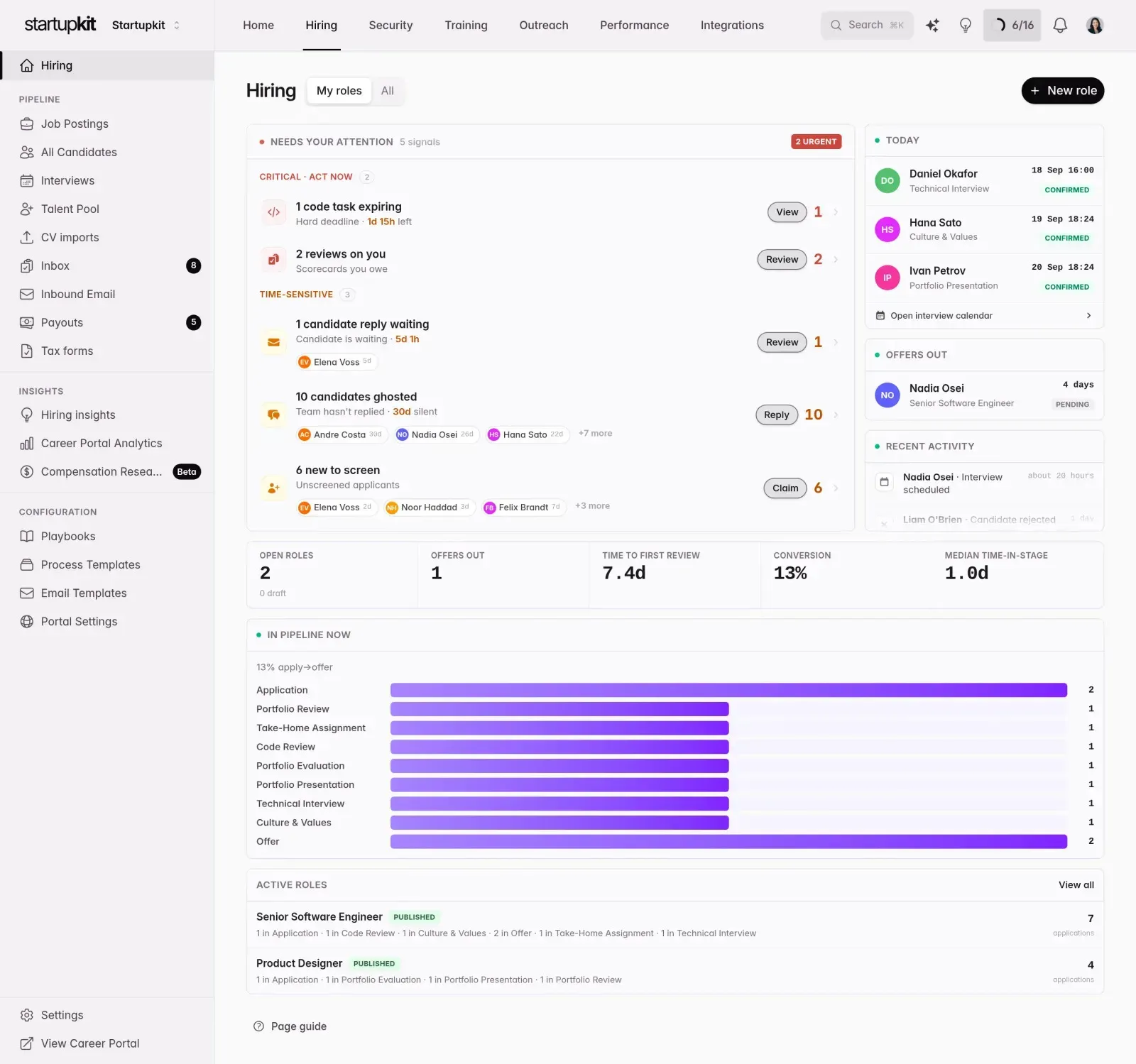
A seed-stage company opening its first engineering pipeline can copy a role template, publish a careers portal on its own domain, and let candidates book interviews against the team's genuine availability. The operator dashboard flags reviews waiting on a decision, code tasks nearing expiry, and candidates still awaiting a reply.
A product team running a vulnerability disclosure program can track acknowledgment SLAs, validate a stored XSS report, handle a researcher appeal, and approve a $1,500 bounty with a recorded ledger credit. The researcher views the same status, updates payout details, and uploads tax documents through a single link.
A compliance lead preparing for an ISO 27001 audit can ask an AI assistant which staff have completed security awareness training, then export the tamper-evident register with per-person evidence bundles for the auditor.
Differentiators
Kit's main distinction is consolidation across four domains that normally sit with separate vendors, wrapped in a per-seat price that avoids per-learner training charges. Its MCP layer goes further than most rivals by flagging destructive and externally contacting actions before execution. EU data residency and an available DPA suit privacy-conscious buyers, and the interface is localized in five languages.