
Overview
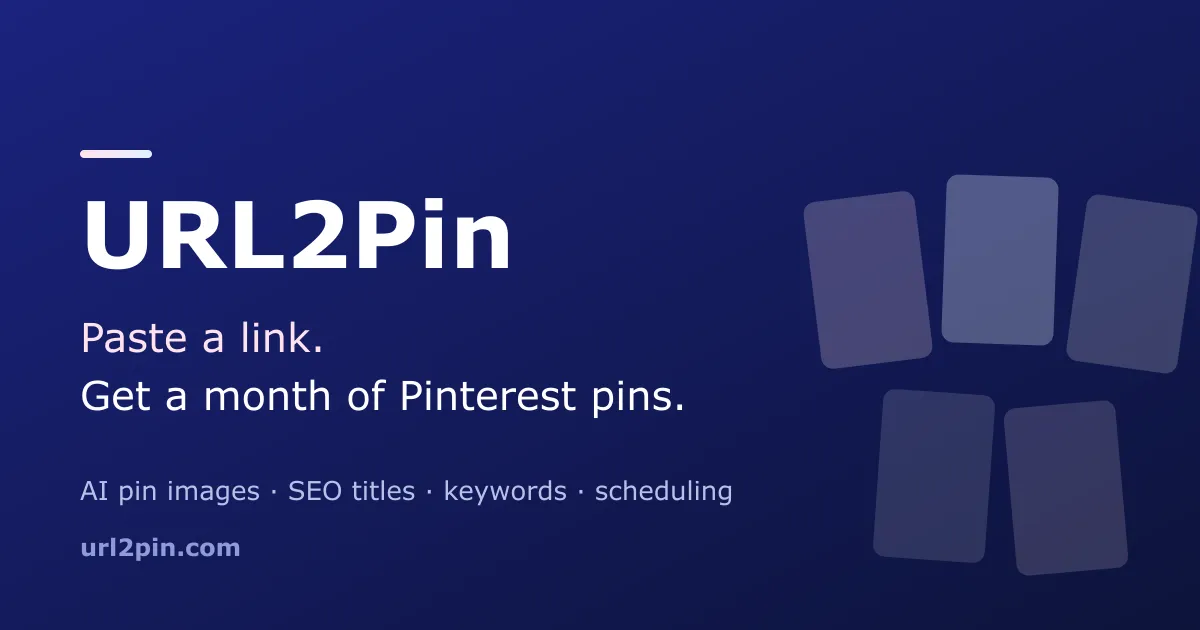
URL2Pin is a browser based marketing application that converts a single product listing or blog article URL into a batch of publish ready Pinterest pins. It targets a narrow but expensive operational bottleneck in affiliate marketing: vertical pin graphics have to be composed, keyword heavy titles and descriptions written, affiliate tags preserved on every link, and posts distributed across a publishing calendar without tripping spam detection. URL2Pin compresses that sequence into a paste and generate loop, then completes the cycle by posting through Pinterest's official API.
The product is aimed at Amazon affiliates, Etsy and Shopify merchants, and bloggers who treat Pinterest as a traffic channel rather than a social feed. Its market position sits between three categories that creators normally stitch together by hand: design tools such as Canva, bulk schedulers, and AI copywriting assistants. The clearest differentiator is the owned landing page. When a product URL is processed, URL2Pin can build a hosted page carrying an affiliate disclosure, pros and cons, and a buy button wired to the merchant link. Pins then point at that page instead of a raw marketplace URL, giving the marketer a destination with a branded wrapper and a measuring point. That single design decision shifts a campaign from a one way redirect into an asset the creator controls.
Key Features
URL to campaign generation. The core workflow accepts a pasted Amazon, Etsy, Shopify, or blog link and returns a set of pins rather than a single asset. Each generated pin carries a distinct visual angle, headline, and layout, so one product yields several testable creative directions instead of one image that either works or fails. The marketing site demonstrates this with a throw pillow listing that produces a clean text overlay pin, a bold statement pin, a lifestyle composition, and a four tile collage.
AI written SEO copy. Every generated pin arrives with its own title, description, and alt text rather than a single block of text reused across the batch. Copy is editable, which matters because Pinterest search favors natural keyword placement in descriptions. Reviewers inside the app note that output is generally accurate and occasionally contains spelling errors, so a proofreading pass remains part of the routine.
Publishing through the official Pinterest API. URL2Pin posts directly to Pinterest through its sanctioned API instead of simulating a browser session. In practice this reduces account risk compared with grey market automation tools and keeps pins behaving as native content. Users select boards, choose spacing between posts, and review a calendar view showing exactly when each pin will go out.
Owned product landing pages. Product links can be routed to an auto generated page hosted by URL2Pin, complete with a disclosure statement, a pros and cons block, and a buy button that carries the affiliate tag. The page requires no blog infrastructure and sits as one option inside the pin flow. For affiliates working without a content site, this is the most strategically interesting part of the product.
Roundup and comparison pins. A dedicated tab accepts two to six product URLs and produces either a numbered multi product card layout or a side by side X versus Y comparison. Users can also paste an Amazon idea list, and the system loads every product in it so individual items can be ticked for inclusion. Brand footer, color choices, and the #ad disclosure are appended automatically, and real listing photography is preserved rather than redrawn.
Pinterest on autopilot. Beyond single campaigns, URL2Pin offers a mode where the platform selects Amazon products in a chosen niche, including best sellers and listings that already attract clicks, then generates and posts pins daily. It effectively converts the tool from an on demand generator into a lightweight channel manager for creators who prefer to review rather than originate.
Free utility toolset. A separate library of browser tools supports the paid workflow, including an Amazon pin worth checker, affiliate link builder and validator, UTM builder for Pinterest, affiliate disclosure generator, board name generator, pin size checker, income calculator, and a Chrome extension. These tools function as an entry point for affiliates who are not yet ready to commit to a subscription.
How It Works
Onboarding begins on the public homepage, where a single input field accepts a product or article URL without requiring an account. The site promises a free pin from any link before signup, and a demo video walks through the link to pins transformation end to end. This trial before registration pattern removes the usual friction of gated trials and gives prospective users an immediate sample of output quality before any commitment.
Registration opens the pin creation workspace, which is the operational center of the product. The user pastes a URL, the system scrapes the title, imagery, and product details, and a generation step returns several pins with their own copy blocks. From there the workflow is editorial: adjust headlines, rewrite descriptions, swap the featured photograph, and confirm alt text. Affiliate tags saved in the account are applied to outbound links, so a stored Amazon tag flows through every generated pin without re-entry, and the hosted landing page for the product is created as an optional destination.
Scheduling is the final stage. Boards are selected, a posting interval is chosen, and a calendar renders the exact publication dates. Pin dispatch runs through Pinterest's official API, which the site cites as a trust signal alongside a running counter of 33,787 pins uploaded and a claim of more than 500 creators using the platform. Because the scheduling layer is native rather than scripted, campaigns can be paused and edited with predictable results, which is the practical difference between a managed scheduler and a third party automation service.
Use Cases
The Amazon affiliate without a website. A creator with a Pinterest account and an Amazon tag but no blog can paste a product link, receive four pins plus a hosted product page containing disclosure, pros and cons, and a tracked buy button. The result is a legitimate funnel without a domain, a hosting bill, or a content management system.
The Etsy or Shopify seller. Small merchants repurpose existing listings into seasonal pin variations without hiring a designer. Because original product photography is preserved and captions are rendered as exact text, brand assets survive the process rather than being approximated by image generation.
The blogger repurposing evergreen posts. A home decor writer with forty published articles can cycle each URL through the generator to produce fresh pin angles every quarter. The comparison and roundup formats let one article about planters become both a gift guide pin and a budget versus premium pin, multiplying the entry points for a single destination.
The agency managing multiple accounts. A small agency handling several client Pinterest profiles, one of which is documented on the site as having published more than two thousand pins on an Agency plan, uses saved tags and per account boards to batch production. The calendar view makes delivery reporting straightforward because publication dates are visible before the client asks.
The seasonal gift guide publisher. Before a high intent shopping period, a publisher pastes an Amazon idea list, selects six products, and generates a numbered roundup pin with an automatic disclosure footer. This is the format the site identifies as the highest converting affiliate layout on Pinterest, and it is the one that would otherwise require the most manual layout work.
Pricing & Value
The homepage keeps the rate card deliberately out of view and directs prospects to the pricing page for plan structure and trial terms. What the marketing site does disclose is the shape of the offering: a free tier with no credit card required, a Starter plan available on annual billing, and an Agency plan sized for high volume accounts. The absence of published figures on the landing page is a minor friction point for comparison shopping, since buyers evaluating against schedulers and design subscriptions have to open a second page before they can benchmark cost per pin.
Value depends on what is being replaced. A creator substituting URL2Pin for a Canva subscription, a separate scheduler, and a copywriter retainer is consolidating three line items into one, and the arithmetic usually favors consolidation once more than a handful of pins per week are published. A creator who only posts occasionally, or who already has a repeatable design system and enjoys the craft of pin making, will find the free tier sufficient and the paid upgrade harder to justify. The free tool library partially offsets this, since the pin worth checker and link builders remain useful regardless of subscription status.
Final Verdict
URL2Pin solves a real and unglamorous problem: the production cost of consistent Pinterest output. The strongest elements are the official API pipeline, the multi angle generation that turns one URL into several testable creatives, and the owned landing page that gives affiliates a destination without a blog. Roundup and comparison formats extend the value into the affiliate layouts that convert best, and the surrounding free tools give newcomers a low risk path into the ecosystem.
The trade-offs are honest ones. Published pricing lives behind a separate page, generated copy still needs a proofread according to in app reviewers, and the integration surface is concentrated on Amazon, Etsy, Shopify, and ordinary article URLs, which limits sellers on other platforms. Ratings on the site sit at 4.2 out of 5 across 29 reviews, a credible rather than exceptional figure that aligns with the reported copy quality issues.
Affiliate marketers, ecommerce sellers, and bloggers publishing at volume should evaluate it seriously, and newcomers can start with the free tier and the Amazon affiliate guide to judge fit before paying. Designers who want full creative control over every pixel, and casual pinners posting a few times a month, are better served by existing design and scheduling tools. For the specific job of converting product URLs into scheduled Pinterest campaigns, URL2Pin is a focused and defensible choice.