
Overview
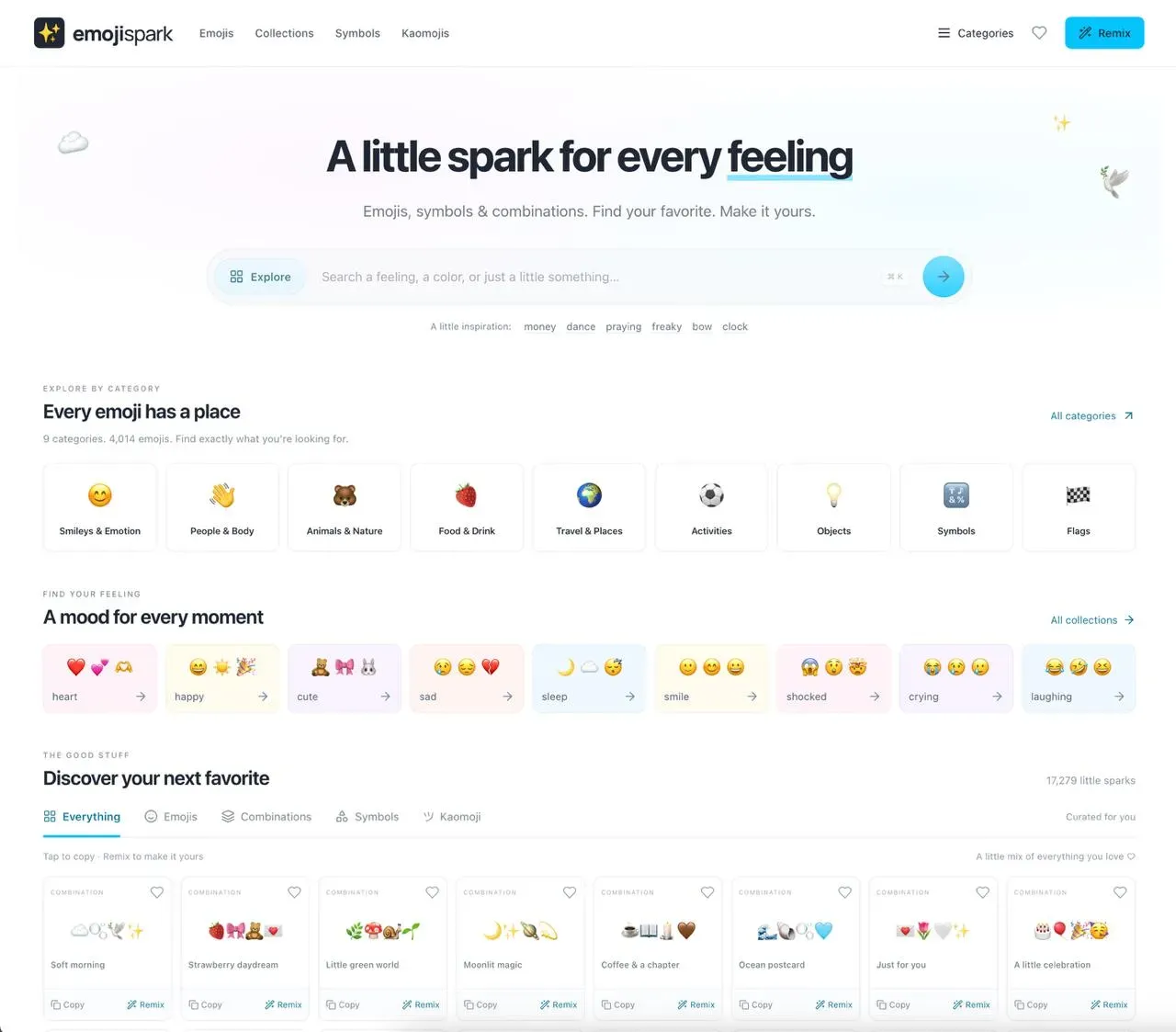
EmojiSpark is a browser-based catalog for emojis, symbols, kaomoji, and curated character combinations, aimed at social media users, designers, community managers, and anyone who needs the right character sequence without hunting through a phone keyboard. The platform organizes 4,014 emoji entries, a figure that includes skin tone and other variant forms, across nine top level categories, then layers a combination playground and a handful of small creative utilities on top of that index. The library is free to browse, requires no account for copying, and ships in English, Spanish, and French.
Key Features
Mixed content catalog with type tabs. The discovery feed exposes 17,279 indexed items and lets visitors narrow the view to Everything, Emojis, Combinations, Symbols, or Kaomoji. Each card carries its own accent tint, a label describing its kind, and quick actions, so a single scroll can surface both a lone glyph and a four-character scene like a moonlit motif.
Nine category taxonomy with filter depth. Emoji browsing splits into Smileys and Emotion (172 entries), People and Body (1,923), Animals and Nature (178), Food and Drink (160), Travel and Places (221), Activities (598), Objects (270), Symbols (222), and Flags (270). Each category card also publishes its number of internal filters, ranging from three for Flags to eighteen for Objects, which hints at how granular the sub-navigation becomes once a visitor drills in.
Copy and save workflow. Cards support one tap copying to the clipboard and a persistent save toggle. Saved items collect into a dedicated /saved view, which makes the service usable as a lightweight personal library rather than a one-off lookup page, though the collection is local to the browser session.
Combo Studio remixing. Every card exposes a Remix link that passes the character sequence as a seed parameter into the generator. The studio presents a large editable canvas, preset buttons, and a palette of emoji for assembling combinations, then returns a grid of remixed results with individual copy controls. This turns the catalog from a static reference into an active composition tool.
Companion micro tools. Four standalone utilities sit alongside the catalog: a Heart Sticker Maker that renders a 320 by 320 canvas export, a Heart Text Art generator producing ASCII style hearts, a Moon Phase Emoji checker, and the Combo Studio itself. They are narrow in scope but address specific requests that a plain emoji search cannot.
Community submissions with moderation. A dialog invites visitors to submit a combination of up to 100 characters with a name and comma separated tags. Submissions are explicitly queued for review before publication, a reasonable safeguard given how quickly an unmoderated emoji feed can degrade.
Use Cases
Social media managers and creators can pull mood-aligned sets from the curated collections, which cover themes such as heart, happy, cute, sad, sleep, shocked, crying, and laughing. Copying a pre-built sequence is faster than assembling one glyph at a time, and the tagged topic pages give a starting point when a caption needs a consistent visual signature.
Designers and content producers working on mockups, landing pages, or notification copy can use the symbol and kaomoji libraries to source decorative marks that render predictably. The stated character counts across categories help scope an editorial palette before any asset is produced.
Casual users and community moderators can lean on the search field with its suggested intent links, covering terms such as money, dance, praying, bow, and clock, to reach a specific expression in one step. The save function then keeps a working set of reactions close at hand for repetitive messaging tasks.
Differentiators
Most emoji references stop at lookup. EmojiSpark closes the loop by treating multi-character combinations as first class objects, complete with names, tags, save states, and a remix seed that carries directly into an editor. The combination of a documented taxonomy, multi-language support, and purpose-built mini tools places it closer to a small creative suite than to a static character chart.