
Overview
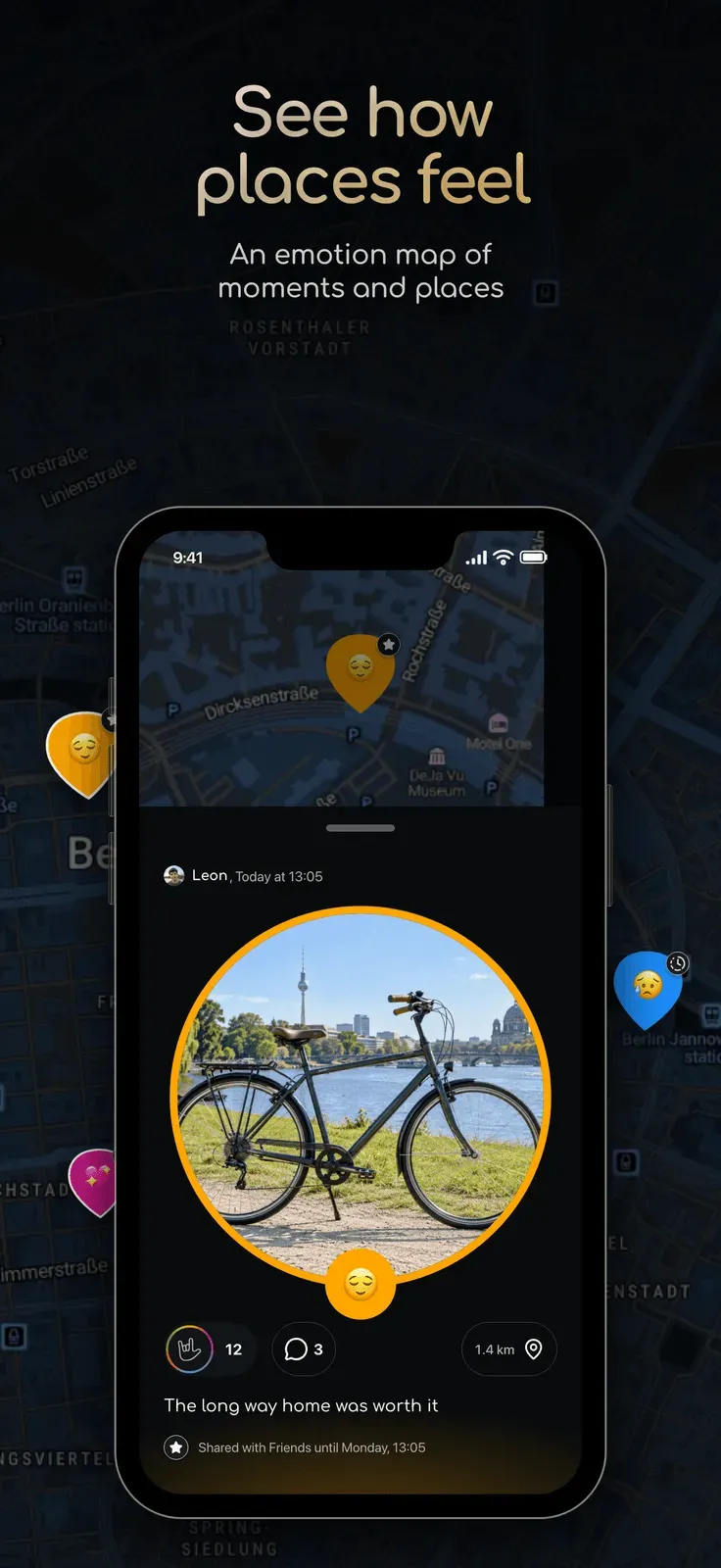
Vibes'n'Feels is a mobile application that treats location-based sharing as an emotional record rather than a social performance. Built by VisioFutura and credited to Pavel Bochkov Rastopchin, the product describes itself as an emotion map of moments and places. Its atomic unit is the Vibe, which bundles four elements: a freshly captured photo or a clip of no more than 20 seconds, a nearby place, an emotional spectrum paired with a refining emoji, and an audience tier that governs visibility.
The problem it targets is well documented in consumer social software. Conventional photo platforms optimize for accumulation through follower counts, public profile histories, popularity rankings and algorithmic feeds. That structure nudges people toward presenting a curated identity rather than noticing where they actually are. Vibes'n'Feels strips those mechanics out. There are no follower numbers, no public friend lists, no direct messages and no ranking signal attached to engagement.
The app is aimed at adults aged 18 and over, a restriction stated plainly in its FAQ. The natural audience spans urban walkers, travelers who want a memory layer over a city, and journaling enthusiasts who have grown tired of presenting a permanent identity online. Adjacent products occupy different ground. Day One handles private journaling without a map, Snapchat's map layer shows friend locations without emotional tagging, and Polarsteps documents journeys without any ephemerality. Vibes'n'Feels fuses a map, an emotion taxonomy and time-boxed sharing into a single flow, which is its clearest differentiator. The product ships in English and Russian. Full details live on the official Vibes'n'Feels site.
Key Features
Six-Spectrum Emotion Tagging. Every Vibe begins with a choice among six emotional spectra: joy, love, anger, sadness, discomfort and surprise. After picking a spectrum, the user selects a more precise emoji from a refinement row containing options such as 😊, 😄, 🥳, 🤩, 😎, 😌 and ✨. The interface renders as a radial petal layout with a distinct color per spectrum, and a double-tap shortcut accelerates continuation. The framing deliberately avoids clinical language. The FAQ states the app does not diagnose, does not require a named mood, and does not offer mental-health advice.
Camera-Only Capture Bound to Location. Vibes'n'Feels rejects gallery imports entirely, a constraint that shapes the whole product philosophy. A photo must be taken live with the device camera and then cropped, while video is capped at 20 seconds and requires a confirmed account. Location access is mandatory rather than optional. A pin can be dragged within 250 metres of the position detected by the app, and if a follow-up check detects significant movement, the place must be updated and the media recaptured. No background location tracking runs at any point.
Three-Tier Audience Model. Before saving, each Vibe is assigned a visibility scope. Personal keeps the Vibe stored on the device and visible only to its creator. Share with Friends exposes it for three days to people who are currently mutual Friends. Share with Everyone publishes it to the community map at the exact pin for 24 hours, subject to automated safety screening of photos and videos. Personal Vibes and Friends shares sit outside the public sharing limit.
Feel Reactions. A Feel is a lightweight response to a live Shared Vibe. The aggregate count is publicly visible, but supporter identities are not disclosed, and the landing copy states that Feels never change discovery or ranking. This is a deliberate inversion of the like economy, where visible endorsement volume usually translates directly into reach.
Vibe-Bound Discuss Threads. Discuss is a threaded conversation attached to one specific live Shared Vibe rather than a standalone inbox. Messages can quote the originating Vibe, support emoji reactions such as 👍 and ❤️, and carry counts alongside timestamps. The thread closes automatically when the Vibe expires, and the notification default is set to mentions only.
Privacy-Oriented Media Handling. The privacy section states that camera originals are never uploaded. Sharing and sync rely on a processed JPEG for photos and an MP4 with a JPEG poster frame for video. Shared videos may be screened through sampled frames and speech. A confirmed account can synchronize up to 1 GB of its newest eligible Vibes.
Private Mutual Friendships and Dual Browsing. Friendships are mutual and added by exact username. There is no people search, no public Friends list and no follower system, which removes browse-and-follow discovery patterns. Visible Vibes can be explored either spatially on the Map or chronologically in Feed, where cards display author, timestamp, distance, response counts and the exact expiry window. The interfaces show no profile pages or popularity surfaces.
How It Works
Onboarding is deliberately permissive. The app can be used without supplying an email, and Personal Vibes work from the first launch. A confirmed account becomes necessary for every video Vibe, including Personal ones, and it also unlocks Friends, writing in Discuss, a custom avatar, and cloud sync or restore of up to 1 GB of the newest eligible Vibes. That design places the account requirement exactly where server-side processing and social reach begin.
The creation loop follows a fixed order. The user taps New Vibe, chooses Photo or Video, then places a pin on a map screen that instructs the user to drag it or tap inside a circle. The camera step follows, framed as an iOS-style capture screen with a 1x zoom indicator and a PHOTO mode label. After capture, the emotion picker appears, followed by the audience selector and a Save Vibe action. Each stage carries its own explanatory line, so the sequence reads as guided rather than modal-heavy.
The consumption loop is a toggle between Map and Feed. The Map presents pins colored by emotional spectrum and tagged with their emoji, while Feed presents the same content as a vertical list with distance in kilometres and precise expiry timestamps. Tapping a Vibe opens a detail view showing the author, time, distance, the note, and the audience label. From there, a Feel reaction or a Discuss thread can be started.
The app is currently in private testing, and the Google Play and App Store buttons on the landing page are present but disabled. Architectural details such as the sync ceiling, the safety-screening pipeline for public posts, and the requirement to re-capture after significant movement suggest a backend oriented around verification rather than archival storage. Legal and policy documentation is split across separate documents, including a published privacy policy and terms of use.
Use Cases
The neighbourhood resident building a memory layer. A Berlin-based commuter walks the same route daily and captures a Vibe at Hackescher Markt whenever something shifts, a street musician, a seasonal light, a quiet hour. Those Personal Vibes stay on the device and accumulate into a searchable emotional history of a familiar district without ever entering a public feed.
The traveler constructing an emotional atlas. Someone spending two weeks between Tokyo and Berlin tags each discovery with a spectrum and an emoji, from surprise at a shrine garden in Akihabara to discomfort on a crowded platform in Friedrichshain. Because every Vibe carries a pin, distance and timestamp, the trip becomes a geographic diary rather than an undifferentiated camera roll.
The small friend group coordinating spontaneously. Four friends share Vibes with Friends only, each visible for three days to current mutual Friends. A shared note such as a long way home being worth it invites a short threaded Discuss exchange, and the whole conversation disappears when the Vibe expires, leaving no permanent group chat to maintain.
The solo journaler avoiding feed pressure. A user who wants reflection without an audience selects Personal for every Vibe. Because there are no follower counts, rankings or public profile histories, the activity carries no comparative dimension, and the 1 GB sync ceiling allows a confirmed account to restore the newest eligible Vibes after a device change.
The public contributor during a specific window. A photographer posts a city Vibe to Everyone at a precise pin for 24 hours. The post passes an automated safety check, receives Feel responses whose counts are visible but whose identities remain hidden, and then vanishes from the map, which suits creators who want reach without building a permanent presence.
Pricing & Value
No public pricing information exists at the time of writing. Both store buttons on the Vibes'n'Feels landing page are disabled, and the call to action reads that the product is coming soon to stores and currently in private testing. There is no visible subscription screen, credit system or tiered plan documentation on the site, so any cost structure remains speculative.
What the available material does reveal is a set of architectural hints about value. Personal use requires no email, meaning a basic tier of on-device storage is likely to remain free. A confirmed account unlocks video, Friends, Discuss writing, custom avatars and up to 1 GB of sync, which reads like the natural boundary between a free tier and a future paid one. Compared with established journaling and location apps that charge monthly for cloud storage, a 1 GB sync allowance is modest but reasonable for photo and short-video derivatives rather than originals. Honest assessment suggests waiting for the public release and published terms before committing. Readers tracking the rollout can follow updates through the main landing page.
Final Verdict
Vibes'n'Feels is a coherent, opinionated take on location-based sharing. Its strongest idea is subtraction: removing follower counts, public identities on reactions, permanent posts and gallery imports produces an experience that rewards noticing rather than broadcasting. The three-tier audience model is unusually clear, the emotion taxonomy is expressive without being diagnostic, and the decision to keep camera originals off the servers is a meaningful privacy commitment rather than a slogan.
Areas for improvement are equally visible. The enforced live capture rule and the 250 metre pin radius exclude a large set of legitimate uses, including retroactive journaling and places a user cannot physically reach. The 18-and-over restriction and the confirmed-account requirement for video, Friends, Discuss and sync add friction that many casual users may not tolerate. Pricing and availability remain undisclosed while the app sits in private testing, which makes any value judgment provisional, and the absence of a web client limits access to phone users.
For urban walkers, travelers and journaling-minded users who want a map-shaped emotional record and are comfortable with ephemeral sharing, Vibes'n'Feels is worth watching closely. For teams, brands, or anyone seeking analytics, follower growth or permanent archives, the product is structurally the wrong fit. The recommendation is to treat it as a promising private beta and revisit once store availability and pricing terms are public.