
Overview
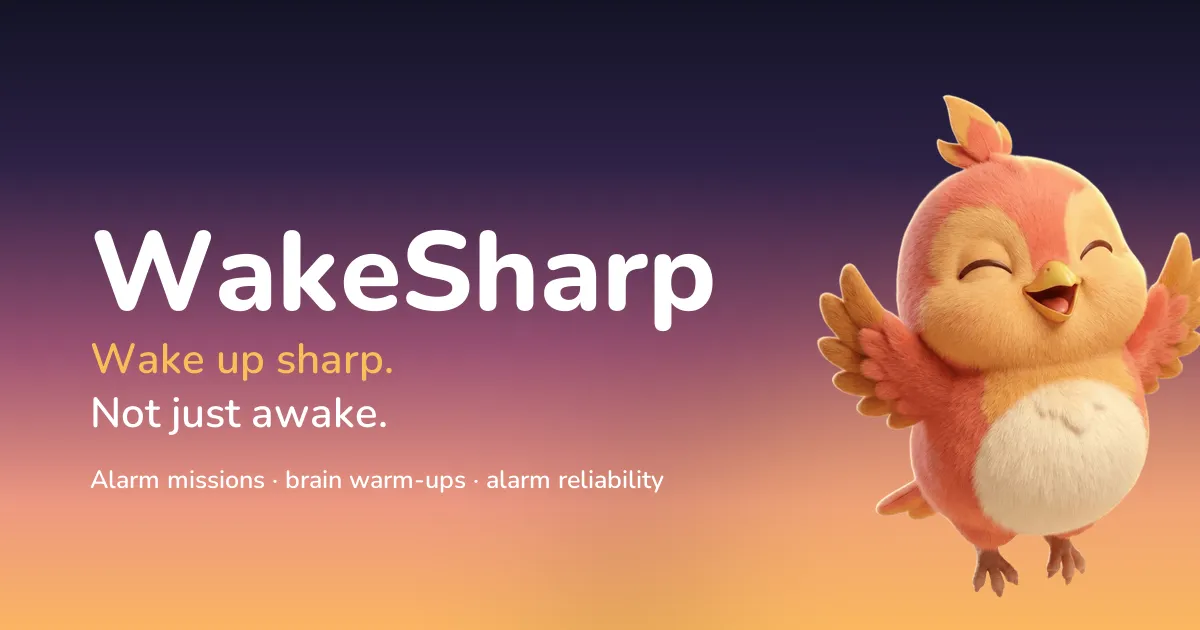
WakeSharp is a mission-driven alarm clock application for iOS and Android, built by KineticBit Inc., a small independent studio, and distributed through the App Store and Google Play. The product addresses a specific and often underserved problem: heavy sleepers who routinely dismiss a standard alarm without ever becoming properly conscious. Rather than accepting that a single swipe is all the interaction an alarm should require, WakeSharp inserts a task between the alarm sounding and the alarm stopping. That task can be arithmetic, a memory puzzle, a photograph of a location chosen the previous night, a walk of real measured steps, or a spoken answer. Only once the task is complete does the morning count, and the app then issues a score out of 100 describing how alert the person actually was.
That combination of forced engagement and quantified outcome is the differentiator in a category where most competitors compete on sound design or on overnight sleep tracking. WakeSharp declines to track sleep at all. There is no microphone listening through the night, no sleep staging, and no assessment of when the user drifted off. The app measures only what happens after the alarm fires, which is a narrower and arguably more honest claim than the composite sleep scores common elsewhere. The alternatives range from long established puzzle alarm utilities to the native clock applications shipped by Apple and Google, plus the broader sleep suites that bundle a smart alarm as one component among many. WakeSharp's bet is that wake reliability and wake quality are separate problems, and that the second one has been largely ignored by the market.
Key Features
Mission System With Fourteen Task Types. WakeSharp ships with a catalogue of missions grouped into four families: brain, camera, movement and voice, plus a randomised Surprise Me option that selects a different challenge each morning. Brain missions include arithmetic rounds, Memory Match card pairing, Sequence Recall tap patterns, a Colour Clash variant that requires naming the ink colour rather than reading the word, and a typing exercise completed with autocorrect disabled. Camera missions cover Photo Proof, which retakes an image of a spot selected the night before; Scan an Object, which points the lens at a bottle, mug or sink; Fetch, which sends the user to find a specified item; Face Check, which needs eyes open for the camera; and a Fruit Slash game. Movement missions count genuine steps or require walking to a window and holding the phone in daylight. Voice missions include Serial Sevens and Name Five. An alarm can chain several missions in a chosen order, and the full mission catalogue is documented on the site. Where a sensor is unavailable, such as a dead camera or a phone without a step counter, WakeSharp falls back to a mission that can run.
Alarm Reliability Verdict. Instead of presenting a settings checklist, the app inspects permissions, alarm volume, notification configuration, lock screen takeover behaviour and battery restrictions, then leads with a verdict stating that the alarm will ring, may not ring, or cannot ring. Where the platform withholds information, the app says so rather than displaying a passing tick. A pre-bed reminder folds the most serious finding into the evening notification so the issue is visible while there is still time to correct it, and a failed alarm produces either a provable cause or an explicit admission that the cause could not be established.
Calendar-Aware Smart Alarms. A rule can be expressed as a relative offset before the first meeting of the day, so an alarm set to ring ninety minutes before the first engagement moves when that engagement does. WakeSharp reads the calendar on the device, rechecks it overnight, and adjusts accordingly. Access is read-only and optional, and event data is never transmitted. The mechanics are explained in detail in the calendar alarm documentation.
Shift Rotations and Profiles. Rotational patterns that do not repeat weekly, such as two day shifts followed by two nights and four days off, are supported with a preview calendar and the ability to skip a single date without deleting the schedule. Profiles swap an entire alarm set for work, vacation or on-call periods, while search, sorting and a Today view keep large alarm collections manageable.
Sharpness Score and Trends. After the mission, the app runs a warm-up of roughly two minutes drawn from Mind Games, Memory Match, Sequence Recall, Word Dash and Reaction Tap. Three games appear each morning and rotate so the complete set cycles within a week, and the selection deliberately avoids repeating whatever the mission already demanded. The resulting number out of 100 is scored against the individual's own rolling baseline rather than against strangers, and the company is explicit that it is an in-app score rather than a clinical test. A streak counter, trend chart and freeze tokens for disrupted mornings accompany milestone markers at 7, 30, 100 and 365 days.
Wake With a Friend. A shared link causes the receiving phone to construct the same alarm locally, with no account to create and no server in the middle. The Beat My Wake variant issues an identical problem set with the same seed, rounds and difficulty, allowing two people to compare performance directly. Each participant keeps an independent copy, so editing one alarm does not alter the other.
Native Builds and Wearable Support. The app is written twice, in SwiftUI for iOS and in Kotlin with Compose for Android, rather than wrapped in a cross-platform shell. That decision is what allows each side to use platform-specific alarm behaviour. Companion watch apps exist for watchOS 26 and Wear OS 3, tapping the user awake before the room hears anything and shifting the phone alarm a few minutes later as a backup. Only a dismissal on the watch cancels the phone alarm; a flat watch, one out of range, or one not opened within 36 hours leaves the phone alarm exactly where it was. A watch face complication is also included.
How It Works
Setup begins without an account. WakeSharp requires no email address and no password, and every feature functions while signed out. Optional Apple or Google sign-in exists solely to back up alarms, settings, scores and streaks for migration to a new handset. It is off by default, and no alarm ever waits on the network before ringing. On first launch the user grants alarm access, which is mandatory on iPhone because the app relies on Apple's AlarmKit to present a system alarm over the lock screen through Silent mode and Focus, even if the app was force quit. Declining or revoking that permission prevents any alarm from being scheduled at all. On Android the app uses an exact alarm on the dedicated alarm stream, which reaches through silent mode and through Do Not Disturb when that mode permits alarms. Total Silence mutes every sound including alarms, and the app acknowledges that limitation openly.
Building an alarm involves choosing a time or a calendar rule, selecting a tone, and attaching one or more missions in a defined order. That selection is made the night before rather than at the moment of waking, which removes the negotiation that typically occurs when a half-conscious person weighs up whether to snooze. The reliability screen lives in Settings, and the pre-bed reminder surfaces the worst finding. At the alarm time, the phone presents a full-screen alert, and quieting it does not end the process. A snooze or a dismissal merely suspends the accounting until the mission is finished.
Afterwards the warm-up games run, the Sharpness Score is revealed against the personal baseline, and the result is appended to a history that extends as far back as usage does. Gentle start on iPhone opens the tone quietly and climbs to full volume at roughly 25 seconds, while the Android build brightens the screen in a sunrise simulation before the sound begins. Alarm appearance can follow light mode, dark mode or the device setting, and the palette shifts with the hour either way. Tones range from a gentle Dawn preset to a deliberately abrasive Smoke Alarm, and each ships with a softer twin. Every alarm wallpaper and Lark scene is included, and each scene carries its own celebration animation.
Use Cases
A rotating shift nurse working two days, two nights and four days off is the clearest fit for the shift rotation engine. Weekly alarm patterns fail for this schedule entirely, and the preview calendar plus single date skipping means an irregular roster does not require rebuilding alarms every month. The reliability verdict matters more here than for a nine-to-five worker, because a missed alarm on a night shift has direct consequences for a ward.
A remote employee whose first meeting drifts between 8am and 11am is served by the calendar rule. Rather than maintaining a set of manual alarms and adjusting them the night before, the rule recalculates overnight, and the read-only calendar access means no event details leave the phone. The same person is likely to use profiles to swap a working set of alarms for a vacation set without deleting anything.
A university student with a history of sleeping through an 8am lecture represents the mission system's core audience. Arithmetic or Sequence Recall forces a level of cognitive engagement that a swipe does not, and the streak counter adds a behavioural layer that converts the morning into something closer to a daily habit than a chore. The warm-up games double as a measure of whether the student is genuinely functional or merely vertical.
A couple or pair of roommates can use the shared link to set a common alarm on two phones without either installing a synchronisation service. Because each device builds its own local alarm, there is no dependency on a third party server and no privacy exposure, which matters for a product that otherwise markets itself on local processing.
A frequent flyer with an early departure is a case where WakeSharp helps and also declines to overpromise. The reliability screen will flag battery restrictions and permission gaps, but the app states plainly that no software can ring on a phone that is switched off or out of battery, and it recommends a second independent alarm for anything that genuinely cannot be missed. That admission, repeated in a full safety notice on every page, is unusual in a category where marketing tends to imply guarantees.
Pricing & Value
WakeSharp operates on a single plan. WakeSharp Unlimited is priced at $34.99 per year or $4.99 per month, with a 7-day free trial available on the yearly option only and restricted to eligible new subscribers. The monthly tier carries no trial. The published pricing puts every mission, the rotating warm-up games, the complete Sharpness history, smart calendar alarms, shift rotations and profiles, the reliability check, all alarm tones, every Lark scene and wallpaper, the shared wake links and the watch apps behind the same subscription. Billing is handled by Apple or Google, both tiers renew until cancelled, and cancelling happens in the store account rather than in the app. Deleting the application does not cancel a subscription. Users who purchased a previous Lifetime tier keep permanent access, with Restore Purchases bringing it back on a new device.
The value calculation depends on how the alternatives are framed. A single-purpose puzzle alarm typically asks for a one-time fee in the low single digits, which makes a recurring charge look steep by comparison. Against that, WakeSharp bundles calendar-driven rules, shift rotation handling, dual native codebases, two watch applications and a scoring system with longitudinal history, which is closer to a full scheduling tool than to a novelty alarm. The absence of a permanent free tier is the most significant friction point, because the alarm clock is a category where users expect to trial behaviour over several weeks rather than seven days. No advertising appears anywhere in the app, which is consistent with the subscription model.
Final Verdict
WakeSharp is an unusually well considered entry in a category that rarely receives this level of engineering attention. The mission system is broad enough to suit different sleep depths and living situations, the reliability reporting is honest to the point of being uncomfortable about platform limitations, on-device calendar and camera processing is the right default, and the deliberate refusal to add sleep tracking keeps the product focused. Native iOS and Android builds plus watch companions indicate a studio willing to pay the maintenance cost of doing things properly, and the no-account architecture removes a common source of friction.
The reservations are practical rather than conceptual. The iOS 26 requirement excludes a substantial installed base of older iPhones, including hardware that remains perfectly functional. Subscription-only pricing with a trial limited to the yearly tier is a hard sell against one-time-purchase competitors, and there is no permanent free tier to evaluate over a longer period. The most serious limitation is environmental rather than product-related: a powered-off or depleted phone cannot ring, Android's Total Silence mutes alarms, and the app itself advises a second alarm for critical mornings. Anyone looking for an absolute guarantee will not find it here, because no alarm application can provide one.
For shift workers, students, remote employees with unpredictable first meetings, and anyone who has lost confidence in the stock clock app, WakeSharp is worth the annual fee. For users seeking a simple, cheap, one-time puzzle alarm, or for those on older iPhones, the value proposition is weaker and a lighter alternative will likely suffice.