
Overview
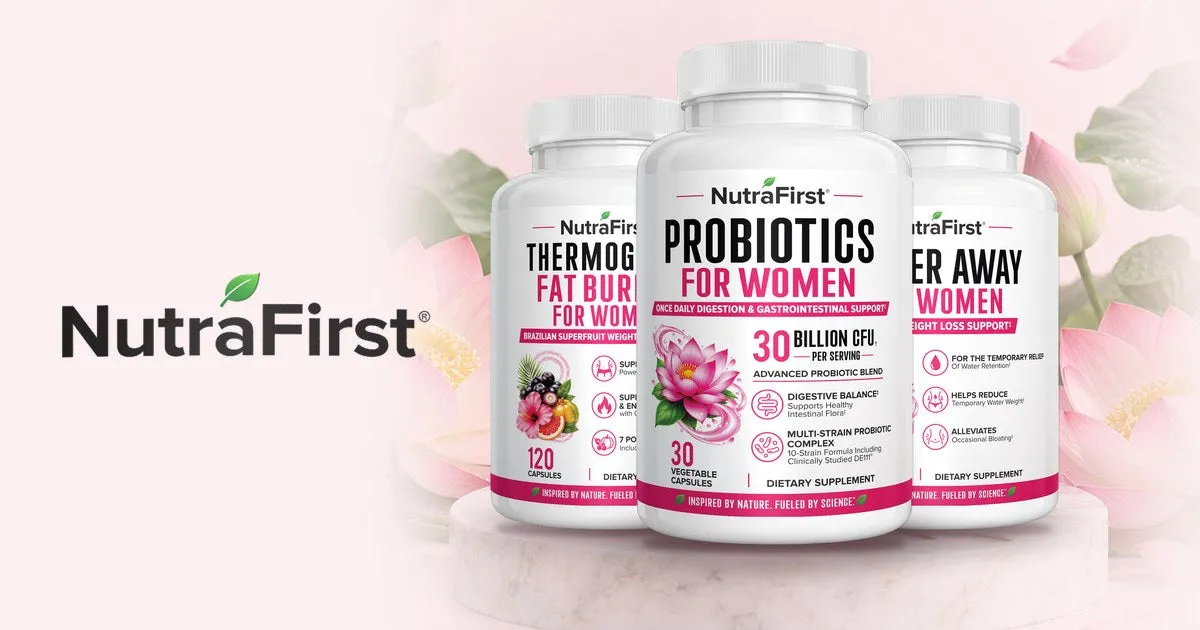
NutraFirst is a direct-to-consumer supplement brand built specifically around women's health, operating an online storefront at nutrafirst.com under the tagline "Wellness Begins With Her." The catalog is organized around four need states the brand treats as its pillars: digestive health, hormone balance, daily wellness, and energy and vitality. The three products currently pulled to the homepage are a 30 billion CFU probiotic for women, a water retention formula called Water Away, and a thermogenic fat burner. The site's own metadata, however, references probiotics, NMN, magnesium, and menopause support, which suggests a broader roadmap than the three hero SKUs.
The problem NutraFirst addresses is fragmentation. Women's wellness shoppers are usually forced to assemble a regimen from several unrelated brands, each with its own formulation philosophy, dosing conventions, and quality claims. NutraFirst instead presents itself as a single curated destination with a female-first lens, competing against legacy pharmacy labels as well as newer influencer-fronted supplement brands. It is an e-commerce brand rather than a software product, so the honest comparison set is other supplement storefronts and subscription vitamin clubs, not SaaS platforms. What distinguishes it is the explicit positioning, the ingredient-level detail on product cards, and an editorial layer the brand calls the Wellness Journal.
Key Features
Probiotic Formula With DE111 The flagship product is a once-daily probiotic delivering 30 billion CFU across a 10-strain blend that includes DE111, a branded Bacillus subtilis spore strain. The homepage card lists the strain count, the CFU level, and the digestive balance claim directly, which removes the guesswork that usually accompanies probiotic shopping. A single daily dose is a deliberate convenience decision, since multi-capsule protocols are a common reason shoppers abandon probiotic regimens.
Water Away Water Retention Support Water Away is positioned around temporary water weight and occasional bloating rather than as a general wellness tonic. The card frames three outcomes: water weight loss support, alleviation of occasional bloating, and temporary relief of water retention. That narrow scope is useful for shoppers who know exactly which symptom they are trying to manage, and it avoids the vague "detox" language common in this category.
Thermogenic Fat Burner The third hero product is a thermogenic formula aimed at weight loss support, metabolism, and energy levels. The brand discloses that the formula contains seven ingredients, naming acai and Garcinia cambogia specifically. Compared with the proprietary-blend opacity typical of fat burners, listing the ingredient count and two headline botanicals is a modest but meaningful transparency gesture.
Ingredient And Science Education Pages Rather than burying formulation rationale in PDFs, the brand gives ingredients and science their own top-level navigation entries. These pages sit alongside a dedicated benefits section that maps products to outcomes instead of SKUs to categories. For a category where shoppers are skeptical and comparison-driven, this structure does real work in reducing friction before purchase.
Wellness Journal Editorial Hub A blog at the women's wellness path functions as the brand's content layer, giving the storefront a reason to exist beyond transactional pages. Editorial content in this category typically covers cycle awareness, menopause transitions, and nutrition fundamentals, which supports organic search acquisition and gives returning customers something to read between purchases.
Free U.S. Shipping And A 30-Day Guarantee The announcement bar rotates three messages, two of which promise free U.S. shipping on every order with no minimum threshold. The cart drawer repeats the promise. A returns and 30-day guarantee policy is linked from the footer, which lowers the perceived risk of trying an unfamiliar supplement brand.
Stated Quality Positioning The pillars row makes four claims: natural ingredients, science backed, women focused, and made in USA with global ingredients in GMP facilities. The GMP reference is the most concrete of the four, since it speaks to manufacturing process rather than marketing tone.
How It Works
The shopping journey begins on a split hero section that pairs a headline, "Women's Health," with a three-bottle product photograph staged on a marble pedestal with pink lotus flowers. Below the hero, an icon row summarizes the four health pillars, then a full-bleed lifestyle banner introduces the brand promise. Only after that does the featured essentials grid appear, so the first product impression arrives roughly two screens into the experience.
Product discovery happens through the featured cards, a predictive search popdown available from both desktop and mobile headers, or the slide-out cart's recently viewed module. Each product card carries a square image, a product name, an ingredient bullet list, and a single call to action, which keeps comparison fast. A shopper who adds an item triggers a cart drawer that surfaces a subtotal, a checkout button, a "Pair with" upsell collapsible, and the free shipping reminder.
Account creation is optional and gated behind the header's account link, and checkout proceeds through Shopify's native payment flow. Setup requirements are minimal for the buyer: no app, no onboarding sequence, no configuration. The heavier lift sits on the brand side, where the storefront runs on a customized Broadcast theme with a pink and navy palette, Playfair Display headings, DM Sans body copy, and a rounded button radius scaled to 300 pixels.
Use Cases
The Bloating-Prone Professional A woman in her thirties who travels frequently and notices cyclical water retention can go straight to the Water Away product page, read the three stated outcomes, and decide within a minute whether the positioning matches her symptom. The narrow claim set is the point here, since a broader "total wellness" pitch would create more deliberation, not less.
The First-Time Probiotic Buyer Someone who has never taken a probiotic and is overwhelmed by strain-count debates benefits from a card that states 30 billion CFU, 10 strains, DE111, and once-daily dosing in four lines. The ingredient breakdowns page then handles the follow-up questions that a product card cannot answer.
The Menopause Transition Shopper A woman in her late forties searching for menopause support will find the brand through its metadata and blog content, then land on a storefront organized by benefit rather than by product type. The benefits section is the natural entry point for this persona, because it maps outcomes to formulas instead of requiring the shopper to decode ingredient names first.
The Skeptical Comparison Shopper A shopper who has been burned by underdosed blends will look for manufacturing standards and evidence. The science page and the GMP facility claim give that person something concrete to weigh, though the footnote clarifying that statements are not evaluated by the FDA correctly tempers expectations.
The Routine Builder A customer who wants a single brand for a daily stack can combine a probiotic, a fat burner, and a water retention formula from one catalog, which simplifies reordering and keeps shipping free across the entire basket with no minimum threshold.
Pricing & Value
The homepage does not publish prices. Each product card routes to an individual product page, and cost is disclosed only there, which is the single biggest friction point in the buying experience. The value proposition is instead carried by the free U.S. shipping promise on every order with no minimum, and by a returns and 30-day guarantee policy linked in the footer. Because pricing is not visible at the category level, shoppers evaluating cost per serving across the three hero products must open three separate pages.
On value, the brand competes in the premium end of mass-market supplements rather than the clinical or practitioner tier. The formulation transparency, the branded DE111 strain, and the GMP manufacturing claim support that positioning. The absence of published certificates of analysis on the homepage, however, means the value argument rests more on brand presentation than on verifiable lab documentation.
Final Verdict
NutraFirst gets the hardest parts of a supplement storefront right. The positioning is unambiguous, the product cards disclose strain counts and named ingredients instead of hiding behind blends, and the education architecture gives skeptical shoppers somewhere to go. Free shipping with no minimum removes a common cart abandonment trigger, and the 30-day guarantee lowers trial risk.
The gaps are practical. Prices are invisible until a product page is opened, the featured lineup covers only three of the categories the brand's own metadata promises, and third-party testing documentation is not surfaced where a comparison shopper would look for it. The brand also leans on structure and function claims, which is standard for the category but limits how much certainty it can offer.
This storefront suits women who want a focused, benefit-organized catalog and are comfortable evaluating a newer label without extensive third-party validation on display. Shoppers who prioritize published lab results or who need to compare cost per serving across a wide catalog should look at established practitioner-grade brands instead. For everyone else, the product catalog is the right starting point, and the 30-day guarantee makes an initial trial a low-stakes decision.
These statements have not been evaluated by the Food and Drug Administration. These products are not intended to diagnose, treat, cure, or prevent any disease.