
Overview
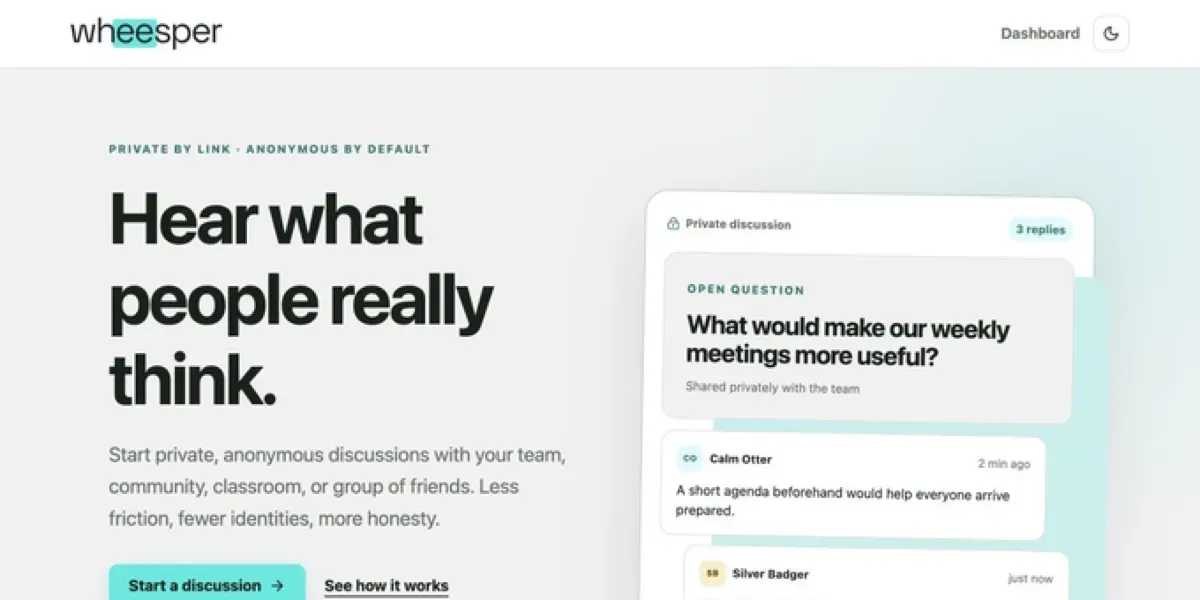
Wheesper is a private anonymous discussion platform designed to eliminate the influence of identity on online conversations. By creating isolated discussion spaces accessed via unguessable links, it allows participants to reply without names, accounts, or public profiles. The platform addresses a common problem in online communities: usernames and pseudonyms can accumulate a posting history that makes individuals identifiable, discouraging honest feedback. Wheesper solves this by generating a fresh pseudonym for each participant per discussion, ensuring no cross-conversation traceability.
The product is built for teams, communities, educators, artists, and friends who need candid input without fear of attribution. It competes with tools like Slido or Mentimeter for anonymous Q&A, but differs by offering threaded discussions and creator controls rather than simple polls. The platform is entirely web-based, requiring no sign-up or installation. It is positioned as a lightweight, zero-friction alternative to more feature-heavy anonymous feedback tools, emphasizing privacy and simplicity.
Key Features
Private by Link Every discussion is accessed through a unique, unguessable URL. The link is not indexed by search engines and does not appear in public feeds or dashboards. Only those with the link can view or participate, making it ideal for confidential conversations. The creator controls the link distribution, ensuring that only intended participants can join.
Fresh Pseudonyms Each participant receives a new pseudonym for every discussion they join. This pseudonym is consistent within that conversation but bears no relation to any other discussion or user history. This design prevents pattern-of-life analysis and ensures that responses cannot be traced back to a single individual across multiple topics.
Threaded Replies Discussions are organized as threaded conversations, allowing participants to reply directly to specific comments. This structure keeps conversations coherent even with many contributors. The interface shows replies indented under parent comments, making it easy to follow sub-threads.
Creator Controls The discussion creator can manage the conversation. While the HTML does not detail specific controls, the site mentions "creator controls" in the feature list. This likely includes the ability to delete comments, close the discussion, or limit participation. These controls give the organizer moderation power without requiring central authority.
No Account Required Participants do not need to create an account or log in. The system generates a pseudonym on the fly when a user first accesses the discussion link. This lowers the barrier to participation and ensures anonymity even from the platform itself. The trade-off is that participants cannot receive notifications or return to a discussion later unless they bookmark the link.
Simple Onboarding The homepage invites users to Start an anonymous discussion with a single call-to-action. The process is straightforward: create a discussion, share the link, and participants reply anonymously. No tutorials or setup guides are needed, reflecting the platform's emphasis on minimal friction.
Responsive Design The site is fully responsive, working on desktop, tablet, and mobile browsers. The header includes a dark/light mode toggle, and the layout adapts to different screen sizes. Navigation is minimal, with links to FAQ, Dashboard, and Start a discussion.
How It Works
A typical user journey begins by clicking "Start an anonymous discussion" on the homepage. The user fills in a discussion topic and optionally a description. Wheesper generates a unique, unguessable URL for that discussion. The creator then shares this link with intended participants via email, private message, or any other channel.
When a participant opens the link, they see the discussion topic and an input field to reply. The system assigns them a random pseudonym, which is displayed next to their contributions. Participants can reply to existing comments or start new threads within the discussion. All interactions happen in real time; the page uses simple refresh mechanisms (not WebSockets) to show new content.
The creator can monitor the discussion via the Dashboard, which lists all discussions they have started. From there, they can see the number of replies, manage comments, or close the discussion. Participants have no persistent identity, so they cannot access the discussion later unless they save the link. There is no email notification or push alert system; the platform relies on the creator to inform participants of new activity.
Once the discussion is concluded, the creator can delete it entirely or leave it accessible for archival purposes. Wheesper does not archive discussions on public feeds or search engines. The entire lifecycle is contained within the private link.
Use Cases
Team Retrospectives A engineering manager wants honest feedback about a sprint without team members worrying about repercussions. The manager creates a Wheesper discussion titled "What went wrong this sprint?" and shares the private link. Team members contribute anonymously, surfacing issues like unclear requirements or burnout that they might not raise in a public meeting.
Classroom Q&A A university professor notices students are reluctant to ask questions during lectures. The professor creates a discussion for each lecture and shares the link. Students can ask questions or clarify concepts without fear of appearing uninformed. The professor answers anonymously, keeping the focus on the content rather than the identities.
Community Feedback An open-source project maintainer wants to know why contributors are leaving. They create a discussion titled "What would keep you contributing?" and share it in a private channel. Contributors can speak freely about governance issues, technical debt, or interpersonal conflicts without being singled out.
Artistic Critique A musician shares a new track for feedback. By using Wheesper, listeners can provide honest reactions without worrying about hurting the artist's feelings or being judged for their own taste. The artist gets unfiltered impressions that are more candid than what they would receive in a public forum.
Friend Group Planning A group of friends planning a trip needs to decide on a budget. One friend creates a Wheesper discussion to anonymously gather what each person can comfortably spend. This avoids the awkwardness of income disclosure and ensures that the plan accommodates everyone's constraints.
Pricing & Value
Wheesper currently offers no pricing tiers. The platform appears to be entirely free, with no premium plans or feature limitations visible on the website. There are no advertisements or upsells. This positions Wheesper as a cost-effective alternative to paid anonymous feedback tools like Polly ($10/month) or Slido (free tier with limits). The lack of pricing information suggests the product is in an early stage or may be supported by donations. For users who need occasional anonymous discussions, the free model is highly attractive. However, teams requiring advanced features like integrations, analytics, or large-scale moderation may find Wheesper lacking compared to paid alternatives. The FAQ page does not mention pricing, reinforcing that it remains free for now.
Final Verdict
Wheesper excels at creating truly private, anonymous discussions with zero friction. Its use of isolated links and fresh pseudonyms effectively addresses the problem of identity leakage across conversations. The simple interface and no-account requirement make it ideal for spontaneous or one-off discussions. However, the platform has notable limitations: no notification system, no integration with common tools, and minimal moderation capabilities. These gaps mean it is best suited for small, trust-based groups rather than large, public-facing communities. Users who need persistent identities, threaded notifications, or governance features should look elsewhere. For educators, team leads, and creators seeking raw, honest feedback without overhead, Wheesper is a solid, free option. The Privacy Policy reinforces its commitment to anonymity, making it a trustworthy choice for sensitive conversations.