
Overview
White Space Signal is a subscription research service that ranks opportunities to build new businesses and to acquire existing ones, built on the premise that artificial intelligence is redistributing economic value rather than simply creating another technology sector. Instead of producing a stream of plausible startup ideas or tracking model releases, the publication asks a narrower question: as AI makes more capabilities cheap and abundant, which parts of the value chain become scarce, expensive or newly necessary, and where does that leave founders and buyers.
The product serves founders, operators, acquisition entrepreneurs, small business owners and private market investors who are deciding how to commit years of work or acquisition capital. Its central argument is that conventional opportunity research is strong at describing the present, covering market size, growth rates, competitor sets and recent funding, while remaining weak at describing where economics are heading. White Space Signal adds an AI durability test to that picture, asking whether a business or category improves or deteriorates as AI capability and adoption increase.
The competitive frame is deliberate. It is not an AI news feed, not a generic startup idea generator, not a directory of businesses listed for sale, and not a promise that anything ranked will succeed. The closest alternatives are analyst subscriptions, market research reports and business brokerage listings, all of which tend to focus on either present-day market data or distressed deal flow rather than on how a category's strategic value changes over a five-year horizon.
The service splits its output into two distinct rankings. BUILD covers new products, services, data layers, assurance layers, infrastructure and specialist capabilities worth creating. BUY covers categories of existing businesses that may become more attractive to own as AI spreads. Because starting a company and acquiring one are different economic decisions, both use separate scoring models, with eighteen factors applied to BUILD candidates and twenty applied to BUY categories.
Key Features
Separate Ranking Models for BUILD and BUY Rather than forcing two very different decisions through one scorecard, White Space Signal maintains independent ranking systems for venture creation and for acquisition categories. The BUILD model evaluates buyer reality, route to revenue, speed to first revenue, capital intensity, distribution, competition and defensibility. The BUY model focuses on cash flow durability, recurring revenue, transferability, owner dependence, acquisition economics, physical and regulatory moats, and whether a category becomes more strategically valuable over time.
Three Distinct Scores Instead of One Number Every ranked opportunity carries three separate metrics. Opportunity Quality measures how attractive the economics and strategic position appear. Conviction measures the strength and completeness of the supporting evidence. White Space measures how much useful, unrecognised value may still remain before the market catches up. The current number one BUILD entry, a release compatibility regression guard, shows 8.8 quality, 8.2 conviction and 7.0 white space, while the number one BUY entry, utility asset inspection and condition monitoring, shows 8.5 quality, 8.3 conviction and 6.2 white space. Keeping the three apart prevents an exciting but early thesis from appearing better proven than it is.
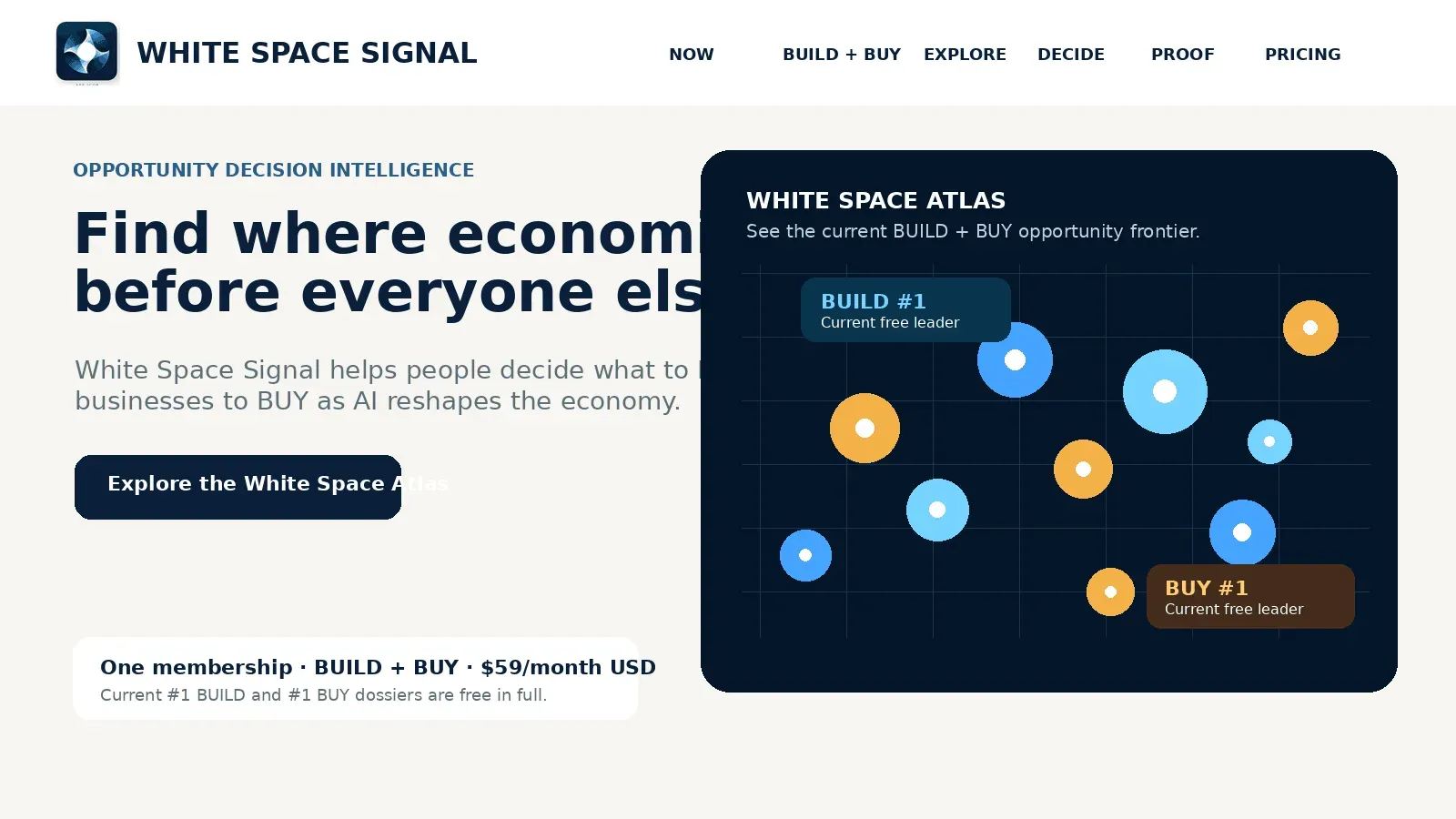
The White Space Atlas The Atlas is a frontier zoom rather than a generic scatter plot. Filterable by all opportunities, BUILD or BUY, it positions entries by AI compounding strength against commercial quality, with colour indicating remaining white space, size reflecting remaining room and glow representing conviction. Public visitors see the overall field and the identity of the two current number one opportunities, while other ranked identities stay masked behind membership.
Two Full-Length Number One Reports Available Free The leading BUILD and leading BUY dossiers are published in full without a signup, email address or shortened preview. The company treats these as a proof layer, arguing that a prospective subscriber should be able to inspect the same research depth used in the paid rankings before committing money.
Dated Track Record and Continuous Reassessment Rankings are reassessed against new evidence rather than frozen as static articles. A position can rise when buyer evidence strengthens, a regulation becomes real or a competitor exits, and can fall when a major incumbent enters or the economics weaken. Every published snapshot is dated and historical calls are preserved so past judgments cannot be quietly rewritten after the fact.
Emerging Sets Each ranking can include up to five emerging opportunities that are not simply the next five ranks. These entries have enough evidence to warrant attention but not enough to displace a top ten position. Each one documents why it is interesting, what is still missing, what would move it into the top ten and what could remove it from consideration.
Decision Support Modules A single membership unlocks the NOW view, the EXPLORE atlas, the DECIDE comparison workspace, the PROOF historical record and a Catalyst and Risk Clock that tracks what may change a thesis. These modules support narrowing a large universe of possibilities into a smaller set of investigated and challenged candidates. A separate, publicly accessible method page outlines factor families, evidence rules and failure tests while withholding proprietary source weighting, exact score weights, internal queries and thresholds.
How It Works
The typical journey begins with the two free number one dossiers. A visitor can read both the leading BUILD and leading BUY reports in full, with no account, email or payment required, and can judge the depth of the economics, the counter-case and the stated uncertainty before deciding whether the wider ranking merits a subscription.
From there, the public White Space Atlas gives a visual sense of the current frontier. Users filter between BUILD and BUY candidates, inspect the positioning of ranked entries and see which opportunities sit in the compounding frontier, the proven value zone, the emerging leverage zone or the watch zone. Public access reveals the field and the two leaders, while the identity of other ranked entries remains protected.
Subscribers then unlock the complete top ten lists for both BUILD and BUY, the emerging sets, full deep dossiers, the NOW view, the EXPLORE atlas, the DECIDE workspace, the Catalyst and Risk Clock, watch functionality and the historical PROOF record. Reports are structured to answer practical questions in sequence, covering what the opportunity is, why the timing matters, who pays, how money is made, what competition exists, what remains open, what could invalidate the thesis, what is still unknown and what evidence to watch next.
Setup requirements are minimal because the product is a research subscription rather than a software platform with data pipelines to configure. The practical workflow is reading, comparing and monitoring. Users follow ranking movement as new information arrives, treating changes in position, evidence strength or white space as signals in themselves. The company explicitly states that stability is permitted, so a rank that does not move is treated as a valid outcome rather than a failure to publish something new.
Evidence handling is a notable design choice. The methodology counts distinct real-world events rather than repeated coverage, separating buyers, budgets, deployments, transactions, standards, regulation, competitors, substitutes, implementation evidence and disconfirming evidence. Ten articles repeating a single announcement register as one event, not ten independent confirmations.
Use Cases
A solo software founder with limited capital can use the BUILD rankings to test a thesis before writing code. The current number one BUILD entry, a release compatibility regression guard, addresses a concrete operational pain: software updates that accidentally break support for older customer systems. For a developer weighing a niche developer tooling business, the dossier format surfaces buyer clarity, competitive substitutes and the specific argument for why growing AI-generated code volume increases rather than erodes demand for release assurance.
A first-time acquisition entrepreneur evaluating a small business purchase can work from the BUY side instead. The number one BUY category, utility asset inspection and condition monitoring, frames a recurring inspection service as a platform for AI and autonomy to lift productivity, coverage and data value. A buyer who lacks industry contacts gains a structured view of category-level durability, owner dependence and whether the underlying service becomes more or less strategically valuable as automation improves.
An independent sponsor or private market investor screening sectors can use the Atlas to compare AI compounding strength against commercial quality across the field. Rather than commissioning bespoke research per sector, the investor observes which categories sit in the compounding frontier, where conviction is high, and how positions shift between publication snapshots. The dated PROOF record supports that monitoring by preserving the original judgment for later inspection.
A small business owner deciding whether to expand, hold or reposition an existing operation can use the white space score as a discipline tool. A category with high quality but collapsing white space signals crowding, while a lower quality category with wide open space may indicate opportunity that has not yet attracted competition. The separation between conviction and opportunity quality matters most here, since a thoroughly proven thesis is not automatically a rewarding one.
An operator weighing two competing paths, launching something new against acquiring something established, can run both rankings side by side. Because BUILD and BUY use different factors and scores, the comparison is not a single ranking but two parallel analyses of the same economic shift. That structure suits anyone genuinely open to either route rather than committed in advance.
Pricing & Value
White Space Signal operates on a single membership price of $59 per month. That membership unlocks both the BUILD and BUY top ten rankings, both emerging sets, full deep dossiers, the NOW view, the White Space Atlas, the DECIDE workspace, the Catalyst and Risk Clock, watch functionality and the historical PROOF record. There is no separate tier for one side of the product, which is a sensible choice given that many readers are deciding between creation and acquisition rather than choosing one permanently.
The free tier is more generous than most subscription research products. Both current number one reports are published in full with no signup and no email requirement, and the Atlas is viewable with the two leaders identified. The recommendation is to check out the pricing structure and read the free material first, since the two dossiers are positioned as the proof layer that justifies the rest of the paywall.
Value depends on decision scale. At under a thousand dollars annually, the subscription sits well below typical analyst retainers or bespoke market research engagements, and roughly in line with specialised newsletter subscriptions. For someone actively deploying acquisition capital or months of development time, the cost is marginal against the downside of a poorly tested thesis. For casual readers interested in AI trends generally, the framing is narrow by design and the material may feel focused on diligence rather than news. The company also publishes the public method page and the dated track record, both of which allow an assessment of rigour before payment.
Final Verdict
White Space Signal occupies a specific and defensible position. Its strongest asset is the discipline of asking how a business or category behaves if AI becomes materially more capable, cheaper and more widely adopted over the next five years. Separating opportunity quality from evidence strength and from remaining white space is a genuinely useful analytical habit, and the refusal to manufacture ranking movement for the sake of activity is unusual in subscription research. Publishing both number one reports in full, with dates on every call and a preserved historical record, addresses the trust problem that typically afflicts paid ranking products.
There are real limitations. The product is a research and ranking system, not a data platform, so subscribers receive analysis rather than dashboards, deal flow, financial models or introductions. Rankings are opinionated by construction, and the company is candid that nothing ranked constitutes a guarantee of success. Every ranked entry beyond the top two sits behind the paywall, meaning the breadth of coverage cannot be fully assessed without subscribing. Readers seeking quick idea lists or daily news will find the format slow and the positioning deliberately narrow.
This suits founders, acquisition entrepreneurs, small business owners and private market investors who are weighing a concrete commitment of time or capital and want a structured counter-argument before proceeding. It is a poor fit for anyone looking for a business-for-sale marketplace, a general AI newsletter or a guarantee of commercial outcomes. For diligent operators who value evidence standards and dated accountability over volume, the subscription is a reasonable, low-cost addition to a diligence process.