
Overview
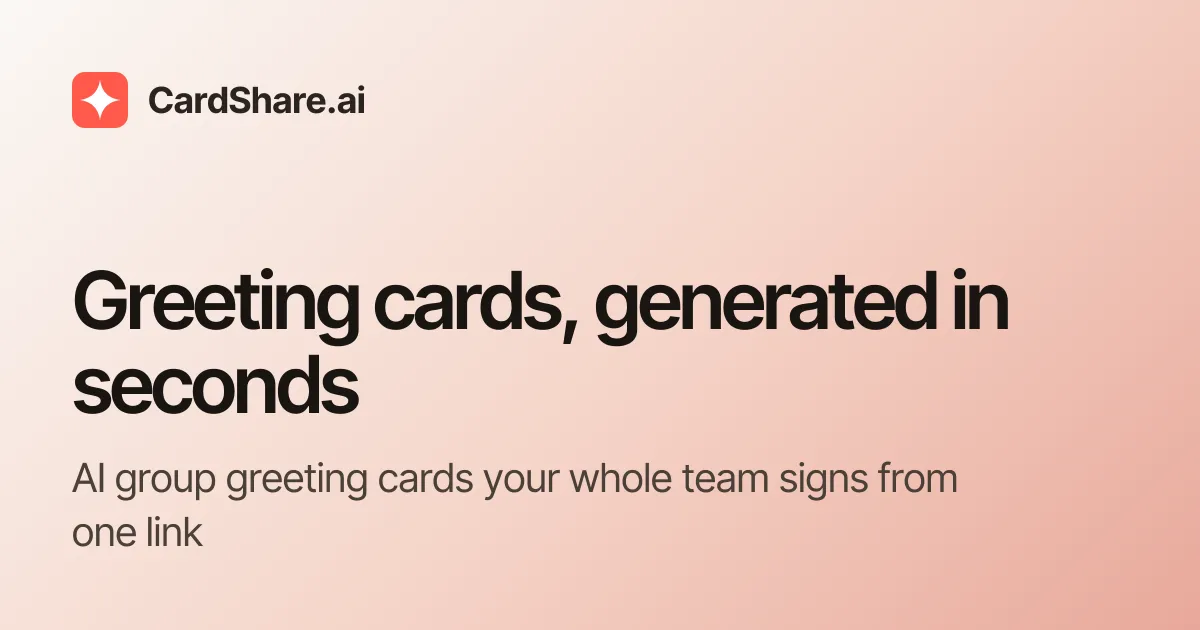
CardShare.ai is a browser-based service for creating group greeting cards with substantial AI involvement at both the design and writing stages. The premise is straightforward: a user describes who the card is for, optionally attaches a reference photo, selects a tone, and the platform generates a cover image together with an opening message. From there, a single link is shared with colleagues, friends, or family, each of whom places a personal note somewhere on the card. The finished product is delivered as one combined artifact rather than a scattered thread of messages.
The problem being solved is administrative rather than creative. Organizing a group card traditionally requires a coordinator to create a document or physical card, email a group, wait for stragglers, follow up several times, and then assemble the responses. The CardShare.ai marketing copy frames this as ten follow ups reduced to one link, which is a fair summary of the value proposition. The AI component lowers activation energy further by removing the blank page problem for both the cover art and the greeting text.
Market positioning is explicitly competitive. The platform maintains comparison pages against Kudoboard, GroupGreeting, Padlet, and SendWishOnline, which suggests a deliberate attempt to convert users already familiar with collaborative card tools. Its differentiation rests on three claims: generative design, generative copy, and native Slack distribution. The Slack angle is the most strategically interesting, because it places card creation inside a tool that office teams already keep open all day, avoiding the context switch to a separate web application.
The audience is primarily workplace teams, though the occasion catalogue spans personal milestones. People operations coordinators, team leads, and executive assistants are the most obvious buyers, since they are the people who habitually inherit card duty. Smaller friend groups and family organizers form a secondary audience served by the same workflow.
Key Features
AI cover generation from text or photo. Card creators can either describe the card in a sentence or upload a reference photo, and the system produces a finished cover design. This matters because design capability is the biggest barrier for non-designers organizing a card under time pressure. The generated cover is previewed in a live three dimensional mockup before the card moves forward.
AI drafted greeting copy with tone presets. The creation form exposes a set of tone options labeled Heartfelt, Roast, Dad jokes, Hype, and Epic. The AI writes the opening message in the selected register, and any line can be regenerated independently. The site describes the model voice as having a light touch and being never saccharine, which is a deliberate editorial choice rather than a neutral one, so users wanting a warmer register have less control.
Freeform collaborative signing canvas. Rather than appending messages into a linear list, every signer positions a note anywhere on the card. Notes can be dragged, resized, rotated, and supplemented with GIFs. This produces a layout that resembles a physical signed card and gives contributors agency over the composition, though a dozen signers on a small canvas can produce a crowded result.
Zero friction participation for signers. Signers open a link in a browser, type a note, and optionally add a GIF. There is no account creation, no app download, and no registration step. Because the primary failure mode of group cards is low participation, removing the sign up step is the single most consequential product decision on the site.
Slack application with a slash command. Installing the CardShare.ai app exposes a /cardshareai slash command that opens a form inline in any channel or direct message. The form collects the card type, recipient name, tone, and context, and the resulting card link is posted back into the channel. The team signs from Slack, or the link is forwarded straight to the recipient.
Live card preview and per line regeneration. The creation interface includes a live preview panel that renders the card in a perspective mockup as configuration changes. Combined with per line regeneration, this creates a fast iteration loop where creators test several directions before committing to a design.
Broad occasion coverage. The browse section organizes cards into thirteen named occasions, including birthday, work anniversary, wedding, promotion, thank you, farewell, kudos, retirement, get well soon, sympathy, new baby, graduation, and holiday. Sympathy and get well soon are notable inclusions, since tone control in sensitive contexts is where AI drafting most easily misfires.
Claude connector. The footer lists a Claude connector alongside the Slack app, indicating an integration path into Anthropic assistant environments. Details are not elaborated on the homepage, but it suggests the company is pursuing a multi surface distribution strategy rather than betting solely on its own web application.
How It Works
The journey begins without an account. A visitor landing on the homepage can enter the creation flow directly from the hero section, where a button labeled Start a card is marked Free. The interactive demo on the homepage shows the shape of the input form: a recipient name field, a sender field, an optional context textarea for details such as hobbies or life events, an optional reference photo attachment, and a tone selector.
After the description is supplied, the system generates the card cover and the opening message. The creator reviews the result in the live preview and regenerates individual lines until the tone lands correctly. This is where the product differs most from template driven competitors, since the creator is editing generated prose rather than choosing from a fixed library of messages.
The next step is distribution. The creator shares a signing link with the group, either by pasting it into a chat channel, emailing it, or sending it through Slack if the app is installed. Each recipient of the signing link opens a browser page, writes a note, positions it on the canvas, and submits. No account, installation, or confirmation email is required, which keeps participation rates high but also means the coordinator has limited visibility into who has not yet responded.
Once the signing window closes, the card is delivered. The platform can send it by email, or the creator can copy the card link and distribute it through any channel. The recipient opens it in a browser as a single assembled card containing every note, signature, and GIF. For Slack users, the entire sequence from command to delivered link happens inside the workspace, with the bot posting confirmation and a preview into the channel. Setup requirements are minimal: a browser for the web path, and workspace admin approval for the Slack app installation.
Use Cases
A people operations coordinator at a two hundred person company is responsible for monthly birthday cards and quarterly farewell cards. Rather than maintaining a spreadsheet of pending signatures, the coordinator generates a card per recipient with a tone preset, posts the signing link into the relevant department channel, and closes it on the day. The time cost shifts from chasing individuals to a single message.
A design team lead wants to mark a colleague thirtieth birthday without producing an awkward corporate message. Using the Heartfelt tone with a context note about the recipient interest in botanical illustration, the lead gets a cover and an opening line that read as considered rather than generic, then lets the team layer in their own notes and GIFs.
A department head says goodbye to an employee who has been with the company for a decade. The farewell and retirement card types are used, and the coordinator distributes the signing link across multiple channels to maximize participation from people who worked with the departing colleague across different eras of the organization. The assembled card becomes a keepsake rather than a thread that gets lost.
A fully remote startup uses the Slack application as its default mechanism. Any team member can type the slash command in a channel, fill the inline form, and post a card link without leaving the workspace. Because Slack is already the operating system for the company, card creation is treated as another lightweight workflow rather than a separate tool visit.
An individual organizes a card for a friend wedding or a sibling graduation. With no team context and no Slack requirement, the web flow handles the whole process, and the absence of a registration requirement means extended family members can contribute notes without creating accounts.
Pricing & Value
The homepage states plainly that the service is free to start, and the FAQ confirms that designing a card, collecting signatures, and sending the card can all be done at no cost. The Start a card buttons carry a Free label, and the sign up prompt is framed as creating an account rather than unlocking paid capability. The site does not publish a tiered pricing table on the homepage, and the comparison pages against Kudoboard and GroupGreeting do not surface explicit price points in the extracted content.
That absence is worth flagging. Anyone evaluating the platform for organizational deployment will want to confirm limits on card volume, AI generation counts, branding removal, and administrative controls before committing. Competitors in this space typically monetize through per card fees or seat based subscriptions for business accounts, and it is reasonable to expect a similar structure behind the free tier here, but the site as presented does not confirm it.
On value, the freemium entry point is aggressive. Kudoboard and GroupGreeting have historically charged for premium boards or larger group sizes, so a free path covering design, signing, and delivery is competitive on paper. The AI generation is the differentiator that justifies attention, but it also introduces a variable cost that may shape future pricing. Teams with modest card volume should find the free tier sufficient, while larger organizations should request explicit commercial terms before standardizing.
Final Verdict
CardShare.ai addresses a real and recurring workplace chore with a focused product. The combination of generative cover design, tone controlled message drafting, and a signature canvas that requires nothing from contributors is coherent, and the Slack application is the sharpest part of the strategy because it puts card creation where teams already are. The claim that signers need no account is the most practically valuable feature on the site, since participation is the usual point of failure for group cards.
The limitations are also visible. Tone presets skew playful, and the stated intent to avoid sentimentality may not suit teams that want warmer messages. Signing is browser only, with no native mobile application advertised, which matters for recipients who live on phones. Pricing beyond the free tier is not disclosed on the marketing pages, and enterprise concerns such as branding, administration, and data handling are not documented.
Teams with frequent card obligations, particularly distributed ones already standardized on Slack, should evaluate the product directly through the card creation flow. Organizations that need heavy visual customization should compare against established board tools using the comparison pages. Anyone wanting to see the range of supported moments can browse the occasion catalogue, which is broader than most single purpose card tools. The recommendation is a qualified yes: strong fit for teams chasing participation, weaker fit for buyers who need published enterprise terms before adopting a tool.