
Overview
1 Beat: Hit Music Game is an in-development rhythm game for iPhone and Android, positioned explicitly as a spiritual successor to Beatstar, the three-lane mobile title whose servers went offline on 31 October 2025. The premise rests on a single structural decision. Where Beatstar charted notes across three vertical lanes in portrait orientation, 1 Beat charts across four. The team argues that the shift from three lanes to four expands the number of ways a player can strike one or two notes at once from six to ten, which opens pattern shapes that a three-lane grid has no room to express. Each thumb gets two lanes of its own, allowing patterns to cross, split and stack.
The product is not yet available. The site presents two store badges marked "coming soon," a single email waitlist, and an unusually large body of supporting editorial content written for players displaced by the Beatstar shutdown. Those supporting pages cover everything from song catalogues to account recovery and private servers, and they double as the marketing engine for a game that cannot yet be downloaded.
The target audience is narrow and well defined: mobile rhythm players, especially the Beatstar refugee cohort, plus players arriving from tile-tapping games such as Magic Tiles 3. The competitive set the site names directly includes SuperStar, Hi Beatz and Beat Tiles. Positioning is free to play, portrait-first, single-thumb friendly, and notably light on monetisation pressure, with a no-fail default and no continue-by-advert mechanics. Readers wanting the mechanical reasoning behind the design choice can read how a four-lane rhythm game plays.
Key Features
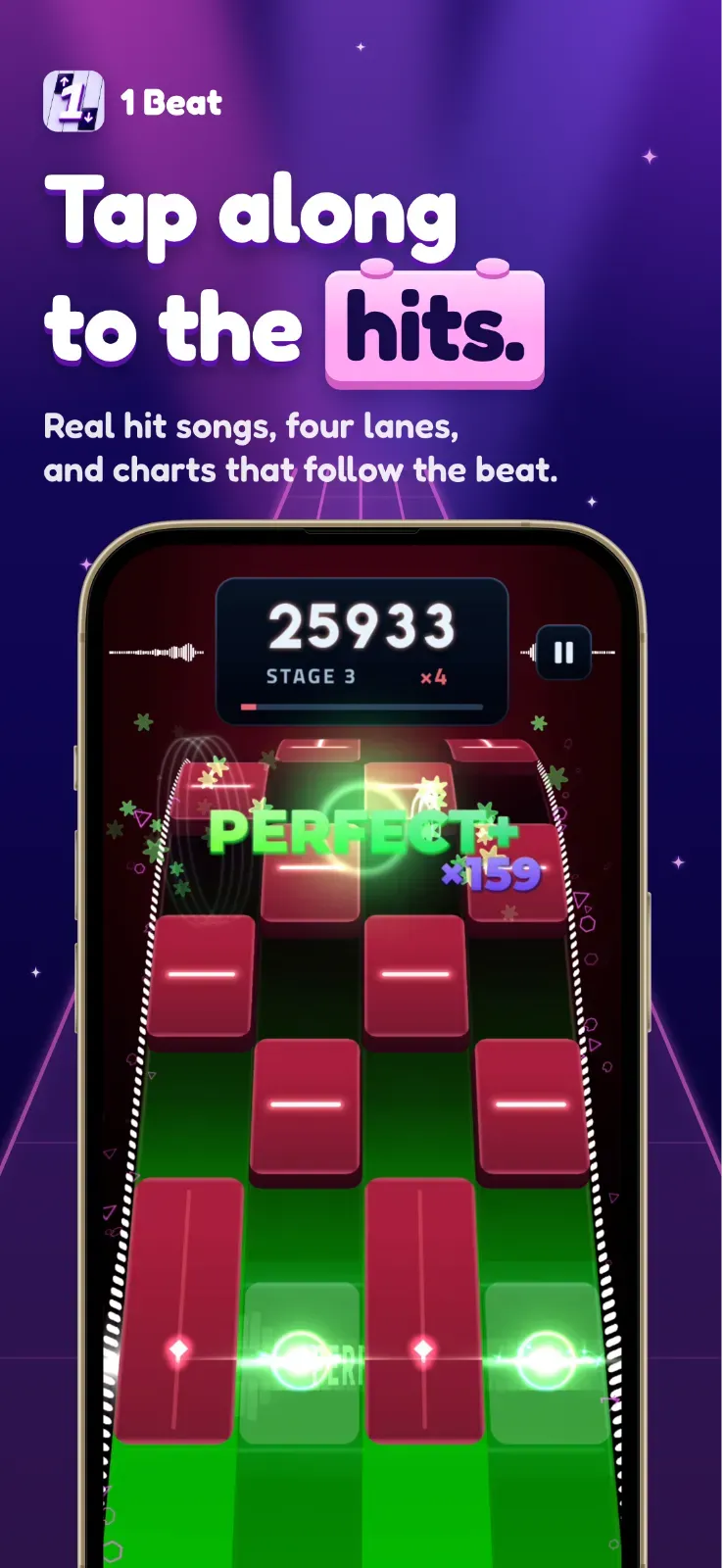
Four-lane portrait highway. The core board is a portrait-oriented note highway split into four columns, with notes descending toward a horizontal judgement line. The design brief keeps one-handed play viable while rewarding two-handed play, and the note vocabulary stays deliberately familiar: taps, holds and swipes. The stated aim is charts that are harder to master rather than harder to read, so anyone who could parse a Beatstar chart can parse a 1 Beat chart without relearning notation.
Tap pads positioned below the judgement line. In the game's own schematic, the four touch pads sit underneath the white judgement line rather than on it. The practical effect is that thumbs rest below the reading area, so incoming notes are never obscured by the fingers that are about to hit them. It is a small layout decision with an outsized effect on readability at high note densities, and it is the kind of detail that separates ports of an existing formula from a considered rework.
Touch-event timing rather than frame timing. Judgement is computed from the timestamp of the touch event itself instead of waiting for the next rendered frame. On paper this means a dropped frame degrades visual smoothness without being scored as a missed note. Mobile rhythm games live or die on perceived fairness, and decoupling input registration from the render loop is the correct technical answer to a problem that plagues lower-end Android hardware in particular.
Per-device audio offset memory. Timing calibration is stored separately for each output device, so a pair of wireless earbuds and a wired headset each keep their own latency correction instead of forcing a fresh calibration every session. The site is candid that Bluetooth drift remains unsolved, since a stored offset cannot compensate for latency that varies over time, but the per-device model removes the most common daily friction. A standalone audio offset calculator already exists for measuring devices before the game ships.
No-fail default scoring. A poor run ends as a poor score rather than as a prompt to watch an advertisement in exchange for a continue. This removes the fail state as a monetisation surface and reframes the loop around score chasing and leaderboard placement instead of survival. It also aligns the game more closely with the arcade score-attack tradition than with the free-to-play energy-gating model that dominates the genre.
Reduced-flashing mode. A single switch gates every visual effect rather than a subset of them, addressing photosensitivity and general comfort during long sessions. The site stresses that the toggle is comprehensive instead of partial, a distinction that matters because half-measures in this area are common and largely useless.
Leaderboards including a weekly board. Screenshots describe competing against friends' scores with a weekly leaderboard visible in the interface. Hand-made charts are advertised throughout, and the game claims chart-topping tracks spanning pop, rock, hip-hop and EDM, though the actual song list has not been announced.
How It Works
The current user journey begins before there is a game to play. A visitor lands on the marketing site, reads the four-lane pitch, and joins an email waitlist with a single field and a submit button. The form is validated in the browser, submits without a page reload, and the site promises exactly one message when a build is ready. There is no account creation, no profile, no payment step and no client download, which makes the onboarding experience roughly ten seconds long and entirely reversible.
Once a build exists, the intended loop follows the established rhythm-game shape. Players select a track, receive a hand-made chart in portrait orientation, and read descending notes against the judgement line. Taps, holds and swipes are scored against a timing window, with the site showing a PERFECT+ judgement tier in its store screenshots. Sessions are short, built around three-minute runs, and results feed into friend and weekly leaderboards.
Setup requirements are modest but include one meaningful calibration step. Players are expected to run an audio offset measurement once per output device, ideally using headphones, and the game will remember that value for the device in question. The site has effectively pre-launched that step as a standalone web tool, letting prospective players measure their own hardware latency months before release and building a small amount of anticipation in the process.
Interface decisions follow a consistent philosophy: the touch surface lives below the reading surface, the fail state is removed by default, and visual intensity is user-controlled. Each of those choices trades a small amount of arcade purity for accessibility and predictability, and together they sketch a game designed to be played in short sessions on commutes rather than in long, high-pressure sittings.
Use Cases
The displaced Beatstar player rebuilding a library. A long-time Beatstar player lost access to purchased songs and progress when the servers closed. That player is now navigating a web of alternatives and private-server explanations, and 1 Beat targets the gap directly. The familiar three note types mean no relearning, and the fourth lane provides a reason to invest in a new chart set rather than simply replaying an old one. The site's own comparison pages serve this persona explicitly, including a roundup of games like Beatstar for those evaluating the market.
The commuter playing one-handed. Portrait orientation with four lanes and a touch area beneath the judgement line supports single-thumb play on crowded transport. The no-fail default means a distracted run produces a mediocre score rather than a forced restart, which suits fragmented attention far better than energy-gated retry loops.
The audiophile with three pairs of headphones. A player who moves between wireless earbuds, wired monitors and phone speakers needs a calibration value per device. Storing offsets per output device eliminates the routine of recalibrating each time the hardware changes. The acknowledged weakness is Bluetooth drift, where latency shifts mid-session, so players using cheap earbuds should still expect occasional wobble.
The photosensitive or accessibility-conscious player. A single reduced-flashing switch that gates every effect matters to players with visual sensitivity, and it also serves anyone playing in low light or at night. Combined with the absence of advert interstitials, the experience stays visually controlled throughout.
The score chaser with a social circle. Weekly leaderboards against friends give a recurring reason to return without requiring a seasonal content pipeline. For players who enjoy competition but dislike gacha collection mechanics, a leaderboard anchored to hand-made charts is a leaner proposition.
Pricing & Value
The site states plainly that 1 Beat is free to play on both the App Store and Google Play. No tier structure, subscription, season pass or in-app currency is described anywhere on the page, and there is no pricing table to evaluate. The absence of an advertised continue flow, where a failed run would otherwise be converted into a video view, suggests the monetisation model will not lean on interruption. That is a positioning statement rather than a confirmed policy, and it deserves scrutiny once a build exists.
Value assessment against alternatives is therefore provisional. Beatstar itself is gone, so the relevant comparison is with SuperStar, Hi Beatz, Beat Tiles and similar free-to-play titles that fund themselves through song unlocks and energy systems. A free four-lane game with hand-made charts and no fail state is a credible alternative on paper, but song licensing is the single largest cost centre in this genre and no catalogue has been announced. Until the track list is public, the value proposition rests on interface design and timing philosophy rather than on content volume.
Final Verdict
1 Beat: Hit Music Game is a well-reasoned design argument wrapped around a product nobody can play yet. The four-lane expansion is a genuine mechanical proposition rather than a cosmetic tweak, and the surrounding decisions on touch-event timing, pad placement, per-device offset and reduced flashing show a team thinking carefully about the parts of mobile rhythm games that usually go unexamined. The editorial scaffolding around the Beatstar shutdown is unusually honest and generously useful, including acknowledgements of what the team has not solved, such as Bluetooth drift.
The gaps are structural rather than cosmetic. There is no downloadable build, so every claim about feel remains untested. The song catalogue, which carries this genre, is unannounced. And the free-to-play promise has no published monetisation detail behind it, which leaves room for the model to shift after launch. Players who want a rhythm game today will need to look elsewhere; players who want to follow a considered take on the Beatstar formula have a clear reason to join the waitlist and judge for themselves when a build appears.