
Overview
erecruit is a specialised opportunity intelligence platform aimed squarely at the Australian government ICT labour hire market. Its premise is narrow and deliberate. Australian government agencies publish open ICT opportunities through BuyICT, while the recruitment agencies that sit on tender panels advertise broadly for the same work without disclosing which contract sits behind the advertisement. That information gap costs recruiters time, because the agency running the ad is not always the agency holding supply rights. erecruit closes the gap by matching every open BuyICT opportunity to the agency advertisement that appears to be chasing it, packaging the link with supporting evidence such as role title, security clearance requirement, location and timing.
The audience is therefore recruitment agencies, talent acquisition leads and bid teams that already operate inside government panels. This is not a general purpose applicant tracking system, nor a consumer job board. The product positions itself as a mapping layer between tenders and advertisements, with candidate management tooling attached so that match intelligence converts into actual submissions. Competitors fall into two camps. Generic recruitment CRMs track candidates but know nothing about government tender structures. Manual spreadsheets maintained by panel specialists monitor BuyICT by hand and break whenever volume spikes. erecruit sits between those two poles, trading breadth for depth in a single regulated market.
Key Features
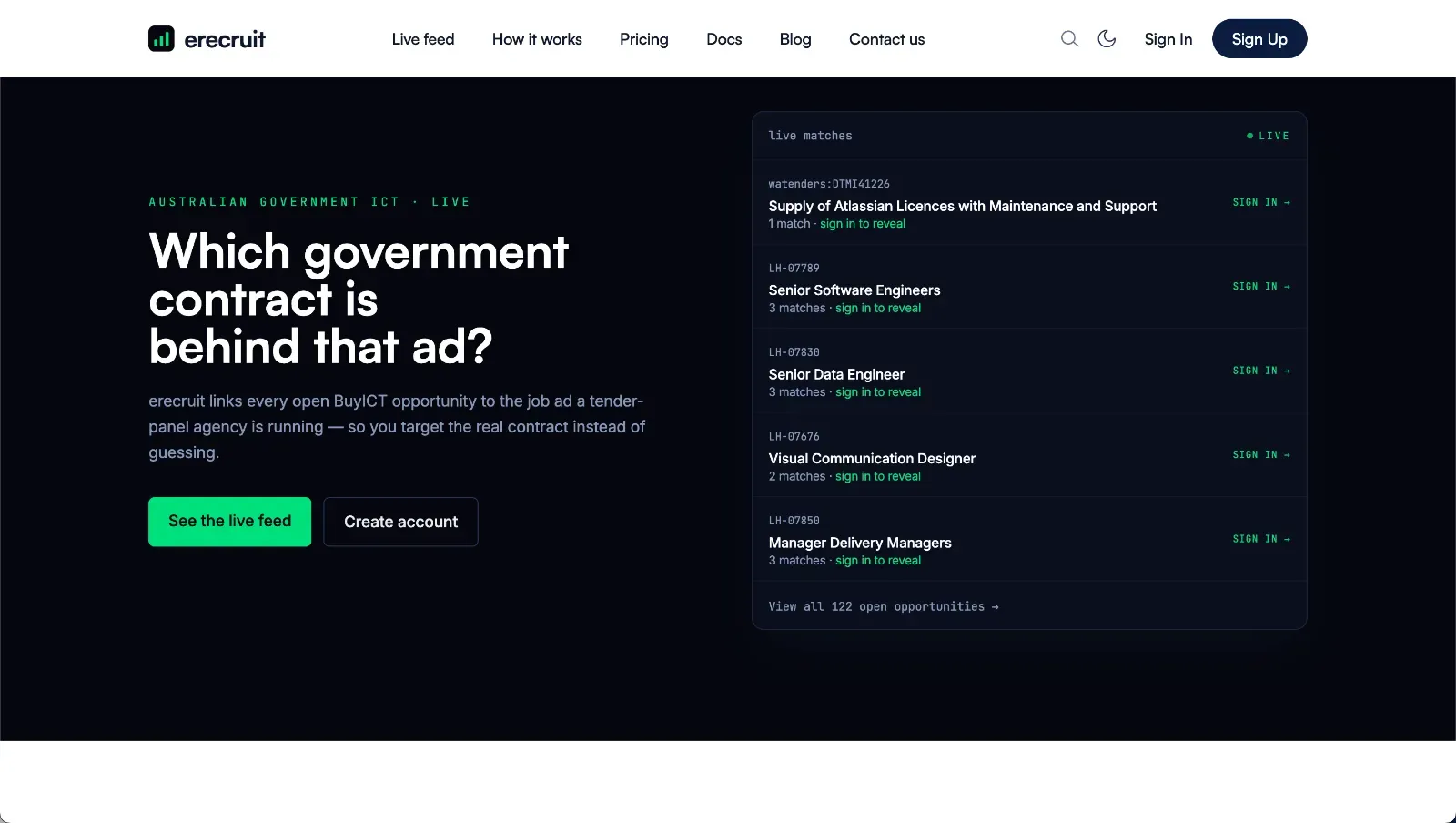
Opportunity intelligence. The platform aggregates every open government ICT opportunity into one monitored inventory, currently listing 122 open opportunities on the landing page. Each entry carries a tender reference, a short title and a match count. The live feed presents these as a scannable list, which means a recruiter can assess market activity without hopping between procurement portals.
Agency advertisement linking. The core differentiator is the connection drawn between a BuyICT opportunity and the tender panel agency job advertisement that appears to represent it. The matching logic leans on structured evidence rather than guesswork, comparing role, clearance, location and timing signals. This is the feature that separates erecruit from a conventional job aggregator, because the value lies in identifying which supplier relationship is already in play.
CV matching with explainable scoring. Recruiters upload candidate CVs and receive a scored alignment against each open role. Crucially, the platform states that the evidence behind each score is exposed, so a shortlisting decision can be defended internally or in a client conversation. The methodology is documented separately in the CV matching documentation, which suggests the ranking is treated as a decision support tool rather than an opaque black box.
Candidate search and importing. Beyond uploaded CVs, the platform allows candidates to be discovered and imported from external sources, with records cached inside the workspace. That caching decision matters operationally, because repeated external lookups are slow and inconsistent, while a local store keeps pipelines responsive and keeps historical candidate context attached to the workspace rather than a third party.
Pipeline kanban. Candidates move through stages on a drag and drop board, and the board can be filtered by opportunity. Tying the kanban to a specific tender prevents the common failure mode where a single candidate pool is reused across unrelated bids without any record of which submission each record belongs to.
Consent gate. Before a candidate is submitted for representation, the platform requires that consent be requested and captured. In government contracting, disputes over who represents whom are expensive, so embedding this checkpoint into the workflow addresses a real commercial risk rather than adding administrative ceremony.
Recruiter dashboard. The dashboard consolidates key performance indicators, CV match summaries, items flagged for review and recent activity into a single surface. For team leads, it acts as a health check on pipeline velocity as well as a queue for decisions that need human judgement.
How It Works
The journey begins with account creation through a standard sign up flow, after which the workspace becomes the working environment. On arrival, the live feed is the primary orientation surface. Each row shows a tender identifier, a descriptive title and the number of matches detected, with the actual matched detail gated behind authentication. That gating is a deliberate product decision, since the landing page can demonstrate inventory volume publicly while reserving the commercially sensitive link between contract and advertisement for account holders.
From there, a recruiter typically selects an opportunity and reviews the associated evidence, then uploads or searches for candidate records. The CV matching engine scores those records against the role and returns both a ranking and a justification. Candidates that clear the threshold are dragged onto the kanban stage appropriate to their progress. Because the board can be filtered by opportunity, the pipeline effectively becomes per tender rather than per recruiter, which suits agencies running several panel engagements concurrently.
Before submission, the consent gate intervenes. A request goes out, approval is recorded, and only then does the candidate become submittable. Alongside this, the dashboard accumulates activity, flagged items and match statistics, giving managers a passive view of operations. Weekly briefings, government buyer pages and agency directories extend the product beyond the transactional workflow into market monitoring territory.
Setup requirements appear light, since the product runs in the browser with no described installation step, and an interface language selector indicates internationalisation support. The main onboarding cost is data, because CV matching and pipeline tracking only become useful once a candidate library exists inside the workspace.
Use Cases
A boutique panel recruiter working a single labour hire contract. A one or two person agency holds a place on a government panel and needs to know which open BuyICT roles fall under that arrangement. Rather than refreshing procurement pages daily, the recruiter scans the live feed, identifies roles with matches, and uses CV scoring to decide which existing candidates are worth submitting this week.
A bid manager at a mid tier agency deciding where to invest effort. With 122 open opportunities in circulation, not every role deserves pursuit. The match counts and advertised evidence help a bid manager triage, prioritising tenders where an agency advertisement already exists and where clearance and location requirements align with the bench of available candidates.
A talent lead at a consultancy scaling a delivery team. Consultancies supplying specialists to departments face rapid mobilisation windows. A pipeline filtered by opportunity means each role has its own candidate queue, and the consent gate keeps representation claims clean when multiple suppliers approach the same contractor.
A recruitment team lead monitoring throughput. The dashboard surfaces key performance indicators, CV matches and items awaiting review. A team lead can spot bottlenecks, such as a role accumulating matches without progressing to submission, and intervene before the tender window narrows.
A market analyst tracking Australian government ICT demand. Weekly briefings, recently closed listings and government buyer pages offer a longitudinal view of where departmental spending is heading. Even without running a pipeline, the platform functions as a demand signal for agencies planning capability investment.
Pricing & Value
The landing page does not publish tier names, seat limits or contract terms. A dedicated pricing page exists, along with a sign up route and a sign in route, which indicates that commercial detail lives one click deeper rather than being broadcast on the homepage. For a niche B2B intelligence product, that is a common approach, because pricing frequently depends on agency size or the number of concurrent searches. Prospective buyers should treat the pricing page as the starting point and expect a conversation before commitment.
Value assessment depends entirely on placement economics. A single successful government ICT placement typically carries a margin that dwarfs most software subscriptions, so the platform only needs to improve targeting modestly to justify its cost. The counterargument is that panels are relationship driven, and mapping advertisements to contracts does not guarantee that a supplier can be displaced. Buyers should therefore evaluate the platform against the cost of the manual research hours it replaces, not against the size of the contract being chased.
Final Verdict
erescruit is a well scoped specialist tool rather than a broad platform play. Its strongest asset is the contract to advertisement mapping, which addresses a genuine asymmetry in the Australian government ICT market and is difficult to replicate without sustained monitoring effort. Explainable CV scoring and a consent gate add practical value for agencies that must defend shortlisting decisions and representation claims.
The limitations are equally clear. The product is geographically and sectorally constrained, so recruitment businesses outside Australian government ICT will find little use for it. Match details are withheld until sign in, which makes independent evaluation harder. Pricing is not published on the homepage, adding friction for buyers doing preliminary comparisons. Teams that already run a modern CRM will need to decide whether erecruit replaces or sits alongside existing tooling, since the site does not advertise deep integrations with third party systems.
The recommendation is straightforward. Recruitment agencies with existing government panel positions, and consultancies that bid regularly into Australian public sector ICT, should evaluate erecruit as a targeting layer that reduces wasted pursuit. Generalist recruiters, internal HR teams without panel exposure and businesses operating outside Australia should look elsewhere.