
Overview
Lizard is a cloud deployment platform built specifically for the AI agent era. It targets developers who use coding agents like Claude Code, Codex, or Cursor, and want to go from code to production without manually configuring infrastructure. The platform provides managed Postgres, Redis, S3, sandboxes, and live logs through a single CLI, with a focus on machine-readable outputs that agents can consume directly. It positions itself as a faster, cheaper alternative to older platforms such as Railway, Render, and Fly.io, which were designed primarily for human workflows. Lizard’s core bet is that the next generation of software development will be driven by autonomous agents, so the entire platform is tailored to their needs: predictable command schemas, structured logs, and instant provisioning. For developers who are tired of fighting with YAML configurations and instance sizes, Lizard offers a more streamlined path that is both agent-friendly and human-friendly.
Key Features
Git push to deploy: Push code to main and Lizard automatically detects the stack, builds it, and ships it live. The platform’s build planner, called lizardpack, reads the repository and determines the language, framework, and package manager, including Node, Python, Go, Rust, Ruby, PHP, Java, and static sites. It then writes a real multi-stage Dockerfile, which is both human-readable and machine-editable. This transparency is a refreshing change from build systems that mask the underlying process.
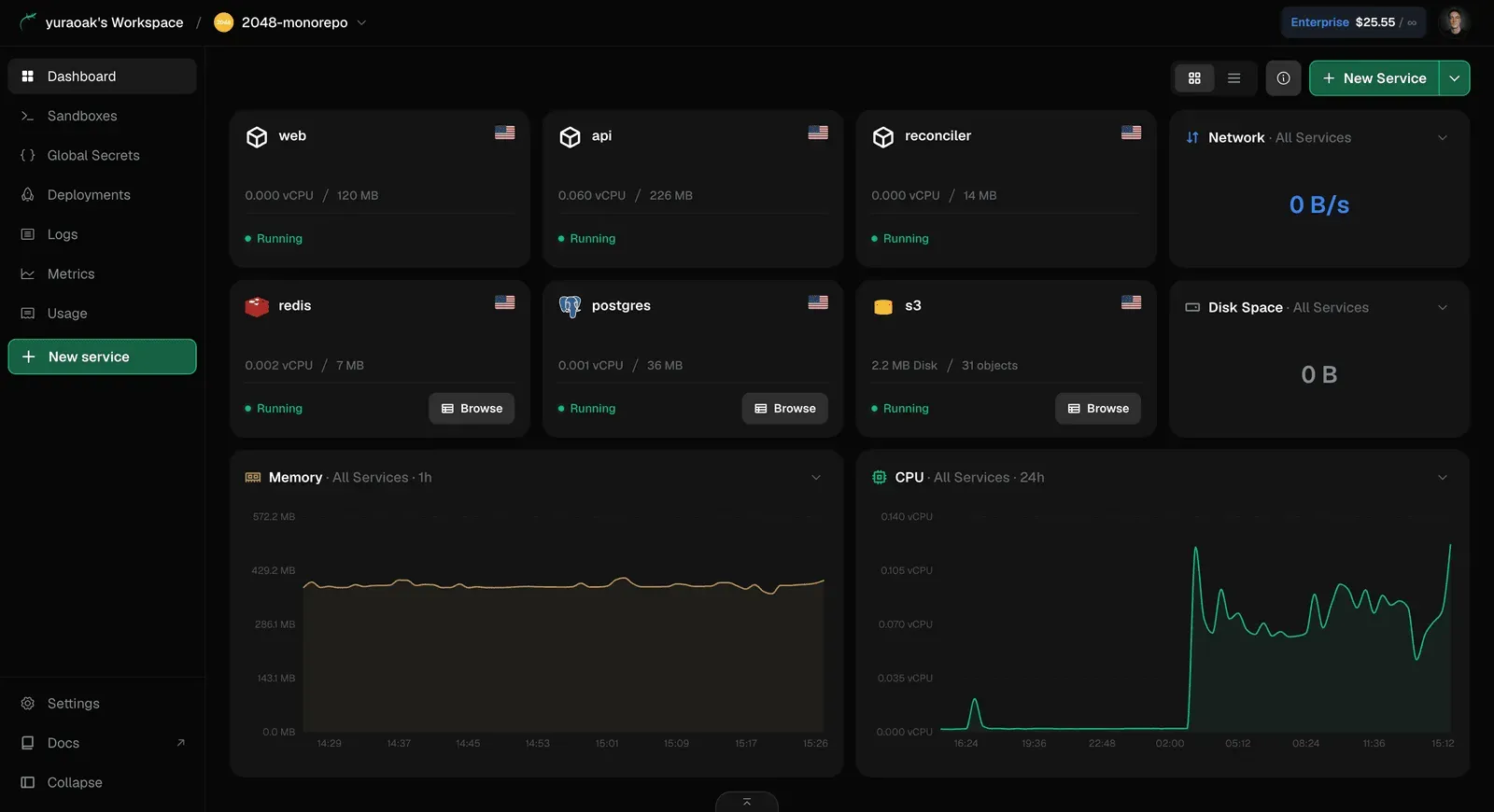
Managed Postgres, Redis, and S3: Provisioning a database or object storage is as simple as one command. Lizard manages the infrastructure automatically and connects resources to the app without requiring manual configuration. The dashboard shows live usage metrics, such as vCPU and memory consumption, for each resource. This tight integration removes the typical friction of setting up separate database services.
Per-second billing: Instead of paying for reserved instance size, Lizard bills on measured CPU, memory, and egress usage. Idle applications can cost nearly nothing because vCPU is parked at near-zero and memory pages are evicted when not in use. This is a significant shift from the container-based reservations used by most competitors. The pricing calculator highlights potential monthly savings of around 41% for a typical app compared to AWS.
Agent-first CLI: The command-line interface is designed to be consumed by AI agents. Every command outputs a machine-readable schema for deployments, events, and logs. When a deploy fails, the agent can read the error, fix the code, and redeploy without human intervention. This feature is a core differentiator, as it reduces the back-and-forth between the agent and the developer.
Live logs and metrics: Lizard includes built-in log streaming and request metrics for every service. Developers can watch logs in the dashboard or through the CLI, with minimal latency. The interface shows request timings, cache hits, and errors, making it easier to debug issues in real time.
Isolated containers: Each deployment runs in its own secure pod, ensuring isolation between applications. This is standard for modern platforms, but Lizard’s implementation is lightweight and fast, allowing rapid iteration.
Sandboxes and Studio: Lizard also offers code interpreter sandboxes that return typed results rather than raw stdout, and Lizard Studio provides a graphical environment for managing deployments. These features are still evolving but point to a broader ambition beyond simple deployment.
How It Works
The user journey starts with signing up on the website, which requires no credit card for the free tier. After creating an account, a developer installs the CLI globally using npm: npm i -g @lizard-build/cli. From the terminal, the command lizard up initiates deployment, and the CLI communicates the entire process in a structured format that both humans and agents can parse. For users of Claude Code, Codex, or Cursor, the recommended approach is to install the Lizard skill via npx skills add lizard-build/skill -g, which teaches the agent how to deploy, provision resources, and migrate existing applications. The platform supports migration from Railway, Render, Heroku, and other platforms, with agents able to carry over secrets, domains, and data. Once deployed, the dashboard provides a clear overview of running services, resource usage, and cost. The platform also supports rollbacks, instant restores, and environment separation for staging and production. For teams with more complex needs, the documentation walks through advanced features like custom domains and object storage setup.
Use Cases
Solo developer building a side project: A developer uses Lizard to deploy a Next.js app with a Postgres database and Redis cache. The free plan’s $5 credit covers the first month, and the per-second billing keeps the cost under a dollar when the app is idle. This makes Lizard an attractive option for hobbyists who want to experiment without committing to a monthly fee.
AI agent autonomously shipping features: A team uses Claude Code to implement a new feature and deploy it directly to production. The agent runs lizard deploy, checks the structured logs, and if the build fails, it reads the error message, adjusts the code, and redeploys. The developer only reviews the final result, cutting down the feedback loop significantly.
Startup migrating from Railway: A small startup wants to reduce infrastructure costs and takes advantage of Lizard’s migration skill. The agent redeploys existing services, provisions managed Postgres and Redis, and moves the data over. The new setup runs in isolated containers with live metrics, and the team appreciates the transparent Dockerfiles that simplify customizations.
Freelancer managing multiple client projects: A freelancer creates separate projects for each client, each with its own app and database. The per-second pricing model means they only pay for what each client actually uses, and they can pause or restore services as needed. The CLI’s speed makes it easy to spin up environments on demand.
Enterprise team needing compliance: A larger organization opts for the Enterprise plan to gain SOC 2 and HIPAA compliance, SSO/SAML, RBAC, and audit logs. They use Lizard’s sandboxes for code interpreter tasks and appreciate the agent-readable logs for their internal automation.
Pricing & Value
Lizard offers a free plan that includes $5 of credit for the first month, with no credit card required. This is perfect for trying out the platform. After that, the Hobby plan is $5 per month, which according to the site, can cover a typical side project. Higher tiers (Pro and Enterprise) are not fully detailed on the homepage, but they likely add collaboration features, higher limits, and compliance options like SOC 2 and HIPAA. The pricing calculator compares Lizard to AWS and shows about 41% savings on a typical application with a database, based on list prices from August 2026. When compared to Render and Fly.io, the savings are even more pronounced. The transparent per-second billing is a major advantage for intermittent workloads, but users with consistently high utilization might not see as dramatic a difference. Overall, Lizard’s pricing is competitive and aligned with the value it delivers for AI-driven development.
Final Verdict
Lizard is a bold, forward-looking platform that understands the shift toward AI-powered software development. Its strengths are clear: agent-first design, per-second billing, and a seamless developer experience that prioritizes speed and transparency. The integration with coding agents is genuinely novel and could save teams hours of manual prompting. The main areas for improvement are the limited details on higher-tier pricing and the relatively new ecosystem, which means fewer community resources compared to AWS or Railway. However, for developers and startups that are already using AI agents, Lizard is an excellent choice that removes much of the infrastructure overhead. For those who prefer a more traditional cloud with a wide range of regions and services, it may be worth waiting. But for anyone looking to ship fast and let their agent handle the grunt work, Lizard is worth a serious look. Check out their pricing page for current plans, explore managed Postgres for database options, and read the documentation to get started.