
Overview
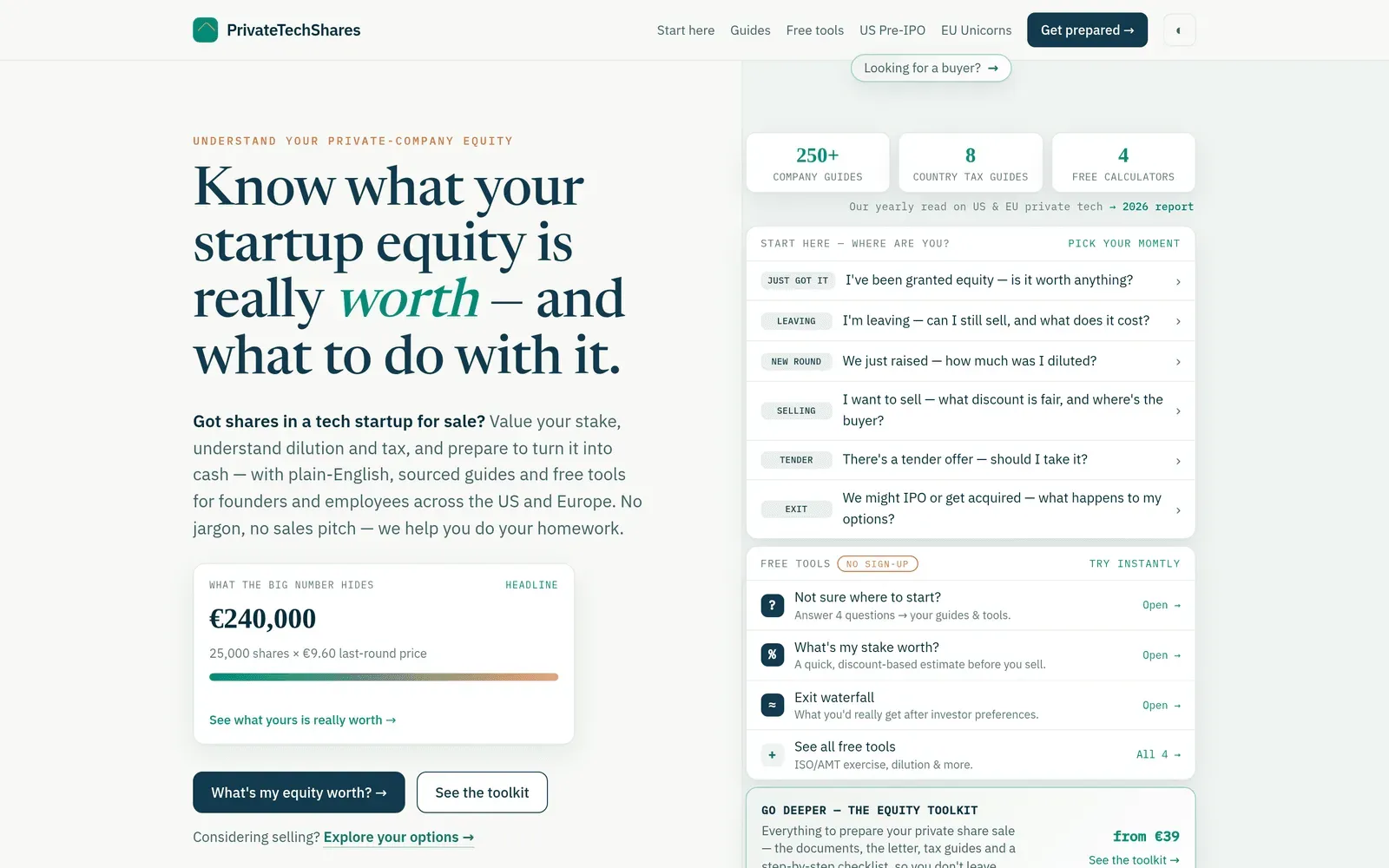
PrivateTechShares is an information and preparation platform built for people who hold equity in privately held technology companies. Its audience spans founders, co-founders, current and former employees with option grants, and early angel investors, with a geographic focus on the United States and Europe. The core premise is that most equity holders cannot answer basic questions about their holdings: what the shares are realistically worth, what it costs to exercise vested options, how a future funding round dilutes the position, and how a private secondary sale would be taxed where they live.
The platform is explicit about what it is not. It does not operate as a broker, hold shares, introduce buyers, or take a percentage of any transaction. It supplies free calculators, sourced country tax guides, company coverage pages for more than 250 private businesses, and a paid Equity Toolkit that guides a holder through an eight phase process. That places it closer to an educational and estimation resource than to institutional secondary venues such as Forge, EquityZen, or Nasdaq Private Market, which the site concedes are oriented toward large, late-stage blocks and rarely suit a 30,000 to 100,000 euro trade.
The market gap it targets is real. Most institutional knowledge about private company equity sits with venture capitalists, angels, and professional advisers. PrivateTechShares attempts to hand a practical portion of that knowledge back to the individuals who earned the equity.
Key Features
Free stake estimator. The homepage hosts an interactive calculator that accepts a currency, the number of shares, the last round price per share, the holding type (common shares, vested options, or preferred), a strike price where relevant, and a company stage selector. It returns a price range rather than a single figure, applying a discount to reflect that common shares held by employees typically trade below the preferred price investors paid.
Option exercise calculator. A second free tool multiplies vested option count by strike price to show the cash required to convert options into shares, then contrasts that figure against last round value to display the paper gain. A country selector surfaces a brief tax note, and the site directs United States holders to a more detailed AMT aware variant.
Eligibility self check. A four question module asks what the holder owns, whether it has vested, whether a right of first refusal or board approval applies, and the approximate size of a potential sale. It returns directional guidance and states that responses are not stored.
Company coverage pages. More than 250 company guides are organized into United States pre-IPO and European unicorn collections, with individual pages for OpenAI, Anthropic, SpaceX, Stripe, Databricks, Revolut, Monzo, Helsing, Anduril, Mistral AI, N26, Trade Republic, Discord, Perplexity, Vinted, and others.
Country guides. Eight national tax and process guides cover Germany, the United Kingdom, France, Spain, Italy, the Netherlands, Poland, and the United States, each presenting rates, rules, and sources with dates attached.
Equity Toolkit. The paid bundle contains an eight phase A to Z deal map marked with explicit stop points where a lawyer, tax adviser, or notary should take over, plus a live Excel calculator for net proceeds and offer comparison, a Deal Room control panel, readiness audits, editable Word documents, and eleven prepared messages. Separate United States and European editions exist, and the European version carries transfer and tax playbooks for seven countries.
Equity Position Report. A personalized deliverable that processes an individual grant and returns a sourced document covering position summary, valuation scenarios before and after tax, exercise cost including AMT exposure, dilution modelling, an exit waterfall after investor preferences, country tax treatment, a conversation pack of questions for advisers, and a sequenced action plan. A human review tier is offered alongside it.
How It Works
The journey begins without any account creation. A visitor landing on the homepage can immediately use the free equity calculators or answer the four question eligibility check. The estimator prefills sensible defaults, such as 2,000 shares at 12.00 euros per share for a growing company, so a first range appears before any data entry. Selecting options as the holding type reveals an additional strike price field, and a note warns that phantom or virtual units, including German VSOP structures, usually cannot be transferred on a secondary market.
From there, navigation is organized around moments rather than product names. Six entry points cover having just received a grant, leaving a company, absorbing a new funding round, wanting to sell, responding to a tender offer, and facing an acquisition or IPO. Each links to a dedicated explainer, and supplementary tools include a dilution calculator and an exit waterfall model that shows what remains after investor liquidation preferences.
Holders who want a structured process purchase the Equity Toolkit through Stripe and receive an instant download containing a PDF guide, an Excel calculator and Deal Room panel, and an editable Word workbook. The materials walk through readiness auditing, document collection, a letter that requests paperwork from the company, pricing and discount negotiation, counterparty messaging, and transfer execution. Stop points are marked throughout, signaling where professional review becomes necessary rather than optional.
For holders who prefer the analysis done for them, the Equity Position Report accepts an individual grant and returns a finished document built on a published methodology.
Use Cases
A departing employee facing a 90 day window. An engineer leaves a London scale up holding vested enterprise management incentive options. The exercise calculator immediately shows the cash outlay required, while the United Kingdom country guide outlines the tax position. The Toolkit provides the sequence for deciding whether exercising makes sense before the window closes.
A second time founder seeking partial liquidity. A founder in Amsterdam holds common shares in a Series B company and wants to fund a property purchase without selling the entire position. The estimator produces a discounted range, the European playbook describes Dutch transfer mechanics, and the Toolkit supplies messages for approaching existing shareholders or an incoming investor.
A United States employee weighing an ISO exercise. An employee at a late stage artificial intelligence company must decide whether to exercise incentive stock options before an expected tender offer. The AMT aware calculator and the United States toolkit material lay out the alternative minimum tax exposure and the questions to bring to a tax adviser.
A former employee evaluating a tender offer. Someone who left a European unicorn two years ago receives a tender offer letter. The situation based navigation routes to an explainer on how tender offers work, and the Toolkit offers an offer comparison model alongside guidance on what to verify before signing.
An early angel selling a small stake in Spain. An angel investor in a Spanish startup holds a modest position that large secondary platforms will not touch. The Spanish country guide and the country specific tax guides collection clarify the mechanics, and the readiness audit helps determine whether transfer restrictions can be cleared.
Pricing & Value
The free tier is unusually generous. The estimator, the exercise calculator, the dilution and exit waterfall models, the eligibility check, the company pages, and the country guides all require no payment and no email address. A PDF Equity Starter Kit is also available at no cost and includes a first request letter template.
Paid products start at 39 dollars for the United States Equity Toolkit and 39 euros for the European edition, each delivered as an instant download combining a PDF guide, an Excel calculator, and a Word workbook. A combined bundle covering both editions is priced at 59 euros against a listed 78 euro total. The Equity Position Report costs 129 dollars, with an option to add human expert review for 249 dollars. Checkout runs through Stripe, downloads are immediate, and a 30 day money back guarantee applies.
Value assessment: the price points sit far below a single hour of advisory time in most markets, and the bundle is the strongest proposition for holders whose situation spans both continents.
Final Verdict
PrivateTechShares occupies a narrow but genuine gap. It gives equity holders an instant, free read on position value and exercise cost, then offers paid structure for those who need to act. The sourcing discipline, the explicit stop points marking where professionals take over, and the refusal to broker deals or hold shares all support credibility.
Limitations are equally clear. Every free output is a rough range, not a valuation, and none of the tools incorporate transaction fees or jurisdiction specific tax into their headline figures. The platform stops short of execution, offering no buyer introductions or transaction support, which means holders must still find a counterparty independently. Geographic coverage, while solid across the United States and seven European countries, leaves other markets unserved.
Founders, employees with option grants, and leavers who need to understand their position before speaking to a lawyer or accountant will find this a sensible first stop. Anyone expecting a marketplace or a completed sale should look elsewhere.