
Overview
CiteTrue's Citation Checker is a free, browser based verification service for academic reference lists. It targets undergraduate and graduate students, professors, research advisors, journal editors, and peer reviewers who need to confirm that a bibliography points to work that actually exists and is described accurately. Users paste their references, and the tool cross references every entry against established scholarly indexes before returning a per citation report. The product sits alongside sibling utilities from the same vendor, including a Citation Finder, a Paper Draft generator, and an AI Humanizer.
Key Features
Field level verification. Instead of treating a reference as one opaque string, the checker splits it into discrete fields and validates each separately. Titles are matched against indexed records, author names are compared one by one, publication years are reconciled with the date on file, DOIs are resolved against the registry that issued them, and venue, volume and page data are compared item by item. The rationale is that a citation can point at a genuine paper and still be wrong, for instance when a real study is credited to the wrong researchers or assigned an incorrect year.
Broad database cross referencing. Queries fan out across a large set of sources, among them Crossref, OpenAlex, arXiv, CORE, Semantic Scholar, PubMed, ScienceDirect, Google Scholar, ResearchGate, IEEE, ACM, Springer, Wiley, Elsevier, BMC, Cambridge University Press, OpenLibrary and several paid data sources. Consulting multiple indexes lowers the odds that a legitimate reference is marked unverifiable simply because it sits in a repository that a single database does not cover.
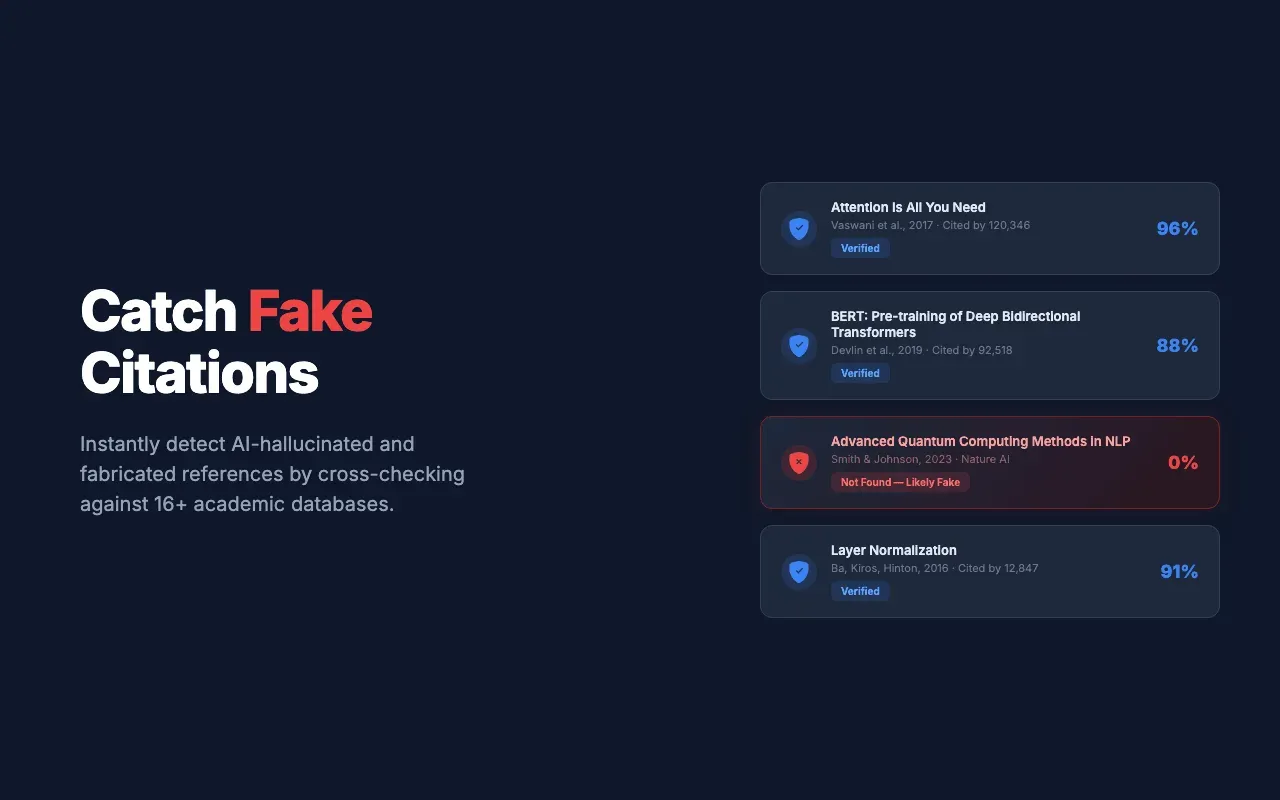
Confidence scoring. A proprietary scoring model assigns each citation a confidence value reflecting how likely the entry is authentic and accurate. Editors and supervisors receive a graded signal rather than a binary pass or fail, which helps them triage large reference lists quickly and spot the handful of entries that deserve manual attention.
Hallucination detection. The tool is explicitly positioned against fabricated references, a problem the site documents with peer reviewed figures. One cited study found that 55 percent of bibliographic citations produced by GPT-3.5 and 18 percent of those from GPT-4 were fabricated outright. Another recorded an average of 4.3 incorrect components per reference across 30 ChatGPT generated medical papers, with 93 percent of them containing a wrong PMID. A third noted that more than 10,000 papers were retracted in 2023, an annual record.
Batch processing. Dozens or even hundreds of citations can be submitted in a single pass, which matters for doctoral theses and editorial screening workflows where manual checking is impractical. A Deep Verify mode exists for structurally complex text, priced at five credits per reference.
Automatic format handling. Input citations are reformatted automatically before verification, so references submitted in inconsistent styles are normalized without manual cleanup. The service supports APA, MLA and other common styles and is available in eleven interface languages, including French, German, Spanish, Arabic, Chinese, Japanese and Korean.
Use Cases
Students preparing coursework, theses or manuscripts can run a complete bibliography before submission to catch fabricated or mistyped entries, reducing exposure to rejection or misconduct suspicion. Advisors and journal editors can screen incoming submissions at the initial review stage, filtering manuscripts with bogus references before committing reviewer time to them. Researchers reading unfamiliar papers can validate the references they intend to build on, avoiding the trap of relying on sources that do not exist.
Differentiators
Most reference managers validate formatting rather than existence. CiteTrue inverts that emphasis, checking whether a source is real and whether its metadata survives scrutiny, with a specific focus on AI generated fabrications. Its free tier, multi database coverage and field level granularity distinguish it from simpler citation formatters.